Bidspirit auction | Shoshanat Yaakov – On Physiognomy
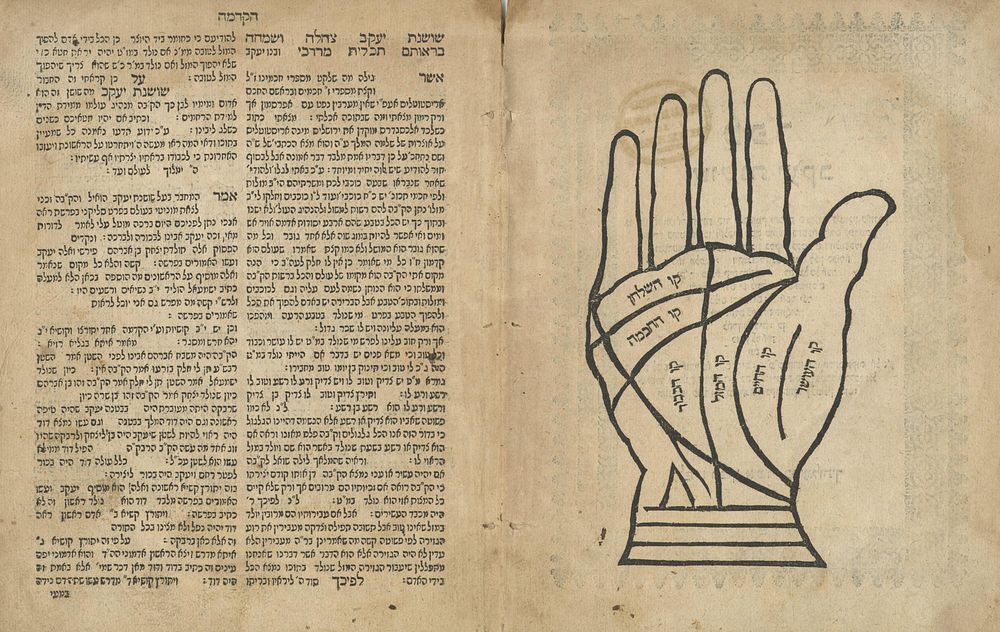
Shoshanat Yaakov – On Physiognomy and Palm Reading – Amsterdam, 1706 – First Edition - Shoshanat Yaakov, palm reading and physiognomy, by R. Yaakov son of R. Mordechai of Fulda. Amsterdam: printer not indicated, 1706. First edition. Detailed handbook to reading palms, faces and hair. On verso of title page, large printed image of palm, and names of the various lines of the palm (”wealth line”, ”life line”, ”luck line”; and more). On pp. 1b-2, spaces left blank for small sketches, filled in by hand. Little is known of the author of the book, R. Yaakov son of R. Mordechai of Fulda. On the title page, he describes himself as having been expelled from Fulda, and currently residing in Skwierzyna, Greater Poland (the expulsion of Jews from Fulda, Hessen, Germany took place in 1671-1677). Ownership inscription on title page: ”Yaakov Mordechai son of R. Michel Yosef Kohen of Fürth, prayer leader and trustee of Hürben” – R. Yaakov Mordechai Kohen, son of R. Yechiel Michel Katz of Fürth (R. Michel Chassid), who published a siddur (Wilhermsdorf 1718) and a Book of Tehillim (Fürth 1760), with commentaries in Yiddish. R. Yaakov Mordechai's works include Tochachat Musar on the Torah, Cheshbon HaNefesh (mimeograph edition Haifa 1969-1971), as well as manuscripts relating to shechitah (NLI Ms. 481). On front endpaper, handwritten inscription: ”I am borrowing it from… R. Isser, prayer leader and posek of Hürben. Tevele Potwisa”. Stamp on title page: ”H. Schwarz, Rabbinner in Hürben” – R. Chaim Schwarz, Rabbi of Hürben, Bavaria, Germany (1800-1875), disciple of the Bigdei Kehunah in Fürth and R. Avraham Bing in Würzburg, Rabbi of Hürben from 1840. Author of Orach Chaim (Berlin, 1872). Translated and distributed Tevuot HaAretz by his younger brother R. Yehosef (Joseph) Schwarz of Jerusalem. His son, R. Yisrael Schwarz, was Rabbi of Cologne. [2], 14 leaves. 20 cm. Somewhat dark paper. Good-fair condition. Stains, including dampstains. Light wear. Small tears to several leaves. Early binding, with wear. Provenance: Collection of Mozes Heiman Gans.