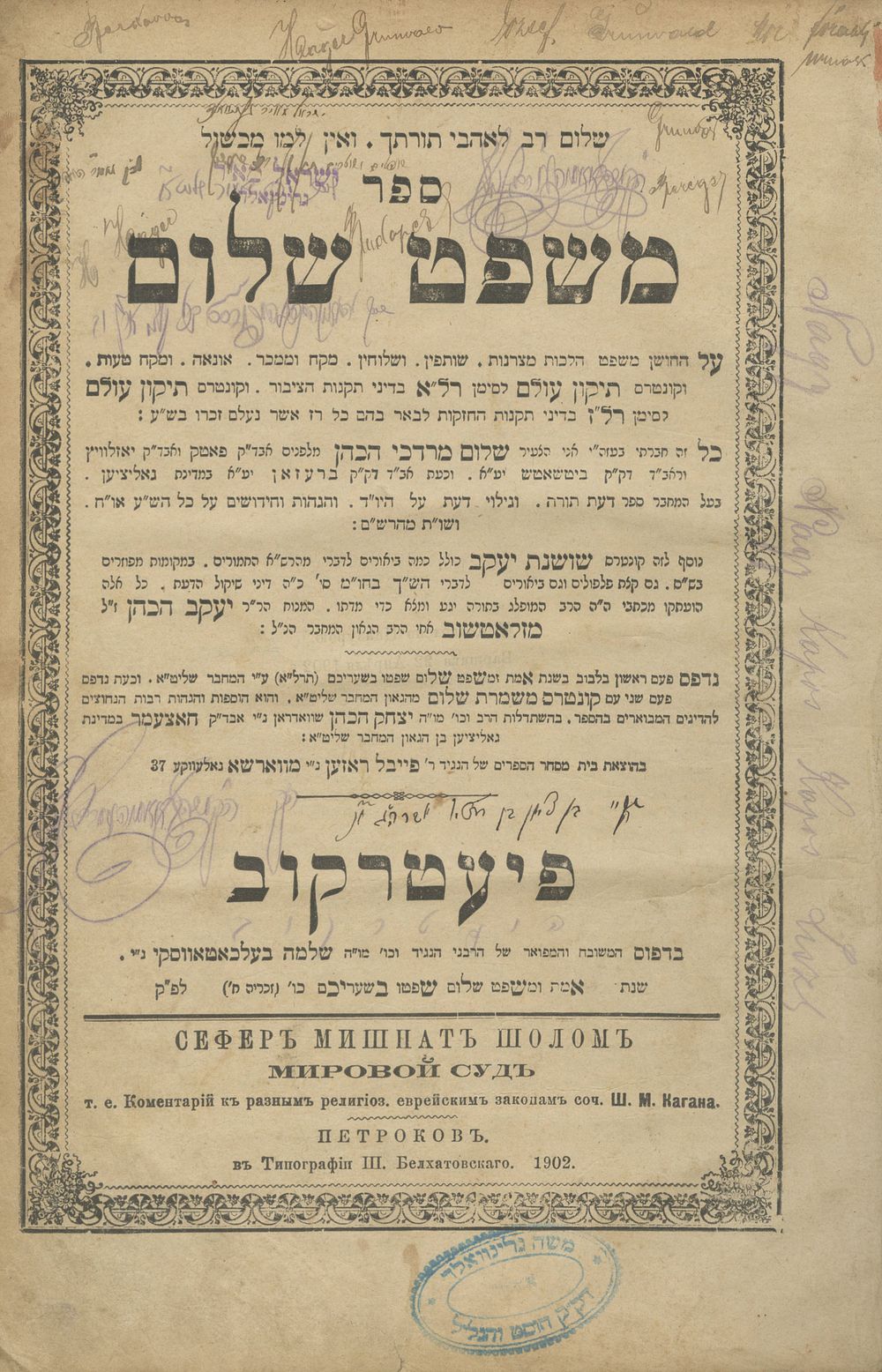
Bidspirit auction | Mishpat Shalom – Piotrków, 1902
Mishpat Shalom – Piotrków, 1902 – Copy of the Arugat HaBosem, Rabbi Moshe Grünwald, Rabbi of Khust - Mishpat Shalom, on Shulchan Aruch Choshen Mishpat, by R. Shalom Mordechai Schwadron, Rabbi of Berezhany – the Maharsham. Piotrków: Shlomo Belchatowski, 1902. Reprinted with Mishmeret Shalom, the author's additions and glosses. Bound with: Tevuot HaSadeh, by R. Eliezer Deutsch Rabbi of Bonyhád, Part V. Paks: Meir Segal Rosenbaum, 1902. Copy of R. Moshe Grünwald, the Arugat HaBosem, with his stamp on title page: ”Moshe Grünwald Rabbi of Khust and the region”. Stamps and signature of his son R. ”Yisrael Meir Grünwald”. Many inscriptions, including a pencil inscription mimicking the signature of R. Moshe Grünwald. Kvittel inscriptions on title page of Mishpat Shalom and on title page of Tevuot HaSadeh. Signature of ”Yisrael Meir Grünwald” on title page of Tevuot HaSadeh. On verso of first title page, Torah inscriptions, apparently handwritten by R. Yisrael Meir Grünwald. R. Moshe son of Amram Grünwald (1853-1910), the Arugat HaBosem, leading Hungarian rabbi and yeshiva dean. Son of R. Amram Grünwald of Csorna (1831-1870), disciple of the Ktav Sofer. R. Moshe was a disciple of R. Menachem Katz Prostitz of Tzeilem (Deutschkreutz) and the Ktav Sofer of Pressburg. Already as a young man he managed a yeshiva in his hometown Csorna, and he later served as rabbi in several Hungarian communities. In 1893 he was appointed Rabbi of Khust. Although he studied under the Chatam Sofer's pupils, he adopted Chassidic manners and habitually traveled to the Rebbes of Belz and Sighet. In Khust he established an elaborate court and expanded his yeshiva, which became one of the largest and most important in Hungary. Students arrived from inside and outside the country, and many Hungarian rabbis were students of his. His descendants include several distinguished lines of rebbes and rabbis. Mishpat Shalom: [2], 58; 3-200 pages. Tevuot HaSadeh: [4], 80, [2] leaves. Approx. 33 cm. Paper slightly dark and dry in part. Good-fair condition. Stains. Light wear. Worming to margins of several leaves. Handwritten inscriptions. Original binding, with wear and defects (many tears across edges of spine).