Bidspirit auction | (CRIMEA). Sepher Ne’imoth Beyemin Netza’ch
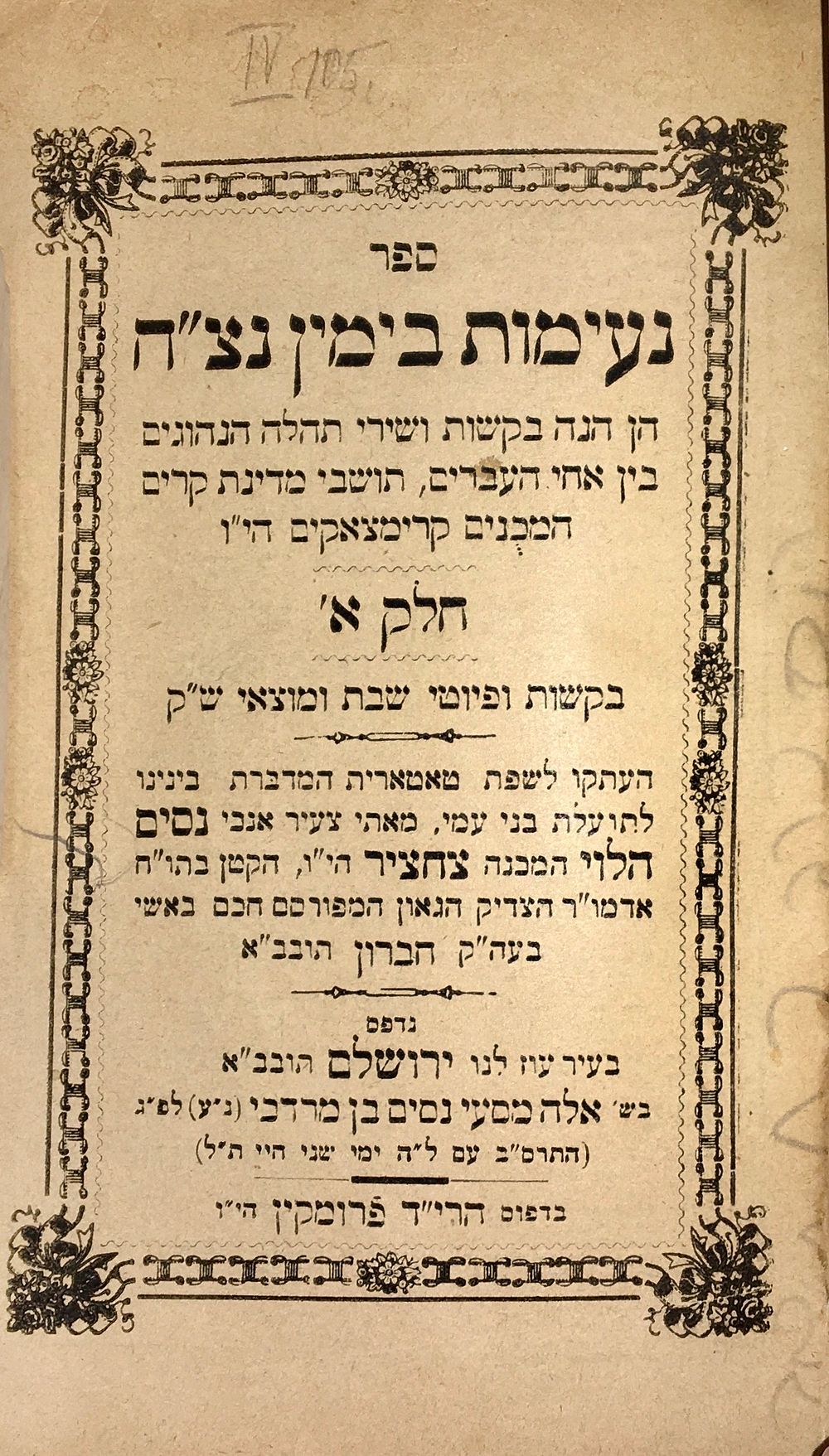
(CRIMEA). Sepher Ne’imoth Beyemin Netza’ch [poems and prayers for the Sabbath]. FIRST EDITION. Hebrew text along with translation by Nissim Halevi Tzachtzir into Judeo-Tatar printed in Hebrew characters. Approbation by R. Haim Hezekiah Medini. pp. 58. Brittle. Modern boards. 12mo. See Kiryat Sefer, vol. 28 (1952) p. 253, no. 6. This first part, unrecorded. Jerusalem, Frumkin, 1902. One of very few Hebrew books printed in the Judeo-Tartar, the language spoken by the Krymchaks, resident in Crimea. The translator, Nissim Halevi Tzachtzir (or, Tchatchir) and known by his Hebrew acronym Netza’ch, was the son-in-law of one of the great Rabbinic scholars of the day, R. Haim Hezekiah Medini, who edited the monumental Talmudic encyclopedia, Sdei Chemed. Chief Sephardic Rabbi of Hebron, Medini earlier served for many years as Rabbi of Karasubazar (now Belogorsk) in the Crimea. From 1867 to 1900, Medini was recognized as Chief Rabbi of Crimean Jewry and was overwhelmingly beloved by the Krymchaks. The Krymchaks are an indigenous Rabbinite Jewish community of the Crimean Peninsula. The term Krymchak (“inhabitant of Crimea”) was first introduced by the Russians following their annexation of Crimea in 1783. The name was chosen to distinguish them from Karaites as well as from the Ashkenazic Jews of Eastern Europe. The 20th-century twin blows of Nazi genocide coupled with Soviet cultural oppression, and later, alongside emigration to Israel and the United States, have now left precious few local Krymchaks clinging to their uniquely Crimean-Jewish identity. The exotic Judeo-Tatar dialect preserved here in one of the very few books printed in this form bears a remarkable resemblance to Turkish - which stands to reason, as the Crimea is right across the Black Sea from Turkey, and was formerly Ottoman territory before its loss to Russian conquest. Today the language, certainly in its Hebrew-form, is essentially lost of native speakers. For the Jews of the Crimea, see EJ, Vol. V, cols. 1103-08.