Bidspirit auction | (LITURGY) Machzor mikol HaShanah [festival
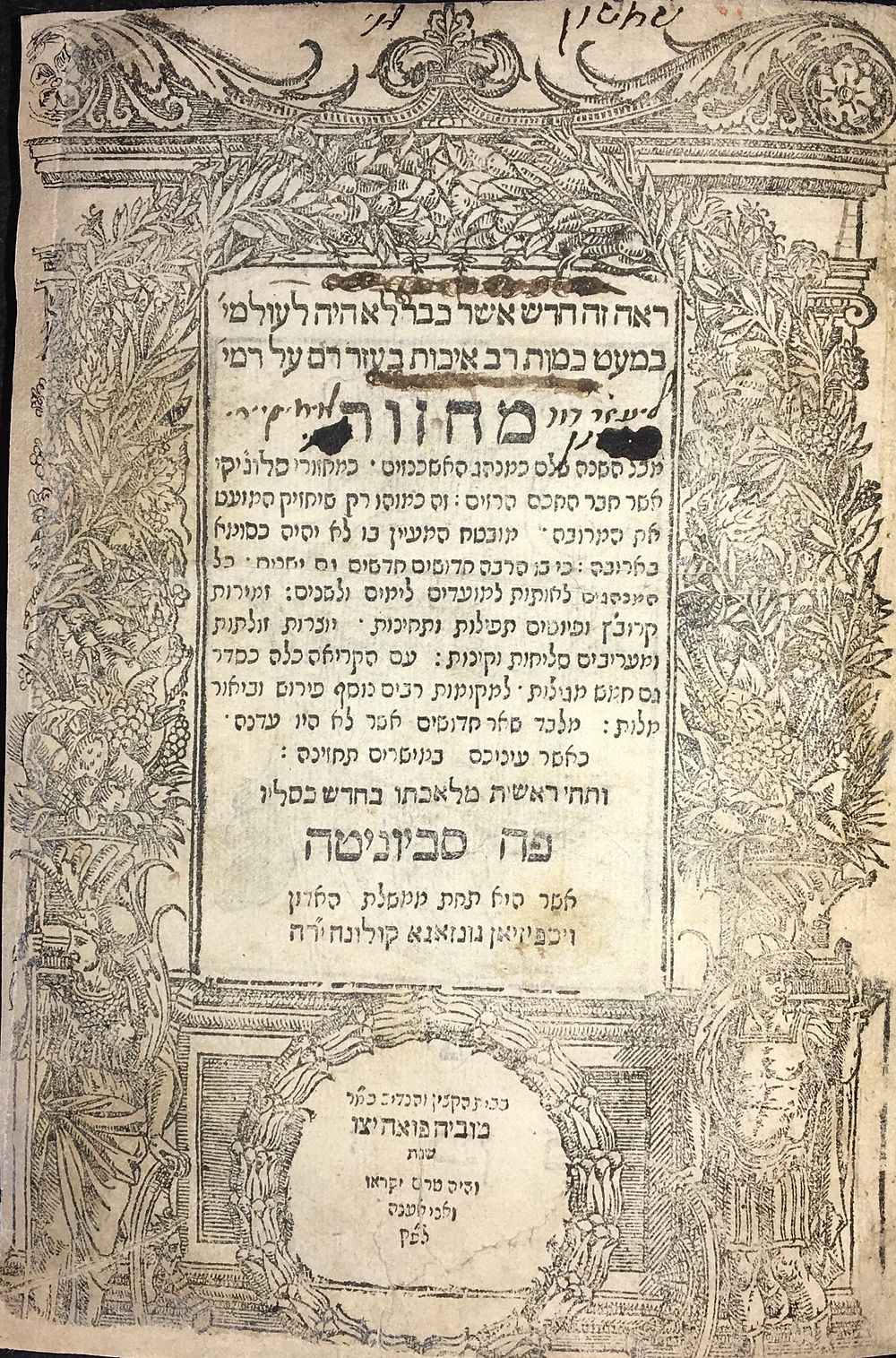
(LITURGY) Machzor mikol HaShanah [festival prayers for the entire year]. According to the Aschkenazic rite. Two parts in one volume. Title within wreath-like decoration over architectural columns. On verso, printer’s mark of Tobias Foa (Yaari, Hebrew Printers Marks, no. 21). Initials historiated. Occasional marginal annotations. ff. 394 (complete). Scattered staining and creasing, many leave neatly reinforced along gutter, some leaves supplied from other copies, outer edge of architectural frame on f. [1r] replaced in facsimile, minor repairs to several leaves, small tears at foot of f. 33, in outer edge of f. 88, and in upper edges of ff. 185-188, larger tears on ff. 294-295, 348 repaired, tape repairs on ff. 324v, 328v, 329v obscuring some text near gutter, censored passages filled in manuscript on ff. 111r, 205r, 326v; individual words and lines expurgated intermittently throughout, sometimes damaging the text (see, e.g., ff. 204v, 251r); censors’ signatures at end. Modern blind-tooled calf, modern pastedowns. Housed in a matching blind-tooled, calf-lined slipcase. Thick 4to. Vinograd, Sabbioneta 42 & Cremona 40. Sabbioneta - Cremona - Venice, Tobias Foa - Vicenzo Conti - Giovanni di Gara, 1556-60. This important Aschkenazic Machzor took years to produce. Begun in Sabbioneta in the house of Tobias Foa, it was completed in Cremona on the eve of the New Year, [5]321 (1560) by Vicenzo Conti (as explained in the colophon at the end of the volume). Folios 225-232 were issued in Venice as a variant section by the printing house of di Gara. According to Meir Benayahu, this prayer-book, as noted on the title, is a second edition of the Aschkenazic Machzor printed earlier in Salonika in 1548-9 for use by the Italian Aschkenazic community of that city. However one of the novel additions to the present edition are the many Kabbalistic commentaries to the prayers. From a typographical perspective, the Sabbioneta Machzor is something of a mystery. Considering it was printed in different cities, clearly the transition was hardly seamless. The great bibliographers, such as Steinschneider, Sonne, and Berliner tried to make sense of how and when various fonts appear. Benayahu believed he found the demarcation line between Sabbioneta and Cremona: Signatures 1 through 36 (f.144), as well as signatures 38-39, are clearly Sabbioneta. From signature 40 (f.157) to the end is certainly Cremona. Signature 37 resembles neither Sabbioneta nor Cremona, and Benayahu reasoned that it is an imitation of the first, Salonikan edition. To add to the puzzle, it seems that the second part of the Machzor went through two printings, each marked by slight variations. See Benayahu, HaDephus Ha’Ivri BeCremona (1971) pp. 139-178. A RARE COMPLETE COPY OF A MACHZOR WITH AN UNUSUALLY COMPLICATED PRINTING HISTORY. Provenance: Sotheby’s, 20th November, 2019, lot 27 - see there for detailed collation.