Bidspirit auction | (ARGENTINA). Yiddish Theater. Group of
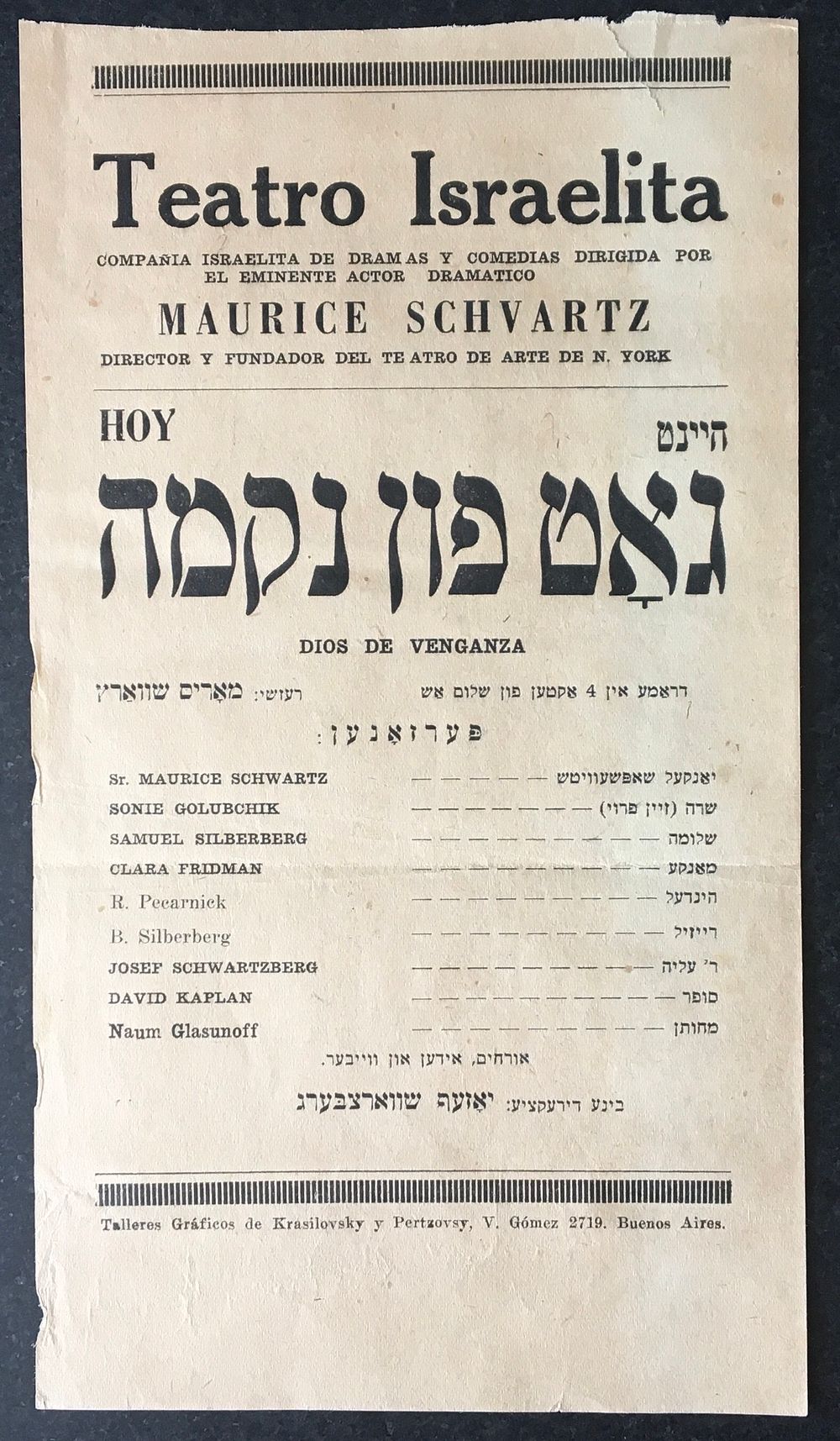
(ARGENTINA). Yiddish Theater. Group of five broadsides promoting performances by local and international stars of the Yiddish stage during their South American tours. Argentina, 1930-35. This interesting collection comprises five original handbills and programs documenting the peak of Yiddish cultural life in South America. Comprising: * 1. Teatro Israelita. Compañía israelita de dramas y comedias dirigida por el eminente autor dramático, Maurice Schvartz, director y fundador del teatro de arte de N. York. Hoy, Dios De Venganza - Gott fun Nekama. Buenos Aires, Talleres Gráficos de Krasilovsky y Pertzovsy, [1930]. 25cmx14cm. Small tear on the upper margin without paper loss. The undisputed highlight of this collection. Broadside promoting the play ‘God of Vengeance’ at the Israeli Theater in Buenos Aires. Directed and starring Maurice Schvartz. God of Vengeance, written by Sholem Ash in 1906, is one of the most controversial works of Yiddish literature. The story is set in a brothel and includes a lesbian relationship. The play, performed in New York for the first time in 1922, featured the first lesbian kiss on stage in any American theater. Subsequently, the play was heavily censored by both civil authorities and the Jewish community itself. In 1923 the play was canceled, the theater closed, and the producers charged with obscenity under the New York Penal Code. Maurice Shvartz is recognized as one of the greatest actors in Yiddish theater. He founded the Yiddish Art Theater in 1918 and participated in more than 150 plays. He also acted on Broadway and in Hollywood silent films. In 1930, he toured South America. This was his first international tour outside the US. * 2. Teatro Colón. Los Eminentes Actores Lucy Y Mischa German. Madrastras - Shtifmamas. Buenos Aires, Talleres Gráficos de Krasilovsky y Pertzovsy, [1930’s]. 33cmx16cm. Small tear on the center of the upper half, without paper loss. Light damp stain on the left margin. A strip of semi-rigid cardboard, about 3 cm wide, glued to the upper edge of the reverse side. This broadside documents a historic crossover between the Yiddish popular theater and Argentina’s highest cultural institution, the Teatro Colón. The participation of Jacobo Ficher as conductor highlights the intellectual and musical sophistication of the production. It represents the peak of Jewish cultural integration in Argentina's ”Golden Age” of performing arts. Jacobo Ficher (1896–1978) was a Russian-born Argentine composer, violinist, and conductor who became a cornerstone of Latin American musical modernism. After emigrating to Argentina in 1923, Ficher co-founded the Grupo Renovación in 1929, an elite collective of composers dedicated to breaking away from academic nationalism and introducing international avant-garde trends (such as polytonality and neoclassicism) to Argentina. As a key link between the Jewish immigrant experience and erudite modernist circles, Ficher’s involvement as a conductor in major Yiddish productions at the Teatro Colón underscores the profound intellectual depth and cultural prestige of the Jewish theatrical scene in Buenos Aires at this time. The play also featured performances by Lucy and Mischa Germán, internationally renowned stars in the Yiddish theater circuit. With portraits of the actors. * 3. Compañía Israelita De Operetas Y Comedias Stramer […] El Soldado De Oro - Der Goldene Soldat. Moisesville, Druk Lanner, 1935. 29cmx21cm. Small tear on the margin without paper loss. Semi-rigid cardboard glued to the upper edge of the reverse side. ‘The Golden Soldier’ was a celebrated Yiddish operetta written by Isidore Lillian with music by the 'Father of Yiddish Operetta, ' Joseph Rumshinsky. This production stared Clara and Salomón Streamer, renowned European artists who emigrated to Argentina in the 1930s. The Golden Soldier was a staple of the international Yiddish circuit, linking the vibrant theatrical scenes of New York's Second Avenue with the thriving Jewish community in Buenos Aires. The Lanner Press who printed this handbill in Moisés Ville were pioneering printers who provided the essential infrastructure for Yiddish cultural life in the Pampas. Moisés Ville being the first and most celebrated Jewish agricultural colony in Argentina. * 4. Teater Colon Rosarie. Molly Picon Revue. Moisés Ville, Imprenta El Relámpago, 1932. 29cmx16cm. Strip of semi-rigid cardboard, about 3 cm wide, glued to the upper edge of the reverse side. Another broadside from the printing presses of Moisés Ville. It announces the presentation of Molly Picon, the quintessential female star of Yiddish theater. * 5. Teatro. Broadside of a concert starring Tzili Tecs and Leon Blumenzon, two local figures of the Yiddish theater. Along with the pianist Simón Tenovsky. [Buenos Aires? 1935]. 29cmx21cm. Printed on both sides. Cardboard, scraps glued to the upper edge of the reverse side.