Bidspirit auction | (HOLOCAUST) Janusz Korczak: Prawo Dziecka
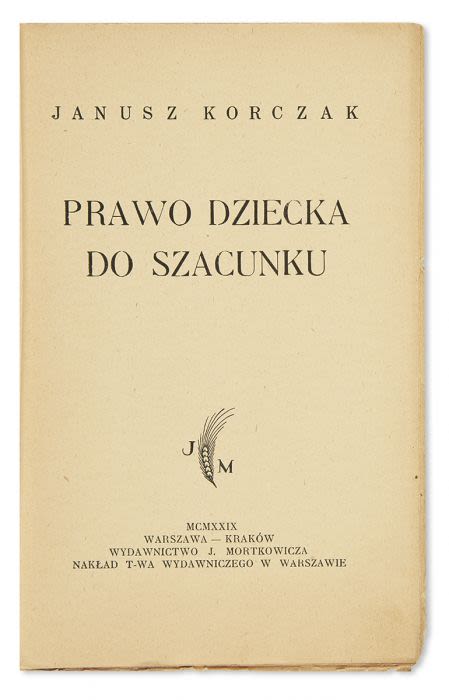
(HOLOCAUST) Janusz Korczak: Prawo Dziecka do Szacunku [“The Child's Right to Respect.”] First Edition. pp. 43, (5). Browned. Original printed wrappers. 8vo. Warsaw: Naukowa 1929 Janusz Korzcak (pen name of Henryk Goldszmit, 1878-1942) was a Polish-Jewish educator and pediatrician. After spending many years working as director of an orphanage in Warsaw, he refused sanctuary and stayed with his orphans when the entire population of the institution was sent by the Nazis from the Ghetto to the Treblinka extermination camp, during the Grossaktion Warshau of 1942. This moment exemplified his educational philosophy, embodied in this important work: “The Child’s Right to Respect” Korzcak’s most widely published and respected works. In it, he advocates for the rights of children not as human beings in potentia, but as human beings with the same rights as the adults who raise them. Further, he criticizes those adults who would scold children while they also commit the same errors: “We hide our own faults and guilty actions. … We pose as being perfect. …[Yet] only the child may be shamelessly degraded and placed in a pillory.” Janusz Korzcak (pen name of Henryk Goldszmit, 1878-1942) was a Polish-Jewish educator and pediatrician. After spending many years working as director of an orphanage in Warsaw, he refused sanctuary and stayed with his orphans when the entire population of the institution was sent by the Nazis from the Ghetto to the Treblinka extermination camp, during the Grossaktion Warshau of 1942. This moment exemplified his educational philosophy, embodied in this important work: “The Child’s Right to Respect” Korzcak’s most widely published and respected works. In it, he advocates for the rights of children not as human beings in potentia, but as human beings with the same rights as the adults who raise them. Further, he criticizes those adults who would scold children while they also commit the same errors: “We hide our own faults and guilty actions. … We pose as being perfect. …[Yet] only the child may be shamelessly degraded and placed in a pillory.”