Bidspirit auction | Southern Song Dynasty, Pale-Blue Celadon
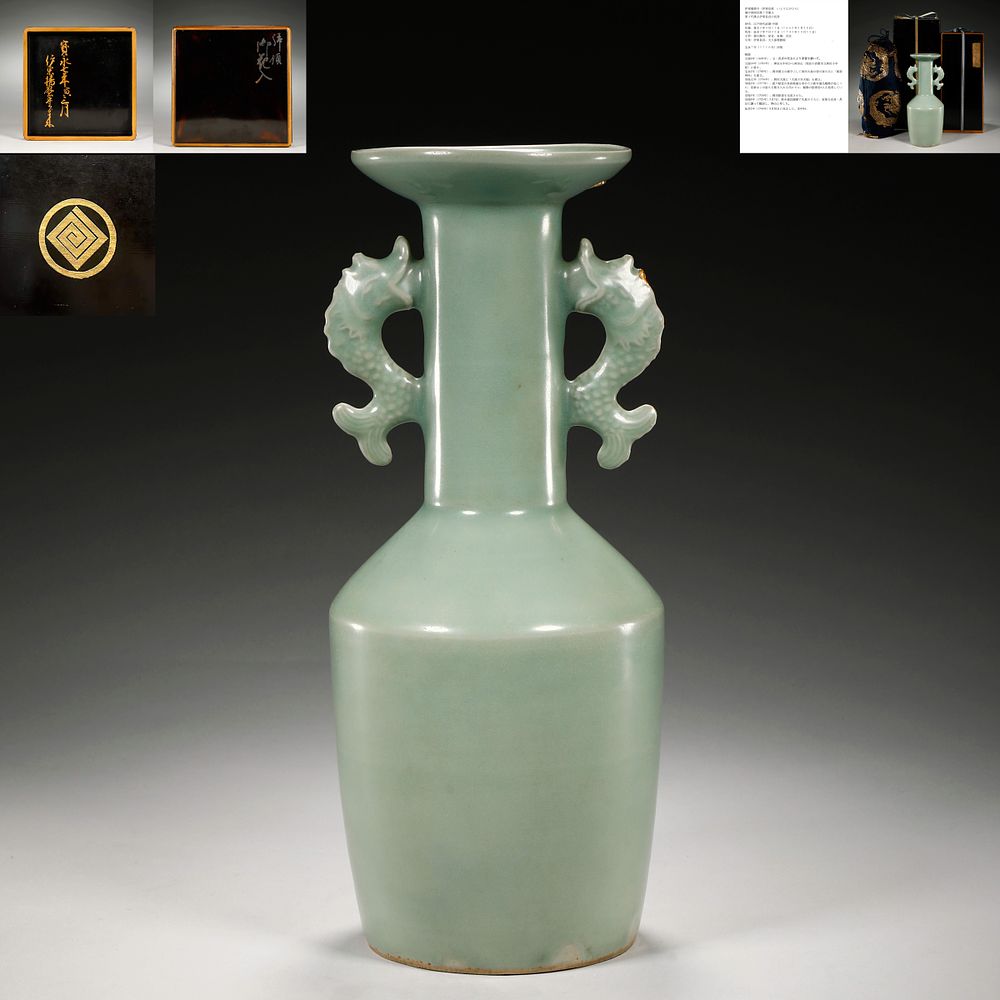
Southern Song Dynasty, Pale-Blue Celadon 'Peanut' Vase with Twin Fish and Dragon Handles - Southern Song Longquan Kiln Powder-Blue Glazed Makara-Eared Dish-Mouth Vase — Formerly in the Collection of Ito Harima-no-Kami: A Documented Masterpiece Returned from Japan This is a long-necked vase with dish mouth and twin makara (fish-dragon) ears, glazed in powder-blue, produced at the Longquan kilns during the Southern Song — a quintessential and important display piece from the kiln’s golden age. It features a broad dish mouth rising above a tall, straight neck, leading to a substantial, squared cylindrical body of dignified and solemn proportion. Symmetrically applied to either side of the neck are moulded makara handles: the heads emerge forward, bodies coiled, scales and fins crisply delineated. The makara motif — symbolizing the ascent from fish to dragon, good fortune and advancement — enjoyed great popularity in the Song era and represents one of Longquan’s most noble decorative themes. The vase is enveloped in a thick, generous layer of powder-blue glaze: evenly toned, mellow and lustrous, in a soft, understated shade of celadon green, with a restrained, subdued sheen that embodies the Song ideal of “jade-like beauty, ice-like clarity.” Pale russet “fire-red” discoloration marks the exposed foot rim; all period characteristics are fully present and the piece is in excellent preservation. The vase’s preeminent distinction lies in its fully documented provenance tracing directly to a Japanese feudal lord house. The former owner, Ito Nagayoshi, styled Ito Harima-no-Kami, was the fifth-generation daimyō of Okada Domain in Bitchū Province, eldest son of the fourth lord Ito Nagasada. Throughout the Edo period, domains maintained official treasuries; large quantities of Song and Yuan celadon entered Japan through trade and were preserved in aristocratic and daimyō households as prized treasures. This vase was held and passed down within the Ito family for generations. It retains two original antique Japanese wooden storage boxes with historic inscriptions on the lid, plus an Edo-period brocade storage pouch woven with gold-thread dragon roundels on a deep indigo ground — richly and luxuriously worked, the kind of fitting reserved only for daimyō-rank treasures. The complete preservation of boxes and pouch alongside the vase renders its lineage fully verifiable, placing it among the most distinguished surviving Longquan works. Museum References Taipei Palace Museum — Holds several Southern Song Longquan makara-eared vases of nearly identical form, mostly former Qing imperial collection, classified as imperial-grade Longquan ware made for court presentation. Tokyo National Museum, Japan — Preserves a closely related example, also from an Edo-period daimyō collection, widely published and long exhibited as a standard reference for Japanese-transmitted Song–Yuan celadon. Zhejiang Provincial Museum — Excavated shards from Hangzhou, Lishui and elsewhere confirm makara-eared vases were produced primarily in the mid-to-late Southern Song, crafted for elite domestic display and export; few were made and intact survivals are exceptionally rare. Most circulating Longquan celadon survives without its original storage accoutrements; the concurrent preservation of early custom boxes and daimyō-grade brocade is exceptionally uncommon. This Ito Harima-no-Kami vase represents the highest Southern Song artistic attainment in both glaze and form, while retaining its complete Edo-period provenance and fittings. It stands not only as a ceramic masterpiece but as tangible historical evidence of centuries of cultural exchange between China and Japan — a treasure of the highest collector significance.