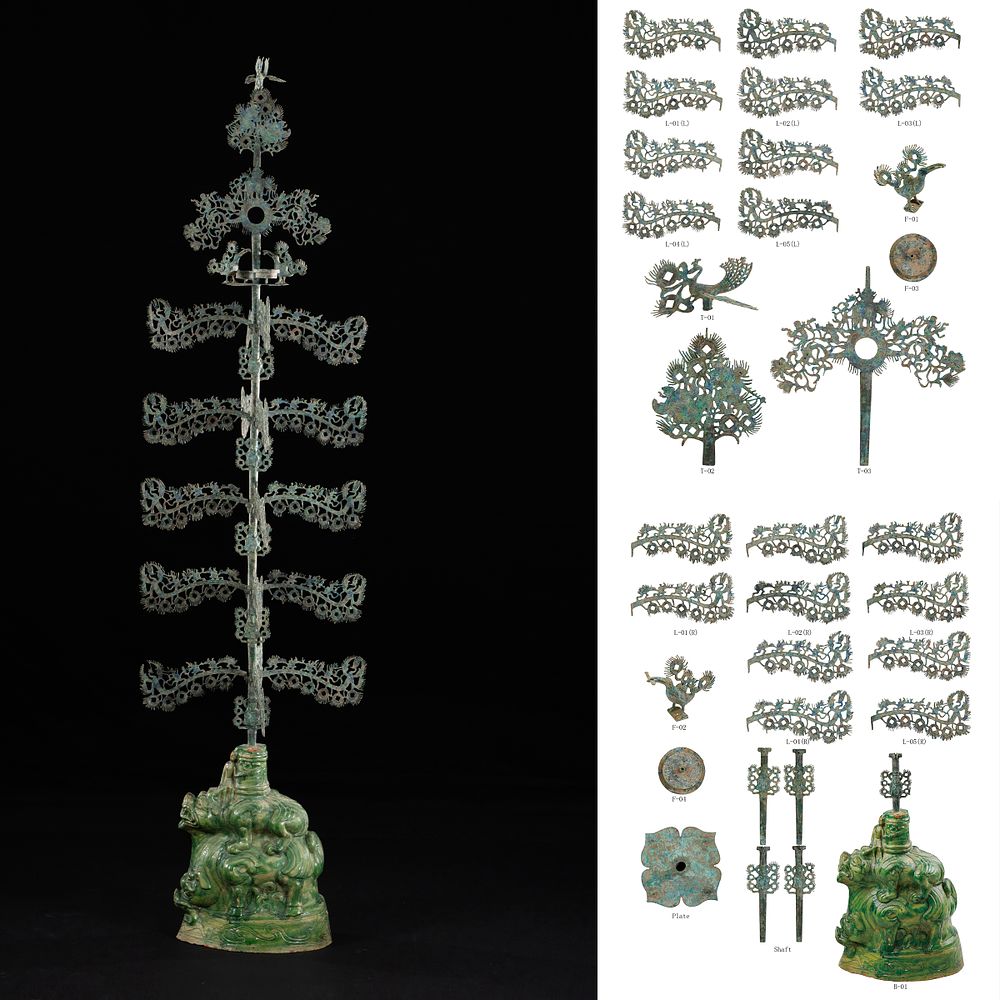
Bidspirit auction | Han Dynasty, Bronze Money Tree
Han Dynasty, Bronze Money Tree with Original Green-Glazed Pottery Base - A bronze money tree cast in the Bashu region of Southwest China during the Eastern Han, this magnificent piece stands 205 cm tall — exceptionally large, fully intact, and without parallel among known surviving examples. No other excavated or published piece combines such height with such pristine completeness. Composed of its original green-glazed ceramic base and a sectional bronze trunk, it rises with stately poise in clearly defined tiers. Midway up the trunk, a singular feature appears: two phoenixes facing one another, each holding a fish in its beak — a motif unknown in any other public or private collection, rendering this piece uniquely precious. Symmetrically spreading branches form a lush, abundant canopy; a divine phoenix perches at the apex, while round coin motifs, immortals, beasts, dragons, and phoenixes populate every branch in rich yet disciplined profusion. The bronze bears a deep blue-green patina, layered and gracefully aged. The ceramic base is modelled as Mount Kunlun, borne upon auspicious beasts, its glaze rich and luminous — perfectly complementing the bronze above. The entire ensemble conveys grandeur and splendour, representing the zenith of Eastern Han artistic and technical achievement in the Southwest. From base to top, the tree rises in nine distinct tiers: Tier 1 — The green-glazed base, sculpted with mountain peaks, supporting beasts and immortal figures; a nearly identical base is held by Sichuan University Museum, though its bronze upper section is lost. Tier 2 — Lower trunk with Wangmu Niang-niang (Queen Mother of the West) enthroned, attended by retinue amid swirling clouds. Tier 3 — The unique paired phoenixes, each bearing a fish, symbolizing abundance and double felicity — a feature found nowhere else. Tier 4 — Branches bearing coiled dragons, dancing immortals, and perforated coins. Tier 5 — Scenes of music, dance, and acrobatics rendered with vivid lifelike detail. Tier 6 — Auspicious beasts and divine birds interspersed with dense coin motifs. Tier 7 — Early Buddhist figures alongside immortals — a rare visual synthesis marking Buddhism’s early integration with indigenous Daoist beliefs. Tier 8 — Phoenixes facing the sun and radiating coin patterns. Tier 9 — The apex crowned by a splendid phoenix, head raised, wings outstretched — the tree’s crowning glory. This nine-tiered structure ascends from earth to heaven, from mortal realm to immortal paradise. Every motif is crisp and unbroken; compared with holdings in the Sichuan Museum, Tokyo National Museum, and Royal Ontario Museum, this piece surpasses all in height, completeness, decorative richness, and craftsmanship — truly the foremost money tree in existence. Money trees trace to ancient sacred tree worship, descending from Fusang and Ruomu traditions in Classic of Mountains and Seas, and kindred to the Sanxingdui bronze divine tree — a sacred ladder linking earth and heaven, conducting souls to immortality. The apical phoenix embodies the three-legged sun crow; the Queen Mother of the West presides over longevity; early Buddhist figures attest to faith’s earliest arrival in China; coin motifs represent wealth and cosmic order, said to glow at night guiding spirits heavenward. The “fish-in-beak” motif puns on “surplus,” promising perennial abundance; paired phoenixes denote conjugal and familial blessing. The tree unites all virtues: ascent to heaven, prosperity, eternal life, and the harmony of heaven, earth, and humanity. Its provenance is distinguished: preserved in a private art museum and subsequently in a major Kyushu collection, it carries the lineage of Japanese connoisseurship of Chinese antiquities. Among comparable pieces worldwide, most survive at around one metre in height with only three to four tiers; this 205 cm specimen with nine complete tiers, original base, pristine patina, and an unparalleled phoenix-and-fish motif stands entirely alone. Fewer than thirty complete Eastern Han bronze money trees are known globally, nearly all in major museums; a piece of this scale and distinction is virtually unheard of in private hands. It embodies lost-wax casting, openwork carving, and modular joinery at their most refined — an irreplaceable document of Han religion, cross-cultural exchange, and craft. As scholarship deepens, its stature and value will surely rise: the undisputed King of Money Trees, a masterpiece without equal.