Bidspirit auction | Zoya Cherkassky-Nnadi
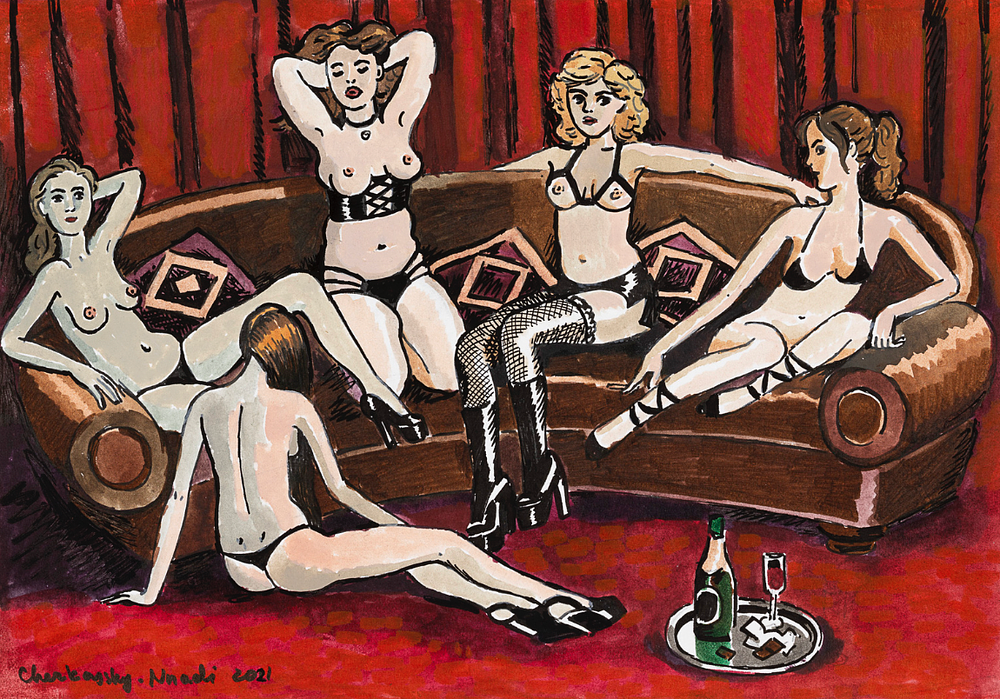
Zoya Cherkassky-Nnadi - Untitled, 2021. An original work by the most talked about artist in Israel from her excellent exhibition in New York ``Woman who work'', an exhibition that opened in July 2021 and received wide coverage. Mixed media on framed paper 18/26 cm (framed 29/37 cm) signed From an article by Naama Riva, *Haaretz*, August 2021: ”Working Women”: An Uncensored Look at the World of Prostitution in a New York Exhibition Zoya Cherkassky draws inspiration from Toulouse-Lautrec, YouTube videos, and the streets of South Tel Aviv in her provocative new exhibition. The exhibition features a series of over 50 works created by Cherkassky under the title ”Working Women, ” which was presented in an online exhibition by the Gansevoort Gallery in New York through August 2021. The paintings depict sex workers alongside their clients; pimps and police officers also appear at times. While the scenes are largely imagined, many are based on films Cherkassky has seen, YouTube videos, or observations made while wandering the streets of South Tel Aviv. It is a jarring series that portrays the world of prostitution without a filter—imbued with deep compassion and the critical eye characteristic of her work—while simultaneously pointing an accusatory finger at the culture that enables it. ”When I started working on this series, I watched police footage on YouTube of raids on brothels in 1990s Russia, ” Cherkassky explains. ”Back then, there wasn't really a functioning government, and all sorts of gangs were flourishing. Perhaps similar situations existed in Israel too, but they weren't filmed or posted on YouTube.” The drawings are small—roughly A4 size or smaller—and were created using markers, pencils, and other materials. Cherkassky drew them rapidly, almost like an obsessive assembly line for an idea demanding expression. Prices for the drawings in the exhibition range from $2,000 to $3,750. Half were sold prior to the exhibition, despite—or perhaps because of—the challenging subject matter they depict. ”I could see myself buying a picture by Otto Dix or George Grosz [two German artists who influenced her] with similar content, even if the images are disturbing.”