Bidspirit auction | [MUSIC] - A Japanese inventor
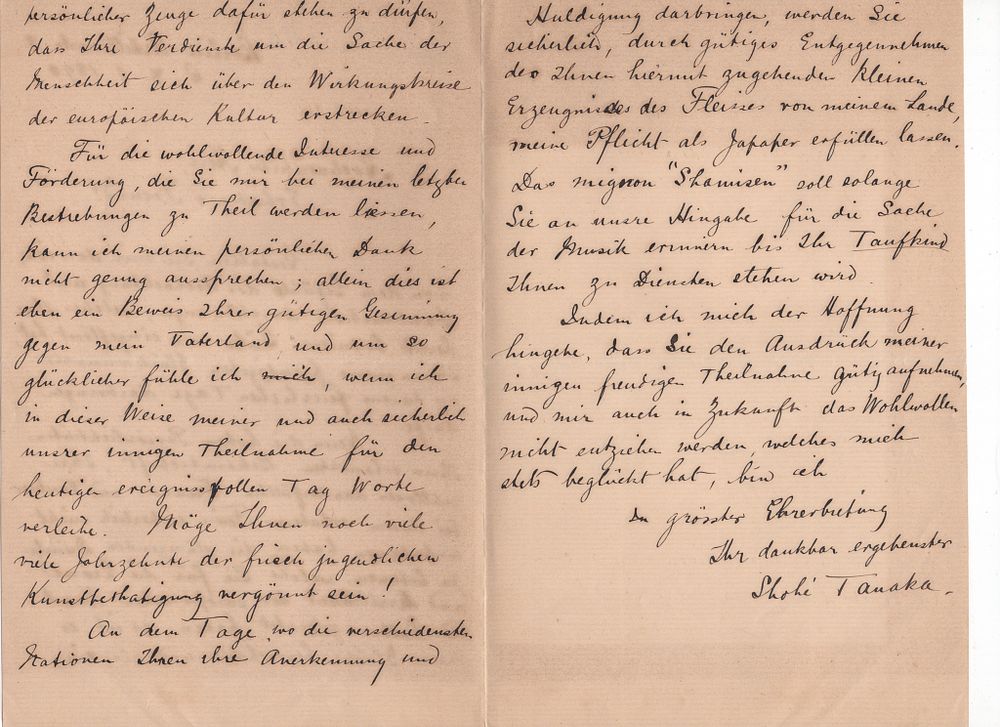
[MUSIC] - A Japanese inventor forerunner of modern computer systems - TANAKA Shohe - Autograph letter signed, dated “Berlin (…) 8. 1. 1890” by the Japanese physicist, music theorist, and inventor. In the early 1890s the young Tanaka, making his doctoral studies in the capital of the German Reich, Berlin, devised an adding machine. In 1895 he applied for and later obtained several patents for such machines: two German patents from 1895 and 1896 (pat. No. DE90288 for “Additionsmaschine”, 14.11.1895, and DE92217), a French patent from 1897 (FR262466 for “Mecanisme d’arret pour machine a additionner”), and a Great Britain patent from 1898 (see pat. No. GB189708723 for “Improvements in and relating to Adding Machines”). In fact, the primary object of Tanaka’s invention was a stop mechanism for adding machines, preventing the toothed wheels from surpassing. The object of Tanaka’s stop mechanism for adding machines is to prevent the toothed wheel, called the number wheel in these machines, being worked by the spring or tappet which makes it move, from surpassing, by its acquired speed the exact point it should reach to mark a number required. In such machines the rotation of the number wheel takes place generally at once by depressing a key, and therefore when the keys are played very rapidly or with great force, then the number wheel, on account of the force acquired, will move far beyond the expected amount. This inherent problem of keyboard calculators remained unsolved in most machines of the time, and thus was addressed by Tanaka’s invention. Tanaka addresses the pianist, composer and conductor Hans von Bulow (1830 - 1894). Making New Year's vows to his friend and protector Bulow, he praises his industriousness, which has been meritorious and is appreciated not only in Europe, but all over the world. He, as a Japanese, also thanks on behalf of his nation for the interest and help shown to his personal aspirations. As a testimony to his land's assiduity in the field of musical progress he offers a “Shamisen” (translated): “…On the day when the various nations pay their respects and homage to you, you will kindly fulfill my duty as a Japanese by graciously accepting the small product of my country's diligence sent to you here. The mignon “Shamisen” shall remind you of our devotion to the cause of music…”. 3 pp. In-8. Envelope included.