Bidspirit auction | [HISTORY] - Gold Gone Missing:
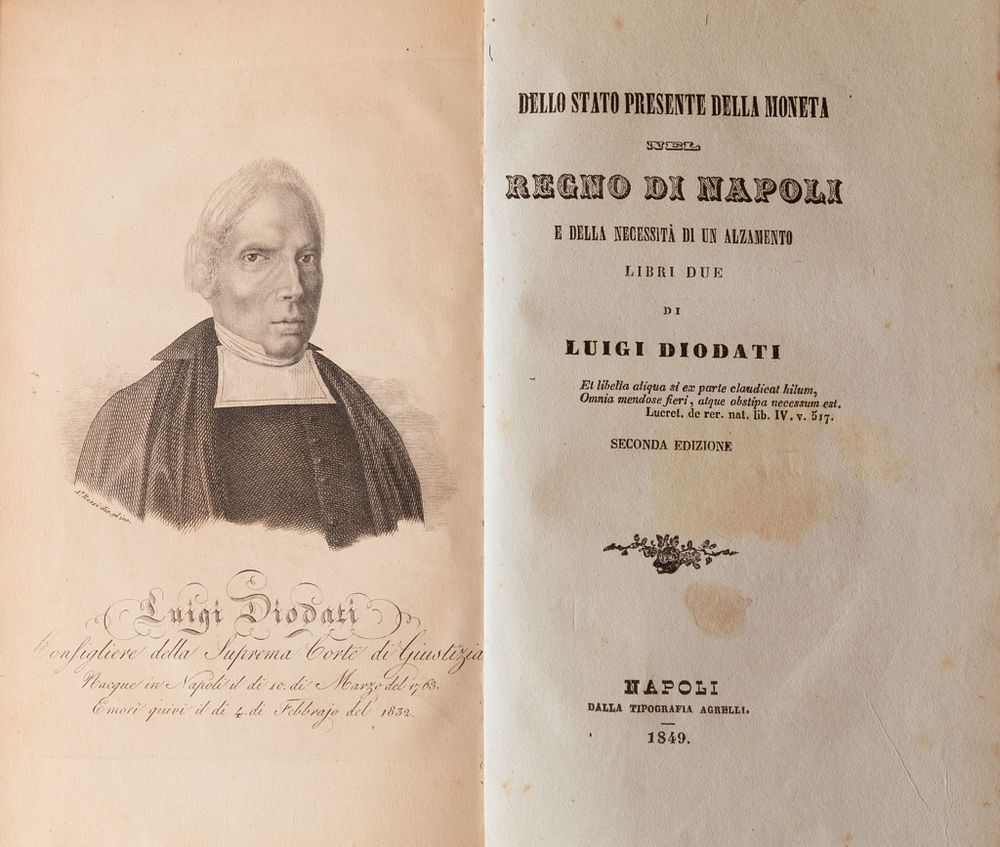
[HISTORY] - Gold Gone Missing: Neapolitan Monetary Crisis, 1849 - DIODATI Luigi (1675 - 1755) - DIODATI, LUIGI. Dello stato presente della moneta del Regno di Napoli e della necessità di un alzamento. Napoli, Agrelli, 1849. (Bound with) Risposta dell’autore ad alcune critiche sulla sua opera intitolata “Sullo stato presente della moneta del Regno di Napoli. [Naples, Agrelli], 1849. 8vo (220 x 130 mm.), early 20th cent. in half vellum with corners, title in gold on red calf label at spine, an attractive, well-preserved copy printed on light blue paper. Pp. [8], VIII, 109, [1], 18, with an engraved portrait of the author facing the title-page, numerical tables in the text. Second edition, uncommon, of this innovative study of monetary history by Luigi Diodati, whose contributions to the history of coins and money were recognised by the government and he was made the director of the Neapolitan mint. Diodati attempts to resolve the question of why gold had disappeared in 1587 from the kingdom of Naples, which was not sufficiently explained by all earlier monetary writers, such as De Sanctis, Serra, Locke, Melon, Galiani or Beccaria. The usual explanation of this fact was an excess of imports over exports. Diodati, however, maintains that the lack of gold was caused by the monetary reform undertaken by the other states of Italy, each of which had raised the nominal value of their coins. This had been a reaction to the rise of prices and the fall in the value of money consequent to the discoveries of silver in America, and the impulse these supplies of metal gave to enterprise and business, whilst reducing all fixed incomes. In the concluding chapter Diodati develops a theory of ideal money, 'moneta immaginaria' which is not subject to re- and de-valuations, but sustains its value. It appears to be a form of exchange-rate mechanism, with fixed exchange rates. Cossa 47 (170); Einaudi 1571; Goldsmiths'-Kress 14462.33. (1)