Bidspirit auction | [SCIENCE AND MEDICINE] - FRACASTORO
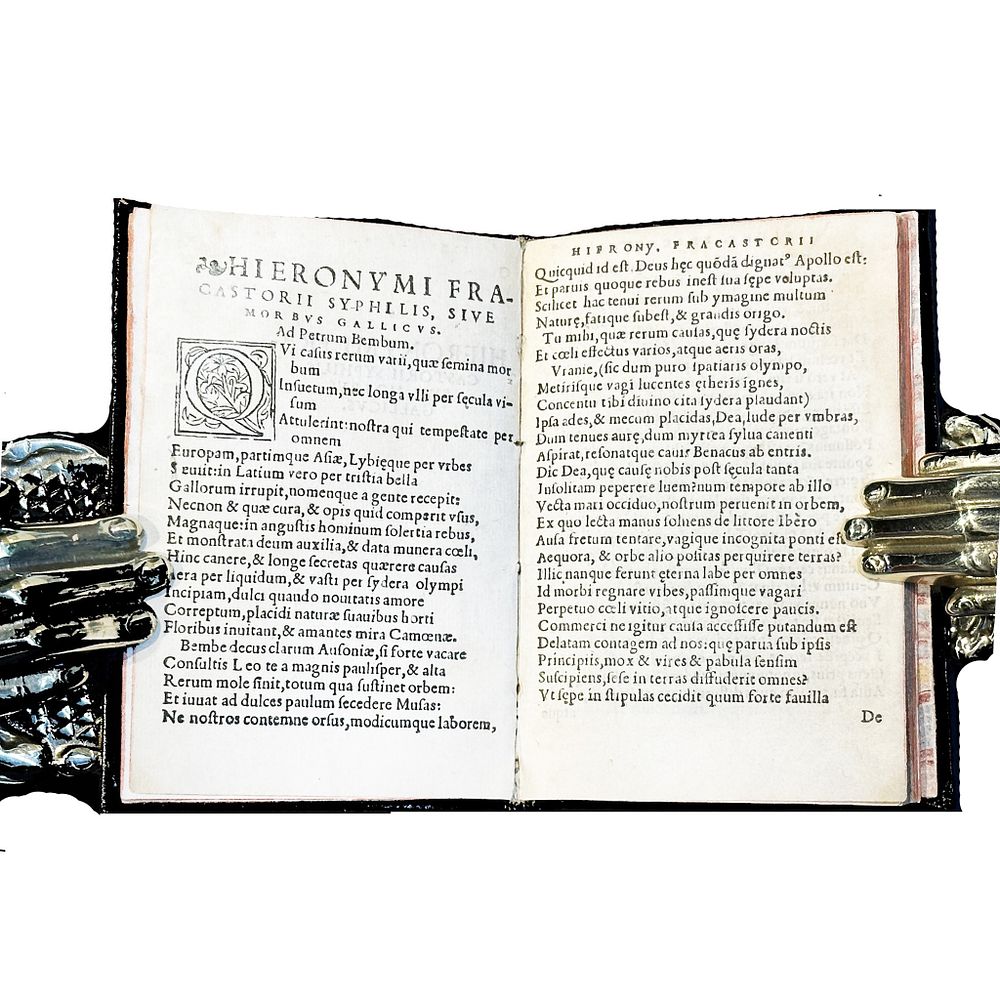
[SCIENCE AND MEDICINE] - FRACASTORO Hyeronimi (1478 - 1553) - The Most Important Poem On Epidemics. Unrecorded (Pirated?) Edition Of Fracastoro’s Syphilis - FRACASTORO, GIROLAMO. HYERONIMI FRA- | CASTORII SYPHILIS, | SIVE MORBVS | GALLICUS. [No printer, no date but presumably Italy: ca. 1530]. 12mo, attractive 18th century dark blue-green morocco with the gilt coat of arms of Francesco Maria Biordi on front cover, gilt double borders, four bands spine, red edges, marbled fly-leaves. Title-page printed in Roman capital letters. Unrecorded edition, likely a contemporary pirated issue and apparently the only extant copy, of the first book devoted to syphilis, the most celebrated of all the medical poems and the most valuable one ever devoted to an epidemic disease. The first edition was printed in Verona by Stefano Nicolini da Sabbio in 1530, and it was followed by a Roman edition printed by Blado in 1531. They are the only two editions printed in Italy in the 16th century, both in 4to. They are formed respectively by 40 and 32 unnumbered leaves and they bear the title in capital letters. The present unrecorded edition similarly bears the title in capital letters but has no indication of printer and place of print and it has omitted the last two lines with the privilege. Due to the immediate success of Fracastoro’s poem, an anonymous still not identified printer probably issued this pirated and useful pocket copy which could be easily carried by physicians and surgeons. Syphilis broke out between the soldiers of Charles VIII during the Italian war of 1495 and spread all over Europe: Niccolò Leoniceno was the first to describe the disease’s etiology with rational means in his work Libellus de Epidemia, quam vulgo morbum Gallicum vocant published by Aldus in 1497. Accordingly, he managed to prove that the disease had already been in existence for a long time on descriptions by ancient authors and attempted to prove that syphilis, although it had appeared recently in Europe, had been known to the ancients and therefore was not essentially a new disease. However, Fracastoro was the first one to use the name ‘Syphilis’ for this epidemic and his poem is the first work bearing the modern name of this disease. There are several references to America, mentioning the curative powers of guaiacum wood and the theory of the American origin of syphilis, whether syphilis came back to Europe from the New World with Columbus’s sailors, which Fracastoro rejects. To the Italians it was the “French disease”, to the French the “Italian disease”, with many other countries blaming one another for bringing the infection to their citizens. In the poem, which is broken into three parts, we learn of the disease and some popular treatments of the time, including mercury and the plant remedy guaiac. We also read the tale of a shepherd named Syphilus, who Fracastoro supposed to be the first person afflicted with the disease, which was his punishment for spurning the sun. The poem was translated into many languages, including William Van Wyck’s translation in English language. Girolamo Fracastoro also known with his latinized name of Fracastorius (c. 1476/8–1553) was an Italian physician, poet, and scholar in mathematics, geography and astronomy. Fracastoro subscribed to the philosophy of atomism and rejected appeals to hidden causes in scientific investigation. He was mainly interested in epidemic diseases and his studies of the mode of syphilis transmission are an early example of epidemiology. He appears to have first used the Latin word fomes, meaning tinder, in the sense of infectious agent, in his essay on contagion De Contagione et Contagiosis Morbis (On Contagion and Contagious Diseases), published in 1546: «I call fomites [from the Latin fomes, meaning “tinder”] such things as clothes, linen, etc., which although not themselves corrupt, can nevertheless foster the essential seeds of the contagion and thus cause infection». His theory remained influential for nearly three centuries, before being superseded by a fully developed germ theory. Condition: A fine copy with a distinguished provenance. Provenance: 1. Gilt coat of Arms of Francesco Maria Biordi (1764-1817) bishop of Dulma and Apostolic Administrator of Anagni. The see of Dulma can be identified, according to what reported by Eubel in his volumes of the Hierarchia Catholica Medii Aevi, with the the diocese of Duvno in Bosnia, suppressed in the second half of the seventeenth century. 2. Stefano Biordi from Cesena, abbot and nephew of the bishop Biordi, his inscription dated November, 3 1817 at first fly-leaf: Questo libro era di Monsigr Franc[esc]o Ma[ria] Biordi vescovo di Dulma, e Ammi[nistratore] Ap[ostolico] di Anagni, e ora di me Abbate Stefano Biordi da Cesena nipote del medesimo nominato di sopra Monsigr Biordi alli 3 di novembre 1817. References: Not in OCLC, not in USTC. Not in NUC, BMSTC and Edit16 Censimento,