Bidspirit auction | [LITERATURE] - MORATA Olimpia Fulvia
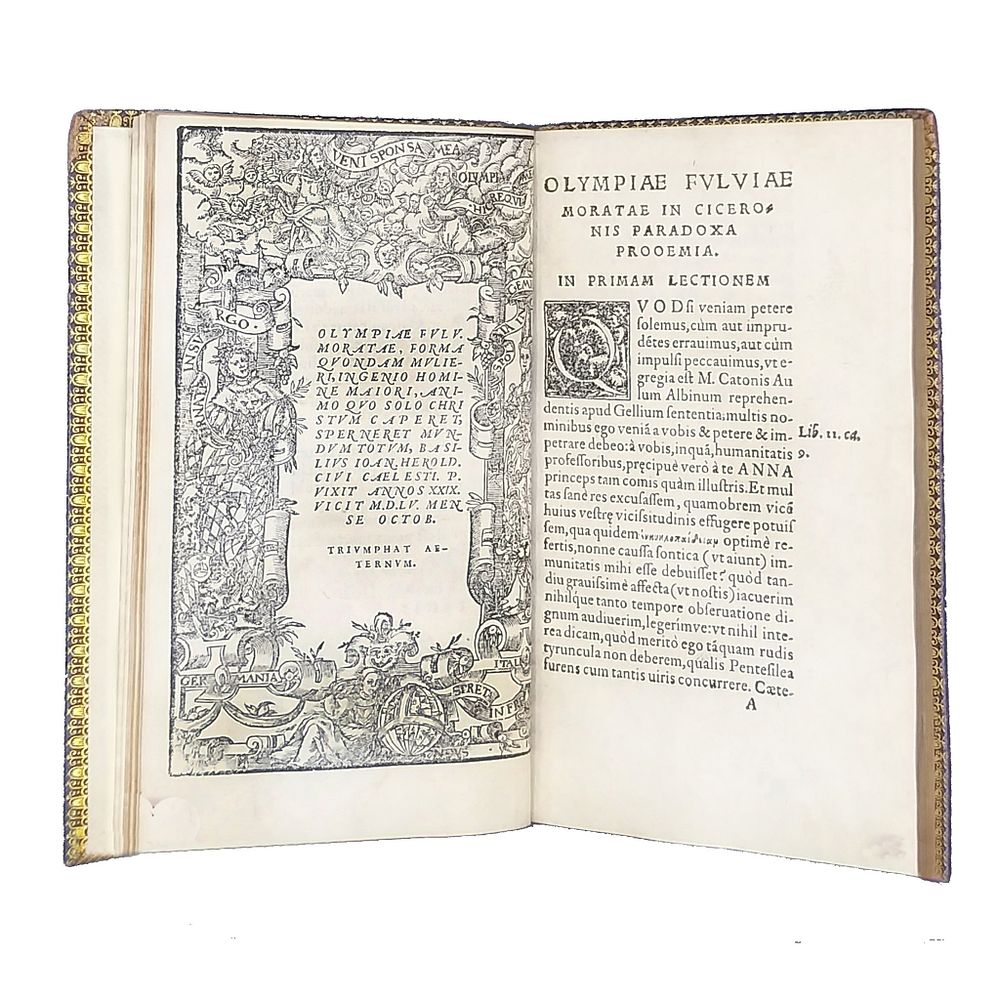
[LITERATURE] - MORATA Olimpia Fulvia (1526 - 1555) - A Woman Who Wrote In Defense Of Women And Their Rights. Among The First Women To Face Censorship. And Be Included In The Index Of Forbidden Books - Morata, Olimpia Fulvia. ”Divinae orationes, dialogi, epistolae, carmina, tam Latina quam Graeca”. Basel: Pietro Perna, 1562. 8vo (160x100mm), 19th-century roan, gilt edges, Full-page decorative border around Morata’s epitaph, woodcut device on title, ff. [8], pp. 278, f. 1. Exceptionally rare second enlarged edition —and earliest obtainable, there are no records of the first appearing— of the writings of the Protestant polymath Olympia Morata. A significant collection of Latin dialogues, Greek letters, orations, and poems by the young Renaissance proto-feminist Olympia Morata, who tragically succumbed to plague in 1555 at the age of 29. These works were gathered by her husband and published posthumously by Celio Secondo Curione. The edition was dedicated to Queen Elizabeth I, a fellow erudite Protestant, crowned three years after Olympia’s death. Notably, Olympia Morata is thought to have been among the first women included in the Index Librorum Prohibitorum. Olympia Fulvia Morata (1526-1555) was an Italian classical scholar, poet, and polymath, a precursor to the ideal of the free Renaissance woman. Born in Ferrara to Fulvio Pellegrino Morato and a woman named Lucrezia (likely Gozi), Olympia was immersed in an environment of classical scholarship from a young age. Her father, a former tutor to the young princes of the Este ducal family, maintained close connections with many of Italy’s leading intellectuals, providing Olympia with a rich educational foundation. By the age of twelve, she was proficient in both Greek and Latin, demonstrating remarkable fluency for her age. Around this time, Olympia was invited to the Este court as a companion and tutor to the young Anna d’Este, daughter of Renata, Duchess of Ferrara. Renata’s court was a center of intellectual and reformist activity, frequented by figures of literary and Protestant prominence, including John Calvin, Vittoria Colonna, and Clément Marot. During her teenage years, Olympia lectured on the works of Cicero and Calvin, showcasing her scholarly prowess. In 1546, she left court to care for her ailing father, and after his death, she assumed responsibility for the education of her younger siblings. Fulvio Morato died as a convert to Protestantism, a faith Olympia herself soon embraced, influenced by the teachings of Luther and Calvin. She dedicated herself to philosophical studies and, around 1550, married Andreas Grundler, a Bavarian student of medicine and philosophy. In 1554, she accompanied her husband to Schweinfurt, his birthplace, where he had been appointed physician to the garrison of Spanish troops. During their travels through plague-stricken Heidelberg and other German cities, Olympia suffered from poor health. In 1555, she wrote her final letter to the scholar Celio Secondo Curione, in which she expressed her nearness to death due to a persistent fever. In this letter, she also mentioned having reconstructed from memory a portion of Curione's work that was lost during their flight from Schweinfurt, urging him to review it. Olympia passed away shortly after, marking the premature end of a life devoted to scholarship and religious reform. The Learned women in in Italy Olympia Morata exemplifies the educated women of her time who achieved remarkable scholarly standards and advocated for women’s intellectual and social rights. Alongside her, figures such as the 16th-century Venetian writer Modesta di Pozzo di Forzi and painter Sofonisba Anguissola (c. 1532–1625) demonstrated the impact of enlightened family backgrounds on women’s education. Like Morata, Anguissola and her sisters were trained to meet the rigorous standards typically reserved for men; four of the five Anguissola sisters became professional painters, a testament to the potential women held when given educational opportunities. Despite the exclusion of educated women from public life, many voiced pioneering ideas. Isotta Nogarola challenged misogynistic literature by defending women in her biographical works and reinterpreting Eve's role, carving out intellectual space for women. Similarly, Laura Cereta re-envisioned societal roles for women, arguing that education is a universal right and asserting that women bore responsibility for asserting their educational claims. Cassandra Fedele was the first woman to join a humanist circle, advocating for gender equality and pride in womanhood. Other notable figures include Margaret Roper, Mary Basset, and the Cooke sisters, who gained recognition through their significant translation work. Writers like Moderata Fonte and Lucrezia Marinella adopted and adapted male rhetorical styles to challenge the societal limitations placed on women. Recognizing the achievements of such women,