Bidspirit auction | [SCIENCE AND MEDICINE] - NEWTON
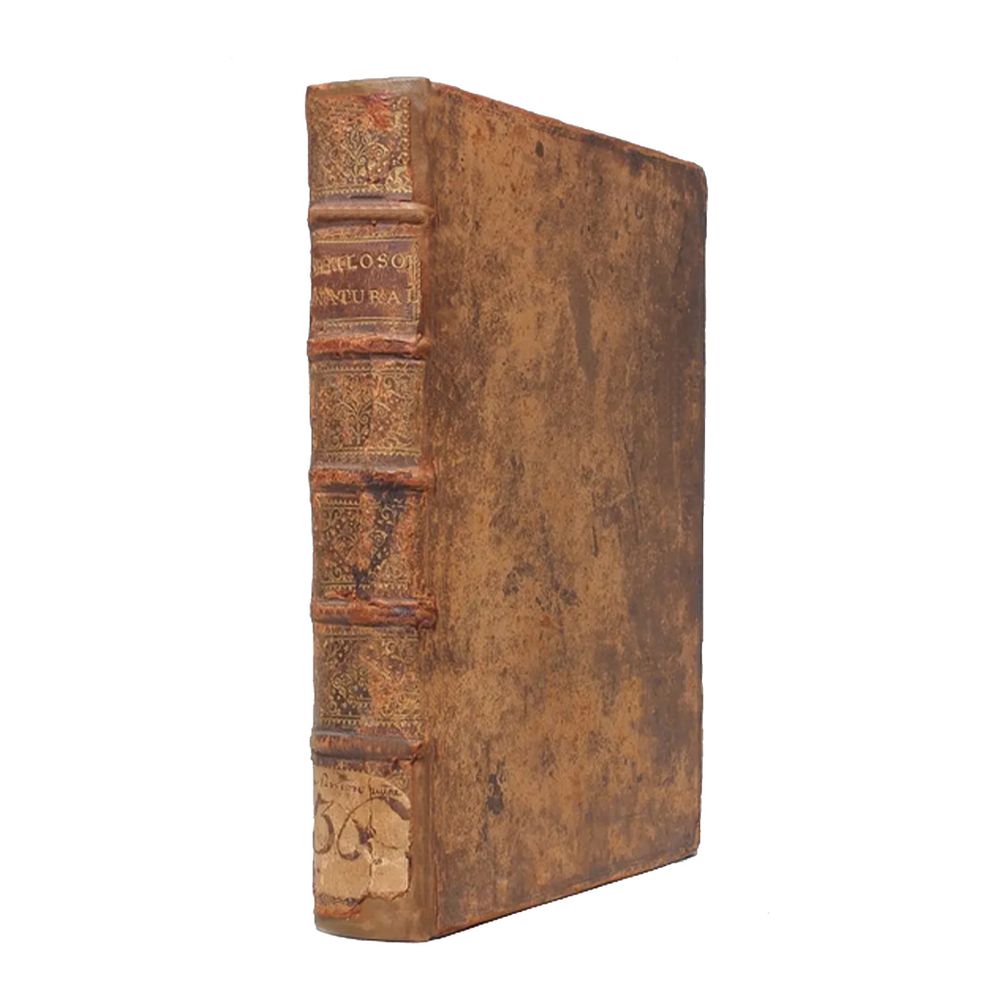
[SCIENCE AND MEDICINE] - NEWTON Isaac (1643 - 1727) - The Most Complete Edition Of Newton’s «Principia Mathematica». Bound With The First Separate Edition Of Analysis On The Higher Mathematics - Newton, Isaac. ”Philosophiae Naturalis Principia Mathematica [...]. Editio ultima.” Amsterdam: Sumptibus Societatis, 1723. [bound with:] Newton, Isaac. Analysis per Quantitatum Series, Fluxiones ac Differentias: cum Enumeratione Linearum tertii ordinis. Amsterdam: Sumptibus Societatis, 1723. 4to (255 x 204 mm), 18th century blond calf, five raised bands spine decorated with a flowered decoration (sympathetically re-backed), red edges, marbled fly-leaves, pp. [28], 484, [8] for the Principia Mathematica; pp. [12], 107 for the Analysis. Two title pages (the first printed in red and black) with vignettes. Introduction by E. Halley and preface by the editor, Roger Cotes, who attacks Cartesian philosophy still in vogue in the universities. Three folding plates: one folding plate in the first work and two folding plates at the end of the second work; many woodcuts in the text for this edition that was a major undertaking, requiring the cutting of new wood-blocks for the figures and a new setting of type. The last revised edition of the «Principia Mathematica» published during Newton’s lifetime: the only one containing the first separate edition of his «Analysis per Quantitatum Series», Newton’s first independent treatise on the higher mathematics, with the invention of the calculus. First published in London in 1687 the Principia states Newton’s laws of motion, forming the foundation of classical mechanics, his law of universal gravitation, a derivation of Kepler’s laws of planetary motion and his mathematical methods, now included in the field of calculus. The 1723 edition is considerably increased, containing extracts from four letters of Newton and especially his following four tracts: De analysi per aequationes infinitas (first published by Jones in 1711), De quadratura curvarum and Enumeratio linearum tertii ordinis (published with the “Opticks” in 1704), and the Methodus differentialis. The edition also contains a revised conclusion, a second preface by Newton and considerable additions, the chapters on the lunar theory and the theory of comets being much enlarged. The edition includes (Principia, p. 481) the “General Scholium”, not present in the first edition, wherein Newton used what became his famous expression: «Hypotheses non fingo» (“I formulate no hypotheses”). This Amsterdam reprint corrects a few errors made in the printing of the second edition and precedes the third edition by twelve years. Condition: Usual light foxing but a fine copy. References: Gray, Bibliography of Newton, 12. Wallis, Newton and Newtoniana, 12. Sotheran, Second Supplement, volume I, 5672. Horblit 78 (1687 edition). Not in Babson and see Babson, 207 (for the Analysis): «[This is] Newton’s first independent treatise on the higher mathematics, containing his invention of the calculus». PMM (Printing and the Mind of Man), no. 161: «The Principia is described as the greatest work in the history of science. Copernicus, Galileo and Kepler had certainly shown the way; but where they described the phenomena they observed, Newton explained the underlying universal laws». •> This lot is located in and ships from the UK. No export license is required for values under £65,000; above this threshold, a UK export license will be needed. Import duties and taxes in the destination country are the buyer's responsibility.