Bidspirit auction | [HISTORY] - POLAND - CONSTITUTION
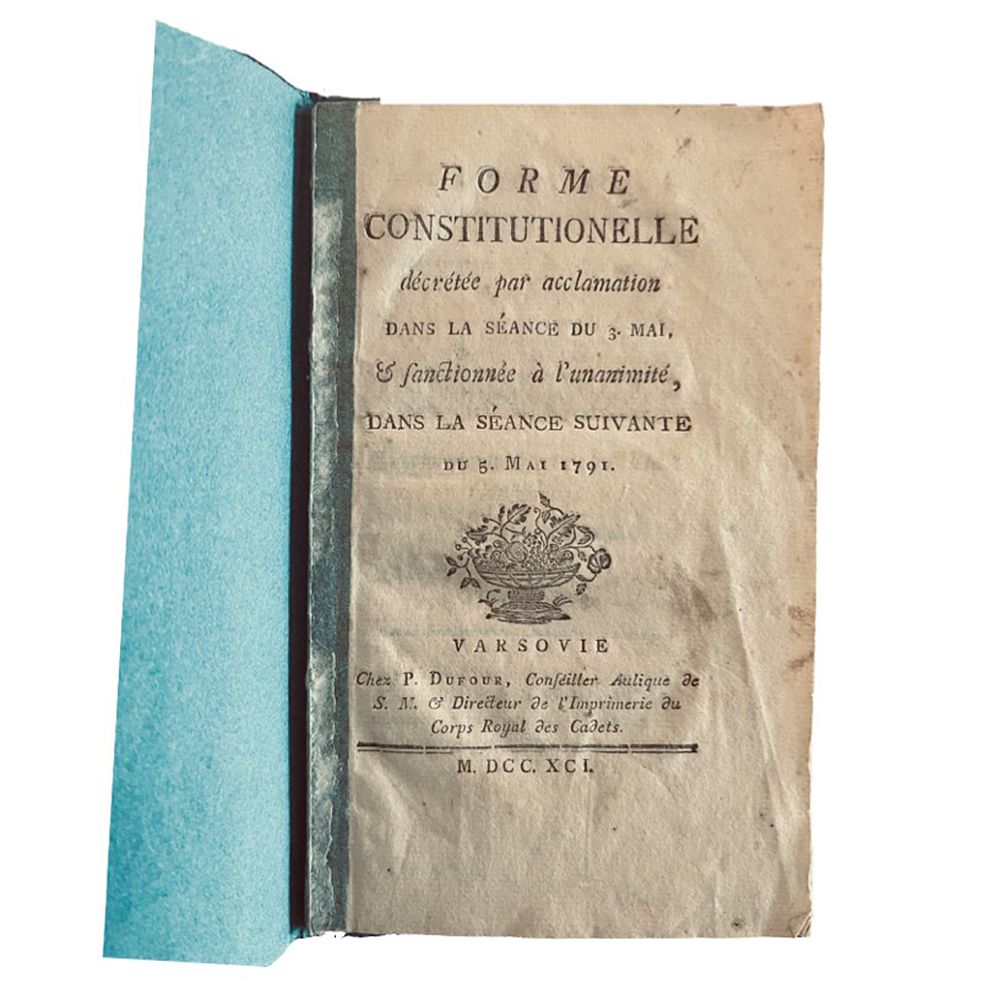
[HISTORY] - POLAND - CONSTITUTION OF 3 MAY 1791 - The Revolutionary Voice of a Vanishing Kingdom: The Rare Warsaw French Printing of Europe’s First Modern Constitution - Forme constitutionnelle décrétée par acclamation dans la séance du 3 mai, & sanctionnée à l’unanimité, dans la séance suivante du 5 mai 1791. Warsaw, Piotr Dufour, 1791. An extraordinary rarity of the highest historical and symbolic importance: the original Warsaw printing, in French, of the Constitution of 3 May 1791, the epoch-making act now universally recognised as the first modern constitution in Europe and the second in the world after that of the United States. Printed in Warsaw by Piotr Dufour, director of the Cadet Corps press, this edition is no mere legislative pamphlet, but one of the great documentary monuments of the European Enlightenment in its final political form: constitutional reform transformed into print at the very moment of history. The importance of this edition lies not only in the text itself, but in its language, date, and place of publication. Issued in French, the diplomatic and intellectual language of late eighteenth-century Europe, it was meant to carry the news of Poland’s constitutional revolution beyond Warsaw to the courts, ministries, and political circles of the Continent. The present printing therefore belongs not merely to Polish national history, but to the wider history of European constitutional thought, presenting the Polish-Lithuanian Commonwealth before the world as a reforming state still capable of legislative grandeur, political intelligence, and sovereign renewal. The Constitution of 3 May emerged from the Great Sejm amid the deep crisis of a Commonwealth already gravely weakened by the First Partition of 1772 and by decades of internal paralysis and foreign interference. Its framers sought nothing less than the political rescue of the state: to strengthen central government, reform representation, restrain destructive parliamentary mechanisms, and create a more viable constitutional monarchy. In retrospect, the text appears all the more moving because it was not a theoretical exercise, but a last great act of national self-preservation. This Warsaw impression possesses a further and very special authority as a contemporary witness to the act itself. Archival material relating to the official printings of the Government Act notes that the text was issued from Warsaw and authenticated through chancery procedures, underscoring that contemporary printed copies were not merely informative but carried legal and documentary force. In that sense, the present item stands remarkably close to the constitutional event it records. Its rarity should be strongly emphasised. The original Warsaw French issue appears very seldom in trade, and in publicly accessible web traces one encounters more readily the Paris edition of 1791 or much later reprints than documented market appearances of the true Warsaw printing itself. I have not located an easily verifiable public auction record for this original Varsovian French edition in the sources reviewed, which only enhances the impression that it survives chiefly in institutions and only exceptionally in commerce. This should be stated cautiously, but from an antiquarian point of view it is precisely the kind of work whose historical renown far exceeds its market visibility. That institutional survival is itself telling. The Constitution of 3 May has long been treated as one of the foundational documents of Polish historical memory; it is singled out in official Polish and European cultural-historical narratives as a landmark of democratic and constitutional heritage, and the constitutional tradition surrounding it has been recognised in memory and heritage contexts of national significance. Few eighteenth-century imprints combine so perfectly rarity, political drama, European significance, and emotional force. This is the printed voice of a state attempting, through law and reason, to save itself from dismemberment; a fragile pamphlet in material form, yet one of the grandest survivals of the age of constitutions. In every respect, it is a piece worthy of the strongest emphasis in any catalogue of rare books, historical documents, or landmark works of political thought. •> This lot is located in and ships from the UK. No export license is required for values under £65,000; above this threshold, a UK export license will be needed. Import duties and taxes in the destination country are the buyer's responsibility.