Bidspirit auction | [MUSIC] - PUCCINI Giacomo (1858
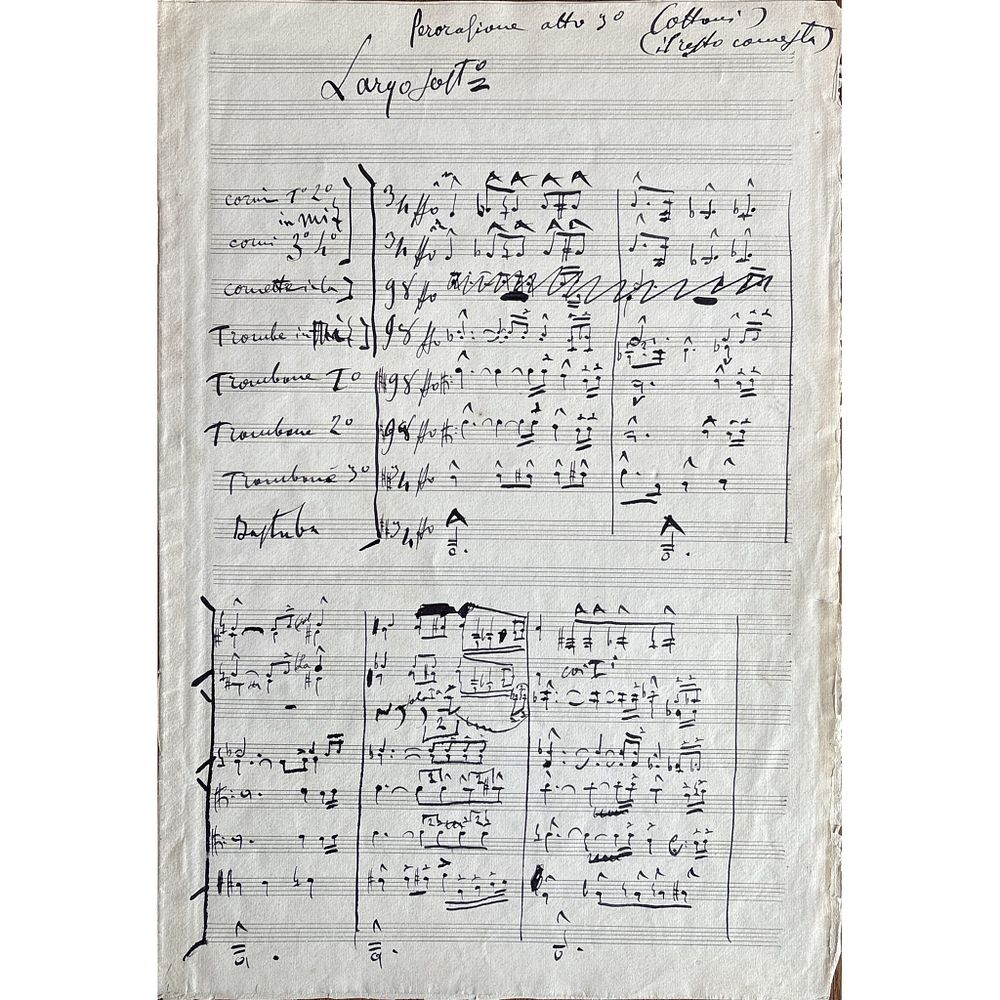
[MUSIC] - PUCCINI Giacomo (1858 - 1924) - Recasting Edgar: Puccini’s Autograph Revision to the Brass Peroration of Act III - Autograph musical manuscript, revision to the end of Act III of Edgar, [early 1892] Autograph manuscript scored for brass, comprising 21 bars notated over two systems of eight staves, on three pages(380 x 258 mm), the first page headed in Puccini’s hand: “Perorazione atto 3o (ottoni) / (il resto come sta)”. Written on a bifolium with the second leaf tipped in and stitched; final leaf blank. The first trombone part, omitted from the preceding system, is supplied in an additional stave at the foot of p. 3. The last four bars, extended into the margin, are subsequently cancelled in blue pencil. Provenance: Musikantiquariat Schneider, Tutzing, catalogue 203 (1976), no. 75; also catalogue 300, no. 87. This arresting manuscript belongs to the long and difficult evolution of Edgar, Puccini’s second opera: a work whose problematic history makes surviving revision material especially revealing. Based on a libretto by Ferdinando Fontanaafter Alfred de Musset’s La Coupe et les lèvres, the opera stages the moral and emotional conflict of the knight Edgar, divided between Tigrana and Fidelia, opposing embodiments of sensuality and virtue. The premiere, given at La Scala on 21 April 1889, proved disappointing, and Puccini never ceased trying to rescue the score from its structural weaknesses. A first revision followed in 1890, but it was in autumn 1891 that the composer undertook the most radical rethinking of the work, reducing it from four acts to three in an effort to tighten its dramatic design. Even this did not settle the matter definitively: a further version would still be produced in 1905. The present manuscript is tied to the closing stages of that crucial second revision. Dieter Schickling dated it to “no later than early 1892”, plausibly identifying it as a correction made in the course of preparing the copyist’s score. In this respect, it is more than a mere fragment: it is a working witness to Puccini’s restless theatrical intelligence, capturing him in the act of rebalancing sonority, tension, and dramatic impact at one of the opera’s decisive moments. Particularly striking is the focus on the brass peroration, a passage clearly conceived to reinforce the end of Act III with greater force and definition. The manuscript preserves not only the substance of that intervention, but also the traces of further adjustment: the supplementary trombone stave, added to compensate for an omission, and the final bars thrust into the margin before being cancelled. Such details bring the composer’s workshop vividly to life, allowing us to observe revision not as an abstract concept but as a physical and musical process unfolding on the page. Autograph revision manuscripts of this kind occupy a special place within Puccini material. They illuminate the distance between first conception and performed form, and in the case of Edgar—a score to which the composer returned repeatedly, with unusual dissatisfaction—they offer unusually direct insight into his self-critical creative method. This leaf therefore stands not only as an autograph survival from Puccini’s early maturity, but as eloquent evidence of his determination to reshape a problematic opera in pursuit of stronger dramatic truth. Reference: Dieter Schickling, Catalogue (1993), pp. 155–173, no. 62.B.4. •> This lot is located in and ships from the UK. A UK export license is required prior to shipment. Import duties and taxes in the destination country are the buyer's responsibility.