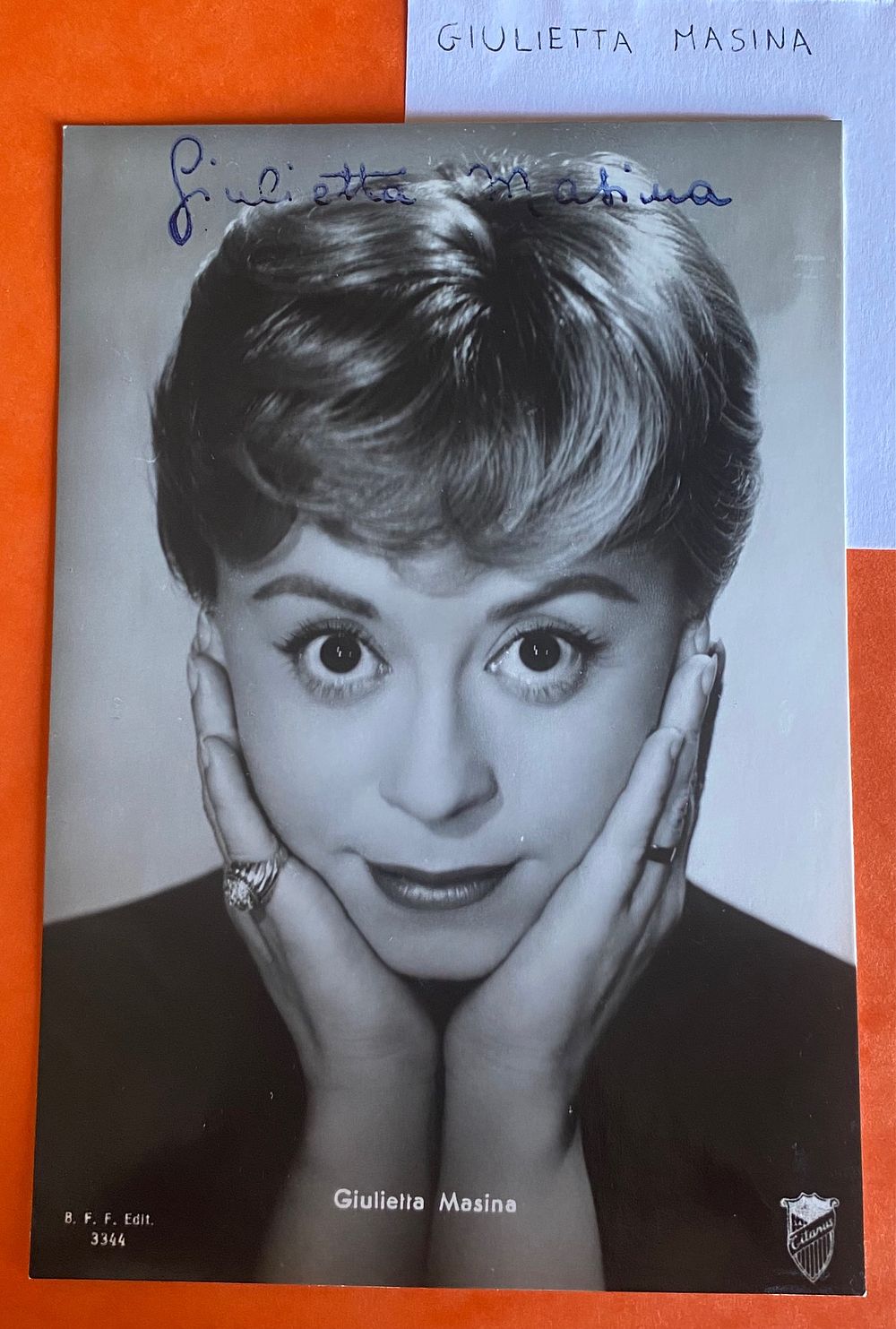
Bidspirit auction | GIULIETTA MASINA - FOTO CON
GIULIETTA MASINA - FOTO CON AUTOGRAFO - Giulia Anna Masina, known as Giulietta (San Giorgio di Piano, February 22, 1921 - Rome, March 23, 1994), was an Italian actress. Considered one of the best female actresses in the history of cinema, she left an indelible mark on the history of Italian cinema especially thanks to her great performances in the films directed by her husband Federico Fellini, in particular La Strada and Le notti di Cabiria. During her long career she won numerous awards including a David di Donatello (plus two special ones), four Nastro d'argento, a Globo d'oro, the award for best female performance at both the Cannes Film Festival and the San Sebastián Film Festival and an honorary award at the Berlin Film Festival; to these are also added two nominations for the BAFTA awards as proof of the success she also had abroad; Charlie Chaplin said of her ”she is the actress I admire the most”. Daughter of the violinist and music professor Gaetano Masina and the teacher Angela Flavia Pasqualini, she lived from the age of four in Rome with a widowed aunt of Milanese origin. She attended the gymnasium and the high school of the Ursoline Sisters, where, encouraged by her aunt, she began to cultivate a passion for acting. From the 1941-1942 season she participated in numerous prose, dance and music shows at the University Theatre in the premises of the Stadium Urbis, which later became the Teatro Ateneo. In the following season (1942-1943) she joined the Compagnia del Teatro Comico Musicale, where she performed as a dancer, singer and actress in various operettas and brilliant comedies. In 1942 Masina met Federico Fellini in the EIAR studios. Already in July 1943 the couple introduced themselves to her parents. After September 8, 1943, their union accelerated: Fellini, instead of answering the call to military service, married Giulietta on October 30. In the first few months, they lived together in the house of his wife's Milanese aunt. In the meantime, their artistic partnership was already underway: in 1942, the young literature student, as well as an actress, played the character of Pallina, first Cico's girlfriend and then his child wife. The young couple's misadventures were broadcast in the radio magazine Terziglio, to resume after the war in an independent series entitled Le avventure di Cico e Pallina, interrupted after fourteen episodes in February 1947. Masina and Fellini had a son, Pier Federico, born on March 22, 1945 and died just eleven days after birth, on April 2. From 1968 to 1976 she had a column in La Stampa, Risponde Giulietta Masina, part of the weekly page Cronache per le donne (for which Alba de Céspedes was responsible). A selection of answers given to readers was included in the volume Il diario degli altri. Aside from the role of an extra that she played in Roberto Rossellini's masterpiece, PAISA' (she is a girl who goes down the stairs of a building), Giulietta Masina made her film debut in 1948 in a film directed by Alberto Lattuada, Senza pietà, where she played, alongside Carla Del Poggio, the role of the small-looking and kind-hearted socialite who would accompany her for a good part of her career in films directed by Carlo Lizzani, Giuseppe Amato and Renato Castellani. But it was with her husband that she achieved worldwide fame with the role of Gelsomina in the film La strada (1954), where she acted alongside Anthony Quinn and Richard Basehart, and then with Il bidone (1955), with Broderick Crawford and Basehart again, without forgetting the first film directed by Fellini with Lattuada, Luci del varietà (1950), again with Carla Del Poggio and Peppino De Filippo. In 1957 she probably reached the peak of her career in the role of Cabiria in the film Le notti di Cabiria (which she had already tackled to a small extent in the first film directed by her husband, Lo sceicco bianco in 1951). In 1958 she played a moving female character in Fortunella directed by Eduardo De Filippo, with Alberto Sordi (dramatic role of the second-hand dealer) and De Filippo himself. In the same year Nella città l'inferno by Renato Castellani in which you can see her acting alongside Anna Magnani. Fellini directed her again in his first color film, Juliet of the Spirits (1965) together with Mario Pisu and, twenty years later, in the melancholic Ginger and Fred (1985) right next to Marcello Mastroianni, in the part of two former tap dancers very popular during the war with the stage name borrowed from the famous Fred Astaire and Ginger Rogers, invited to the dazzling and magniloquent television show And here you are..., a sample of various humanity shown as a freak show sacrificed to the needs of the audience and obsessively interrupted by commercials. In 1969, with the role of Gabrielle and included in a rich cast led by Katharine Hepburn, she participated in the bizarre Hollywood film The Madwoman of Chaillot by Bryan Forbes and John Huston. On television in the 1970s,