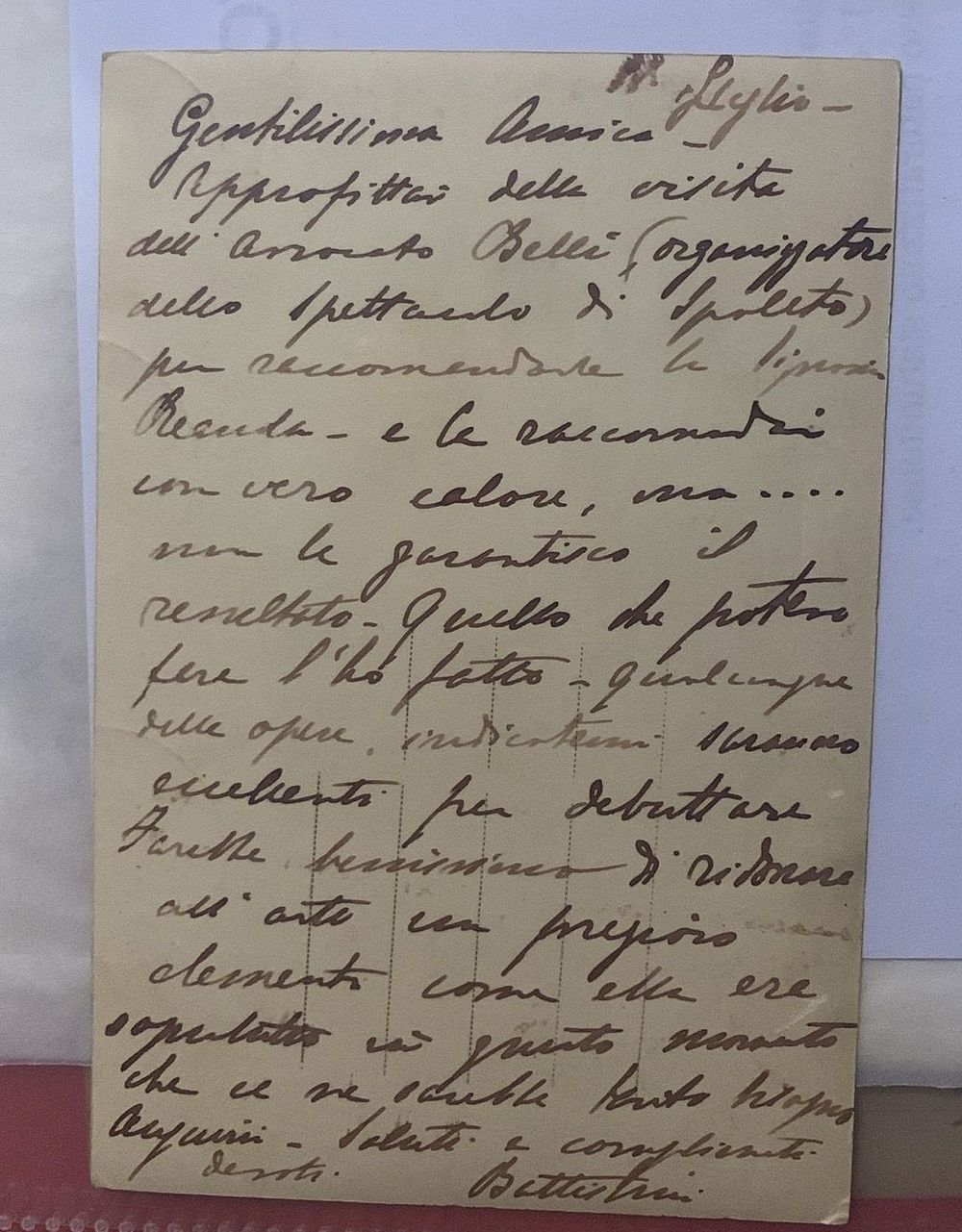
Bidspirit auction | MATTIA BATTISTINI - HANDWRITTEN LETTER
MATTIA BATTISTINI - HANDWRITTEN LETTER - Mattia Battistini (Rome, February 27, 1856 – Contigliano, November 8, 1928) was an Italian baritone. Biography He was born in Rome on February 27, 1856, to Luigi, a doctor, and Elena Tomassi; he spent his childhood in the family villa at the foot of the village of Collebaccaro, then a municipality and today a hamlet of Contigliano. He began his singing studies at a very young age under the guidance of Venceslao Persichini (also teacher of Titta Ruffo and Giuseppe de Luca); enrolled in the faculty of medicine, he abandoned his studies and devoted himself entirely to singing, making his debut as Alfonso XI in La favorita by Gaetano Donizetti at the Teatro Argentina in Rome as early as 11 December 1878. In May 1879 he sang in the world premiere of L'assedio di Cesarea by Giuseppe Persiani at the Teatro Marrucino in Chieti and in December 1880 Simar in the world premiere of La regina del Nepal by Giovanni Bottesini conducted by Carlo Pedrotti with Francesco Navarrini at the Teatro Regio in Turin where in March 1881 he was Enrico Ashton in Lucia di Lammermoor conducted by Pedrotti with Navarrini. Thus began a brilliant career that led him to sing in the main Italian theatres as first baritone in numerous repertoire operas, including La forza del destino, Rigoletto, Il trovatore, Gli ugonotti, I puritani, Lucia di Lammermoor. In 1881 the doors of international theaters opened for Battistini: first in South America (Buenos Aires and Rio de Janeiro), in the two-year period '82/'83 in Spain (Madrid and Barcelona), from 1883 in London where he received great acclaim in La traviata and Il trovatore, and then Vienna, Paris and Budapest. In 1884 in Turin directed by Franco Faccio he was Alfonso XI in La favorita with Giuseppina Pasqua and Sir Riccardo in I puritani. In 1885 at the Teatro Costanzi in Rome directed by Edoardo Mascheroni he was Don Carlos in Ernani, Enrico di Chevreuse in Maria di Rohan, Renato in Un ballo in maschera and Rigoletto. On July 7 of the same year he was affiliated as a Master Mason in the Loggia Universo in Rome, belonging to the Grand Orient of Italy. In 1888 he was again in Buenos Aires for a series of engagements, but due to a sort of phobia of sea travel he never went overseas again. In 1892 in Rome he was Simon Boccanegra conducted by Mascheroni with Hariclea Darclée and Giovanni Battista De Negri and Gianni Rantzau in the world premiere of I Rantzau by Mascagni conducted by Rodolfo Ferrari with Fernando De Lucia and Darclée at the Teatro La Pergola in Florence and conducted by the composer in Rome. From 1892 onwards he was a guest and undisputed star of Russian opera production for 23 consecutive seasons (until 1916); in fact, he became the favourite singer of the Tsar and the Russian aristocracy, a condition that earned him the legendary title of ”King of baritones and baritone of kings”. In 1902 he performed in St. Petersburg in Jules Massenet's Werther in the title role, originally written for tenor, specially adapted for him to the baritone register by the French composer, such was the prestige of the Italian singer. In 1893 at the Teatro San Carlo in Naples he sang in Crispino e la comare (opera) with Darclée and De Lucia. In 1906 at the Royal Opera House, Covent Garden in London he was the title role in Eugenio Onegin (opera) directed by Cleofonte Campanini with Emmy Destinn and Marcel Journet and in 1907 in Rome directed by Ferrari he was Valentino in Faust, Werther with Gemma Bellincioni and Atanaele in Thaïs (opera) with Carmen Melis also sung in Naples in 1908. In 1910 at the Teatro Regio in Parma he was Enrico di Chevreuse in Maria di Rohan directed by Vittorio Gui. He continued his career until he was 70 (1927) thanks to a technique considered prodigious and an enviable artistic intelligence. Undisputed heir of the ”sweet” vocality of Antonio Tamburini, Battistini was accustomed to dampening the vocal impulses derived from Ronconi and very evident in Titta Ruffo in a sweet elegance made of whispered proportions. Still valid today, as a testimony of that taste, are the records of opera arias and salon romances in which Battistini's clear and luminous timbre (almost tenor to our ears) is supported by broad winds and chiaroscuro affectations typical of an elegant and mannered singing now disappeared. He died on November 7, 1928 of heart failure in his villa in Collebaccaro, where he had retired to private life; a branch of the Conservatory of Santa Cecilia in Rome has now been established in Villa Battistini. PRECIOUS HANDWRITTEN LETTER.