Bidspirit auction | Extremely Rare London-Printed Standalone Yiddish/Hebrew
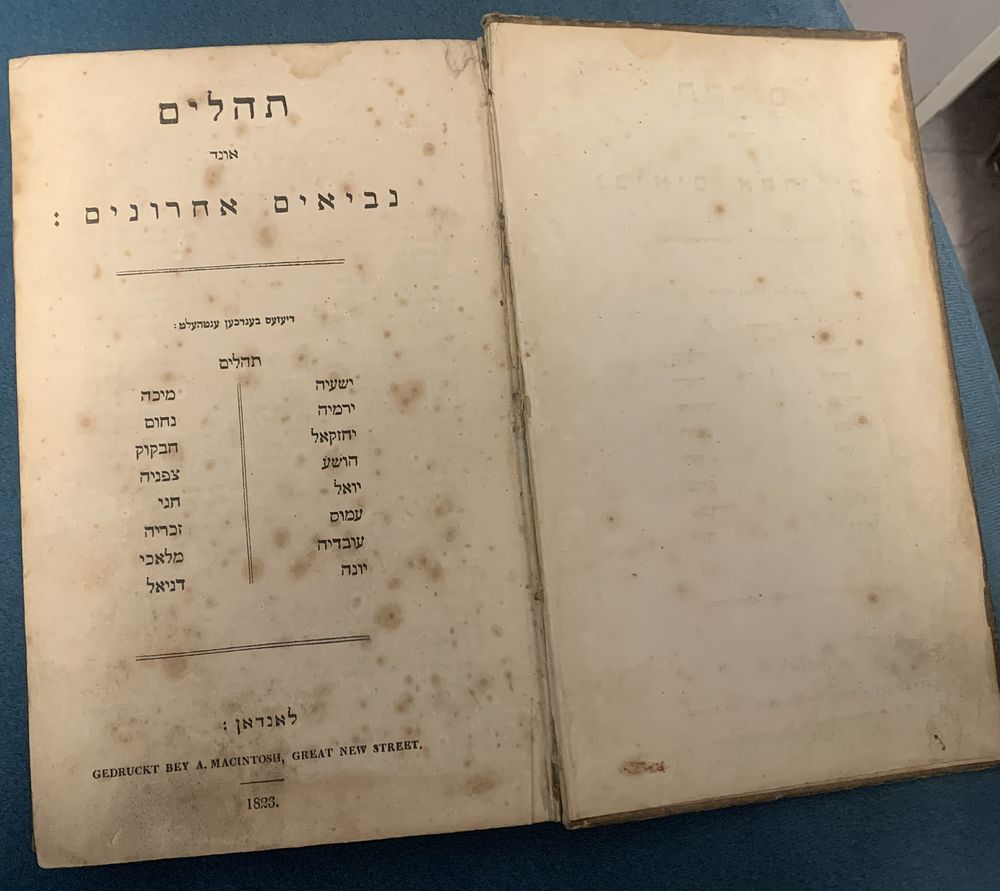
Extremely Rare London-Printed Standalone Yiddish/Hebrew Book (Tehillim & Prophets) — 1823 - A historic 19th-century volume printed in London, featuring the full text of Psalms and the Latter Prophets, uniquely rendered in Yiddish and Rashi Script. Important Standalone Publication: Crucially, this work was issued by the publisher entirely as a standalone, dedicated volume. It is not a stray volume broken off from a complete Tanakh (Hebrew Bible) set, nor was it ever part of a multi-volume series. It was explicitly printed and bound in this exact self-contained format for targeted devotional study and prayer. Content: Contains the complete Book of Psalms (Tehillim / תהלים) followed by the Latter Prophets (Nevi'im Acharonim / נביאים אחרונים): Isaiah, Jeremiah, Ezekiel, and the Twelve Minor Prophets. The volume features prominent internal section title headers, such as The Prophecy of Isaiah (דיא פראפעטען – דער פראפעט ישעיהו) and The Prophecy of Jeremiah (ירמיה א), separating the sacred texts. Print Origin & Date: Printed in London in the year 1823, as noted on the title page: ”Gedruckt Bey A. Macintosh, Great New Street” (Printed by A. Macintosh, Great New Street). Language & Script: The primary text and commentary are rendered in Yiddish (Ivri-Teitch or Judeo-German), written using a distinctive, clear Rashi Script typeface. This layout was highly popular for devotional books intended for broad community readership among Yiddish-speaking Jewish immigrants residing in London in the early 1800s. Rarity: Finding an early 19th-century London imprint explicitly targeted at Yiddish-speaking Anglo-Jewry is uncommon. Its survival as a complete, intentionally standalone single-volume printing makes it an exceptionally scarce find for collectors of antique Anglo-Jewish literature and European Judaica. Provenance: The front endpaper bears a distinct, original handwritten ink ownership inscription reading ”W. Dutch” paired with the early date of ”November 14, 1839”, establishing an early, documented history just 16 years after its publication.