Bidspirit auction | Historic 1872 Rabbinic Halachic Folio
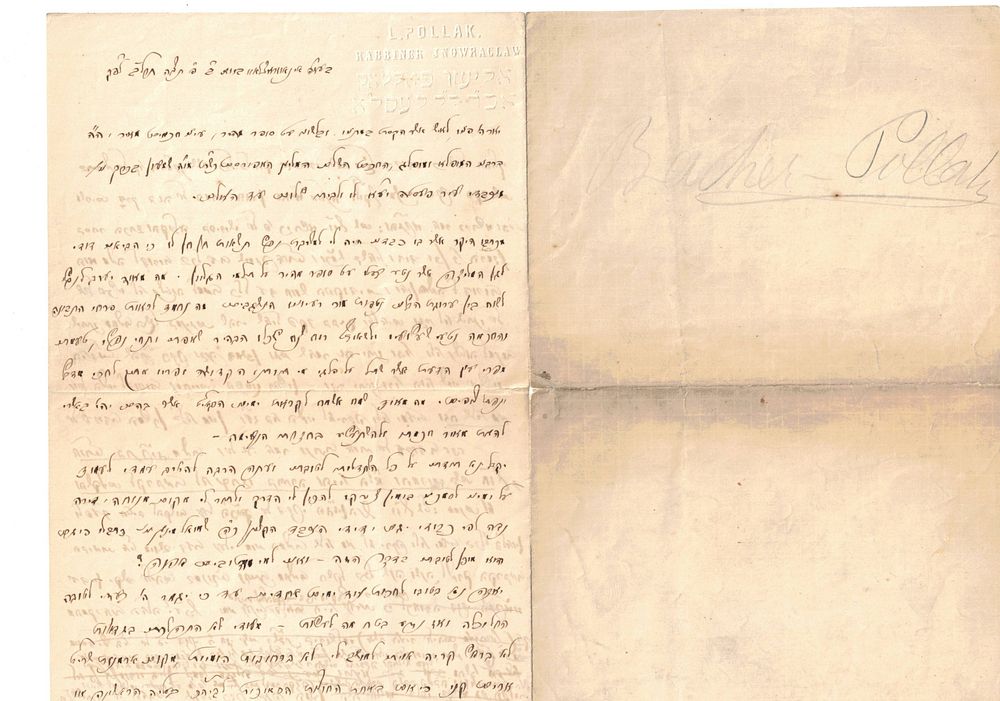
Historic 1872 Rabbinic Halachic Folio with Standalone Insert Leaf – Rabbi Eliezer Pollak to the Communal Dignitary Shimon Bacher of Pest (Budapest), Hungary (Dated תרל”ב) - A highly important, structurally fascinating primary rabbinic manuscript from the late 19th century, capturing the elite halachic and communal networks of the Hungarian capital just prior to the official unification of Budapest. Overview & Structural Elements: A massive and extensive legal response (Teshuvah) and Torah commentary spread across a four-panel folded folio sheet plus an additional matching standalone insert page. Written entirely in a dense, beautiful European rabbinic cursive script, it is explicitly dated within the text to the year 5632 (תרל”ב / 1872). The Author: Rabbi Eliezer Pollak (הגאון רבי אליעזר פולק זצ”ל), a preeminent halachic authority in Hungary who served as a leading rabbinic figure and judge (Rosh Av Beit Din) in the unified capital. The Recipient: The letter is formally addressed to Shimon Bacher / Bachrach (ר' שמעון בכרך / באכער), a highly prominent, wealthy intellectual and community leader among the elite dignitaries of Pest (פעסט / Budapest). The Content: The manuscript opens with warm expressions of gratitude to Bacher for his diligent communal interventions (”השתדלות”). It then transitions immediately into a massive, highly sophisticated multi-page analytical commentary unpacking complex halachic concepts and Torah interpretations, requiring an entire extra standalone leaf to conclude the treatise. Per professional standards, the advanced body text is offered untranscribed. Collector's Highlight: Pristine Multi-Leaf Postal Structure: This piece is a stellar artifact showcasing historical Jewish postal practices before the modern use of envelopes. Rabbi Pollak utilized a single large sheet, writing on the inner columns, adding an extraordinary standalone sheet in the middle to complete his thoughts, and leaving the inverse outer panels blank. When folded down, the outer layer served as the self-enclosing wrapper, bearing a large, bold contemporary cursive delivery notation identifying the two historic families: ”Bacher-Pollak”.