Bidspirit auction | Author’s Presentation Copy: Sefer Kol
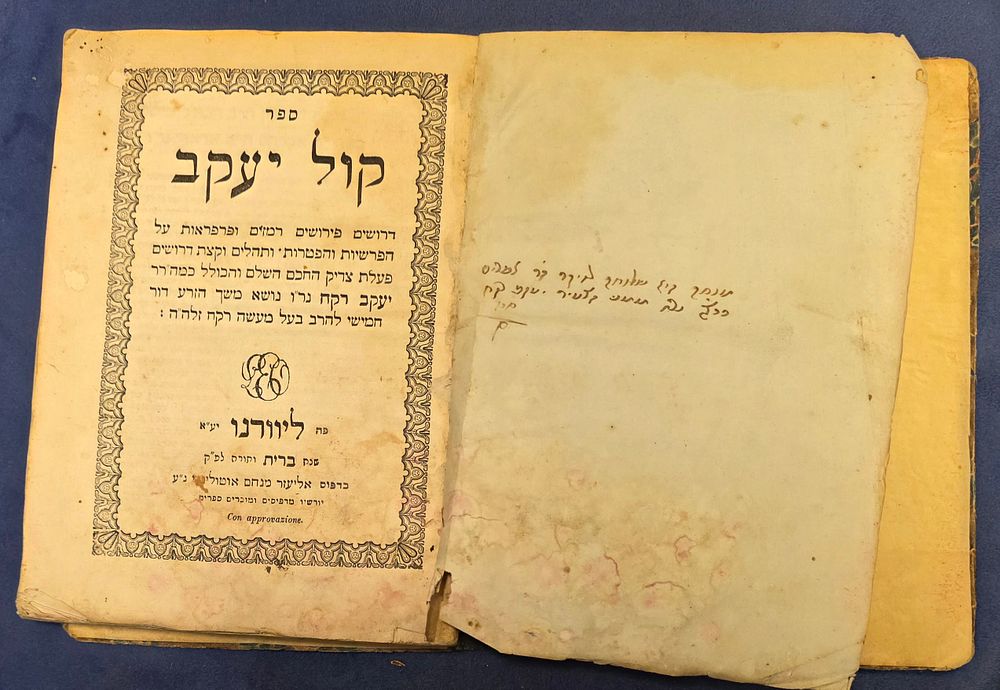
Author’s Presentation Copy: Sefer Kol Yaakov by Rabbi Yaakov Rakach – First Edition, Livorno 1852. Highly Important Tripoli (Libyan) Judaica. - A premier collector's item of North African rabbinic heritage: a rare First Edition of Sefer Kol Yaakov, featuring a personal handwritten gift presentation by the author, the legendary sage of Tripoli, Rabbi Yaakov Rakach. The Masterpiece & Author: Sefer Kol Yaakov is the foundational homiletic work of Rabbi Yaakov Rakach (1800–1891), one of the supreme Torah giants, halakhic decisors, and liturgical poets of Libyan Jewry. Renowned for his extraordinary piety, he founded the famous Rabbi Yaakov Yeshiva in Tripoli and supported himself modestly as a bookkeeper so his Torah output remained completely pure. This work contains profound allegorical, numerical, and halakhic insights (Derushim, Remazim, u-Parpara'ot) on the weekly Torah portions. The Author's Autograph Presentation: Visible clearly in the accompanying images, the page facing the title page contains a beautifully preserved presentation inscription penned in a classic North African/Sephardic cursive rabbinic hand. The text reads: ”מנחה היא שלוחה להיקר אפרים פאנו [או פראנקו / פרג'ון]... ממני הצעיר יעקב רקח ח[זק]”(“A gift sent to the dear Ephraim Fano [or Franco / Fargion]... from me, the young Yaakov Rakach, [may he be strengthened]”). Using standard rabbinic modesty, he signs as ”הצעיר” (the small/young). The recipient, Ephraim, bears a prominent surname deeply linked to the historical Livorno-Tripoli rabbinic and mercantile axis. A Rare First Edition: This volume represents the true first printing of the work, published in Livorno in 1852 (chronogram: ”שנת ברית ותורה לפ”ק”) at the celebrated printing house of Eliezer Menachem Otolenghi's heirs, as proudly displayed on the ornamental title page Historical Rarity: Presentation copies from 19th-century Libyan rabbinic authorities are exceptionally scarce on the market, as a tragic amount of the community's ancestral libraries were destroyed during WWII air raids and subsequent regional instability.