Bidspirit auction | An important 17th-century Flemish tapestry
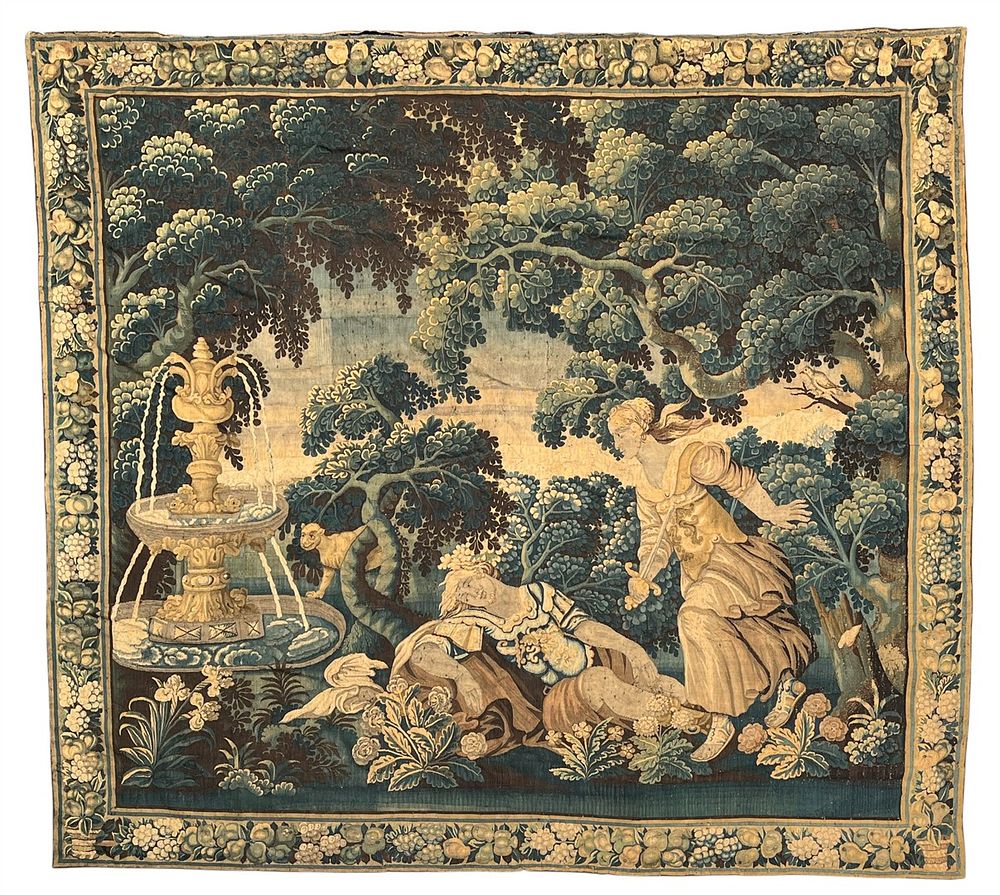
An important 17th-century Flemish tapestry depicting Pyramus and Thisbe. Origin: Princess Helena (Helena Augusta Victoria; 25 May 1846 – 9 June 1923). Daughter of Queen Victoria, Royal Lodge Windsor Park. (according to a label on the back). Story: Ovid; Liber IV, verses 55-166. Pyramus, one of the most beautiful boys, and Thisbe, one of the most beautiful girls in the East, are in love. The fact that they are neighbors only reinforces this. They would like to marry, but their fathers forbid it. However, during construction, a gap appeared between the two adjoining houses, and through this gap the lovers can communicate. One day, the two young people decide to meet at night at Ninus's grave in the shade of a mulberry tree. Thisbe goes to the appointed place and sits in the shade of the tree, but then she sees a lioness quenching her thirst in a nearby spring. The lioness has a bloody mouth from a recent cattle slaughter. The girl flees to a cave, and as she flees, she loses her veil. The lioness steps on the veil and tears it with her bloody mouth. When Pyramus arrives at the mulberry tree, he sees the lioness's tracks in the loose sand and, a little further away, Thisbe's bloody veil. Pyramus concludes that Thisbe has been eaten by the wild animal and decides to end his life, unable to continue living without Thisbe and filled with a terrible sense of guilt. He blames himself for not having arrived at the appointed place sooner. He falls on his sword and dies. When Thisbe returns from the cave and tries to return to the mulberry tree, she doesn't recognize it at first, because its fruit is discolored by Pyramus' blood. Later, she sees her beloved lying dead on the ground. Desperate, she too decides she cannot live without her eternal love, places the sword, still lukewarm from the previous killing, under her ribs, and throws herself at it. Later, after the two dead lovers are found, they are placed together on the pyre, and their parents place their ashes in a single urn to fulfill their desire to be together. 260 x 280 cm. - An important 17th-century Flemish tapestry depicting Pyramus and Thisbe. Origin: Princess Helena (Helena Augusta Victoria; 25 May 1846 – 9 June 1923). Daughter of Queen Victoria, Royal Lodge Windsor Park. (according to a label on the back). Story: Ovid; Liber IV, verses 55-166. Pyramus, one of the most beautiful boys, and Thisbe, one of the most beautiful girls in the East, are in love. The fact that they are neighbors only reinforces this. They would like to marry, but their fathers forbid it. However, during construction, a gap appeared between the two adjoining houses, and through this gap the lovers can communicate. One day, the two young people decide to meet at night at Ninus's grave in the shade of a mulberry tree. Thisbe goes to the appointed place and sits in the shade of the tree, but then she sees a lioness quenching her thirst in a nearby spring. The lioness has a bloody mouth from a recent cattle slaughter. The girl flees to a cave, and as she flees, she loses her veil. The lioness steps on the veil and tears it with her bloody mouth. When Pyramus arrives at the mulberry tree, he sees the lioness's tracks in the loose sand and, a little further away, Thisbe's bloody veil. Pyramus concludes that Thisbe has been eaten by the wild animal and decides to end his life, unable to continue living without Thisbe and filled with a terrible sense of guilt. He blames himself for not having arrived at the appointed place sooner. He falls on his sword and dies. When Thisbe returns from the cave and tries to return to the mulberry tree, she doesn't recognize it at first, because its fruit is discolored by Pyramus' blood. Later, she sees her beloved lying dead on the ground. Desperate, she too decides she cannot live without her eternal love, places the sword, still lukewarm from the previous killing, under her ribs, and throws herself at it. Later, after the two dead lovers are found, they are placed together on the pyre, and their parents place their ashes in a single urn to fulfill their desire to be together. 260 x 280 cm.