Bidspirit auction | Princess Charlotte of Prussia, Granddaughter
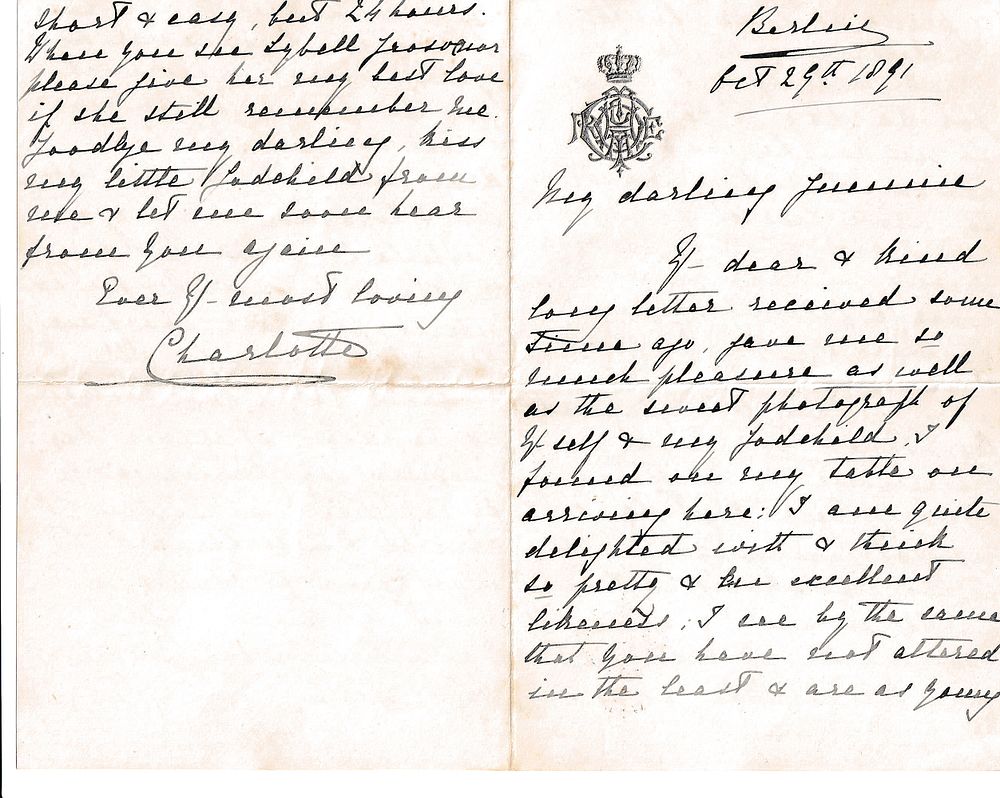
Princess Charlotte of Prussia, Granddaughter of Queen Victoria and Sister of Kaiser Wilhelm II – Personal Autograph Letter to Lady Guendolen Little, Daughter of the 19th Earl of Shrewsbury – Referring to Victoria, Princess Royal and Her Young Goddaughter – Berlin, 1891 – With Original Envelope - An extensive and highly personal autograph letter signed by Princess Charlotte of Prussia (1860–1919), daughter of Emperor Frederick III and Victoria, Princess Royal (“Vicky”), eldest daughter of Queen Victoria and Prince Albert. Charlotte was therefore a granddaughter of Queen Victoria and sister of Kaiser Wilhelm II, the last German Emperor. Written from Berlin, February 1891, to Lady Guendolen Theresa Little, née Chetwynd-Talbot, daughter of Charles Chetwynd-Talbot, 19th Earl of Shrewsbury, and wife of Major Archibald Cosmo Little. Lady Guendolen belonged to the upper aristocratic and court circles of Victorian Britain; Major and Lady Guendolen Little are recorded among guests attending royal society events of the period. Charlotte opens affectionately: “My darling Gwendoline” and thanks her for a long and kind letter. She writes with pleasure of receiving a photograph of Lady Guendolen and her daughter, commenting warmly upon the child's appearance and observing: “little Charlotte seems to be a great darling.” The letter reveals a particularly close personal connection between the families: Charlotte refers to Lady Guendolen's young daughter as: “my little godchild” and towards the conclusion asks Guendolen to kiss the child for her. The goddaughter was apparently Charlotte Theresa Orme Little, daughter of Lady Guendolen and Major Archibald Cosmo Little. Charlotte also writes candidly about her own health, describing herself as having been unwell and referring to physical complaints and treatment which she characterizes as “very painful & tiresome.” She mentions her susceptibility to colds and comments upon the weather in Berlin, providing an intimate glimpse into the Princess's private health and daily life. Of particular dynastic interest is Charlotte's reference to her “dear mother” – Victoria, Princess Royal, eldest daughter of Queen Victoria and widow of Emperor Frederick III. Charlotte expresses concern at hearing that her mother had been unwell and hopes that she has recovered. The letter thus contains a direct and affectionate contemporary reference to Vicky, one of the central figures linking the British and German royal houses. Charlotte also refers to her husband Bernhard, the future Bernhard III, Duke of Saxe-Meiningen, in connection with travel plans and the possibility of returning to England and seeing her friend again. Towards the end of the letter Charlotte sends affectionate messages to Lady Guendolen's husband, asks her to kiss “my little godchild” on her behalf, and requests that she write again soon. She concludes: “Ever yr. most loving / Charlotte” with her prominent full signature “Charlotte.” Accompanied by the original envelope sent from Berlin to England, addressed to: Lady Guendolen Little Roosdike Barford Warwick England retaining two Reichspost 10 Pfennig postage stamps and Berlin postal cancellations. The reverse bears Princess Charlotte's attractive coloured crowned royal monogram, together with an early pencil annotation. A substantial and intimate royal letter documenting the friendship and godparent relationship between a granddaughter of Queen Victoria and a member of a prominent British aristocratic family, with references to Victoria, Princess Royal, Bernhard of Saxe-Meiningen, Lady Guendolen Little and her daughter Charlotte. Dimensions: Each page approx. 17.5 × 11 cm. The letter comprises 4 pages, all handwritten by Princess Charlotte of Prussia, concluding with her clear full signature “Charlotte.” Original envelope: approx. 12.3 × 9.8 cm, addressed to Lady Guendolen Little at Barford, Warwick, retaining two Reichspost 10 Pfennig postage stamps, Berlin postal cancellations and Princess Charlotte’s coloured crowned royal monogram to the reverse.