Bidspirit auction | 1816 – Early Diving History:
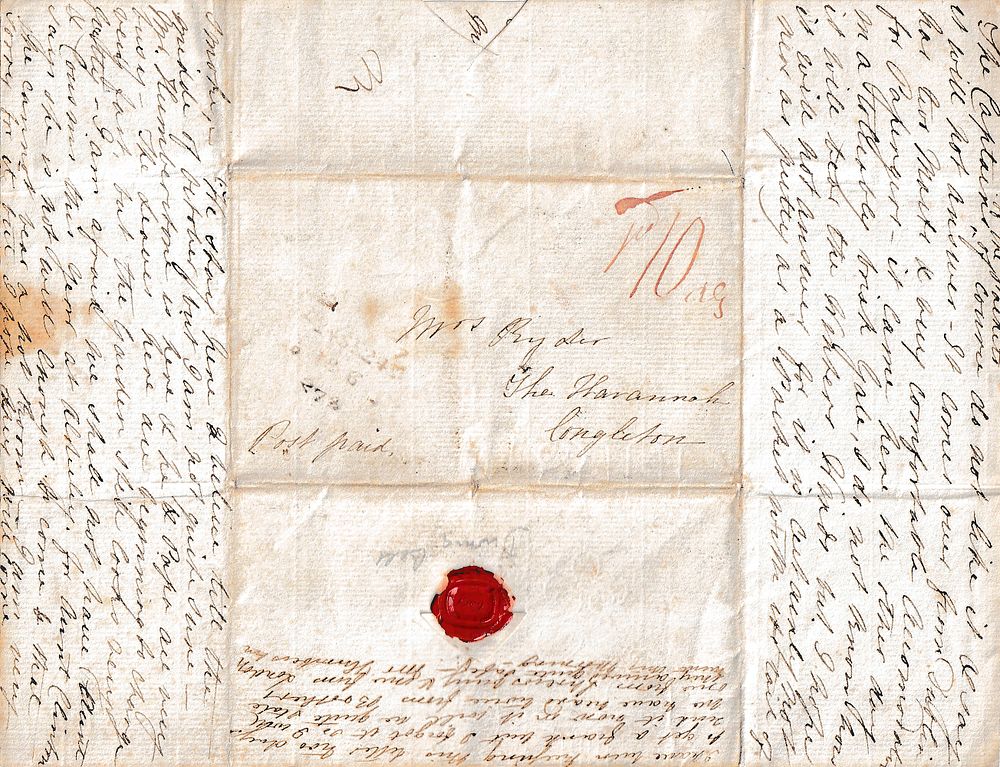
1816 – Early Diving History: Rare First-Hand Letter Describing a Descent in a Diving Bell during Maritime Works in the Anglesey–Holyhead Area + Contemporary Technical Engraving of Early Diving Bells and Apparatus - An exceptional early nineteenth-century lot relating to the history of diving and underwater engineering, comprising a long and densely written 1816 letter containing a first-hand account of an actual descent beneath the sea in a Diving Bell, together with a contemporary technical engraving illustrating several pioneering diving bells and early diving apparatus. The letter was sent from the Anglesey area of Wales to the writer's mother, Mrs. Ryder, at Congleton. The writer gives a lengthy account of his stay, companions, travels and experiences, devoting a substantial section to the remarkable experience of descending beneath the water in a Diving Bell during maritime and engineering activity in the area. A First-Hand Account of a Diving Bell Descent The writer describes the construction of the apparatus, explicitly stating: “The diving Bell is made of iron & can hold conveniently 4 people…” He explains that the bell could comfortably accommodate four persons and, under certain circumstances, as many as six. He proceeds to describe the machinery and operation of the apparatus, noting that the machinery was positioned upon a scaffold above the bell, and emphasizes his confidence in its safety. The writer also records the depth of the water: “Water the sea is about 13 feet deep…” Of particular interest is his description of the physical experience of descending beneath the surface. He notes that some people became sick or uncomfortable when going down, whereas he himself states: “I felt no inconvenience … at all.” This is therefore not merely a theoretical description of early diving technology, but an early first-hand account by an individual who actually descended beneath the sea in a diving bell and recorded its construction, capacity, operating arrangement, water depth and the physical experience of the descent. Maritime Engineering Context The letter refers to the Anglesey / Holyhead area and to maritime activity associated with works in the region. During this period diving bells were becoming increasingly important tools in underwater engineering, permitting inspection and work upon harbour beds, foundations, masonry and pier construction. The date 1816 places the letter at an early and important stage in the practical development and application of diving technology to civil and maritime engineering. The writer additionally refers to Holyhead, a Steam Boat, local travel and numerous other contemporary details, giving the letter considerable interest beyond its principal diving content. Postal History Interest Towards the conclusion, the writer remarks that he had retained the letter for two days while attempting to obtain “a frank”, which would have permitted it to be sent free of postage, but ultimately decided to send it without one. Correspondingly, the exterior bears a red manuscript “1/0” postal rate marking, representing one shilling, together with additional contemporary postal markings. This creates an attractive direct connection between the contents of the letter and the surviving postal history of the document itself. Accompanying Technical Engraving The lot also includes a large contemporary technical engraving headed: “HYDRAULICS – DIVING BELL – PLATE II” illustrating in considerable detail several important early diving devices, including: Dr. Halley’s Diving Bell; Spalding’s Diving Bell; Klingert’s Diving Machine, an important early form of individual diving apparatus; and a Section of Triewald’s Diving Bell. The engraving provides an excellent contemporary technological context for the experience described in the letter, illustrating the various methods developed by the early nineteenth century to enable human beings to descend, remain and work beneath the surface of the water. A rare and fascinating historical lot combining an early first-hand diving-bell account, nineteenth-century underwater and maritime engineering, Anglesey and Holyhead history, early steam navigation, postal history and a detailed contemporary technical engraving of pioneering diving apparatus. Dimensions: When fully opened, each page measures approx. 24 × 18.5 cm. The letter comprises 4 pages, all four handwritten. The accompanying technical engraving measures approx. 29.5 × 22.8 cm.