Bidspirit auction | Duke of Wellington – Signed
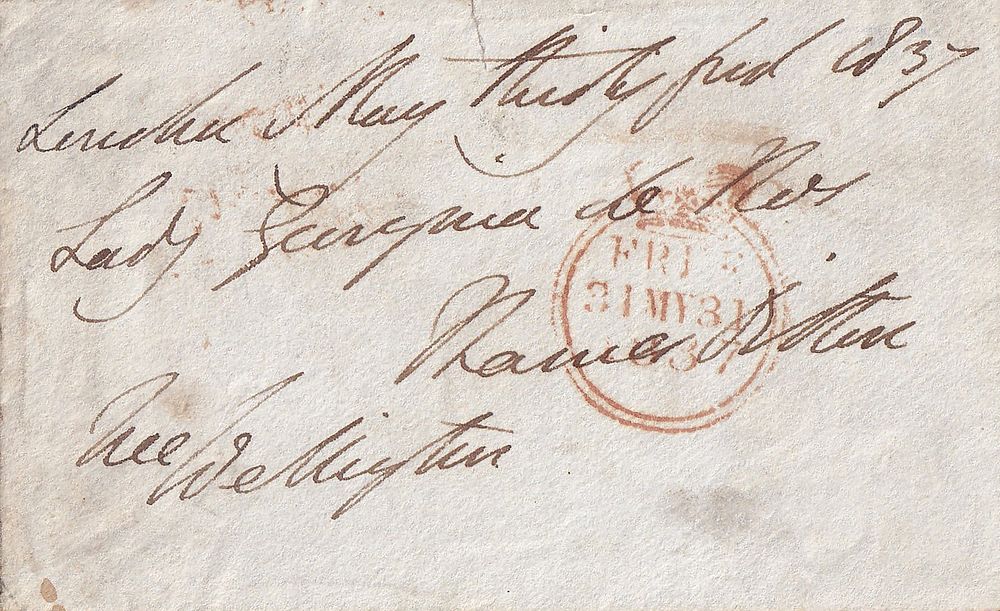
Duke of Wellington – Signed Free Frank Addressed to Lady Georgiana de Ros, Eyewitness to the Famous Ball on the Eve of Waterloo and a Close Friend of Wellington – London, 31 May 1837 - An original Free Frank / envelope front, dated 1837, handwritten and signed by Arthur Wellesley, 1st Duke of Wellington (1769–1852), the celebrated British field marshal, statesman and victor over Napoleon at the Battle of Waterloo. Wellington has inscribed the upper portion: “London May Thirty First 1837” while the lower portion bears his autograph franking signature: “Free Wellington.” The red postal cancellation is dated 31 MY 1837, corresponding with the date entered by Wellington himself. The Recipient – Lady Georgiana de Ros The cover is addressed to Lady Georgiana de Ros (1795–1891), née Lennox, daughter of Charles Lennox, 4th Duke of Richmond, and Charlotte, Duchess of Richmond. This association considerably enhances the historical interest of the item. Georgiana was a long-standing and close friend of Wellington, known within her family circle as “Georgy.” A substantial correspondence between Wellington and Georgiana survives, extending over several decades. Lady Georgiana is particularly remembered as an important eyewitness to the events immediately preceding the Battle of Waterloo. In Brussels in June 1815 she attended her mother's celebrated Duchess of Richmond's Ball, held on the eve of the Waterloo campaign. Georgiana later recalled approaching Wellington during the ball and questioning him about rumours of the French advance. Wellington confirmed that the army would depart the following day. She also sat beside the Duke at supper during the ball. Their personal association is further illustrated by an extraordinary surviving object: at the ball Wellington presented Georgiana with an original miniature portrait of himself. Christie's has documented the miniature and its provenance, together with Wellington's subsequent correspondence to Georgiana concerning the portrait. Lady Georgiana was therefore not merely a social acquaintance of Wellington, but a first-hand witness to the dramatic events surrounding Waterloo and a member of the Duke's close personal circle. Her later recollections became an important historical source for the events of June 1815. A particularly appealing piece of British postal and autograph history directly associating two individuals intimately connected with the story of Waterloo: the commander who defeated Napoleon and one of the best-known eyewitnesses to the famous ball immediately preceding the campaign.