Bidspirit auction | Battle of Waterloo, 1815 –
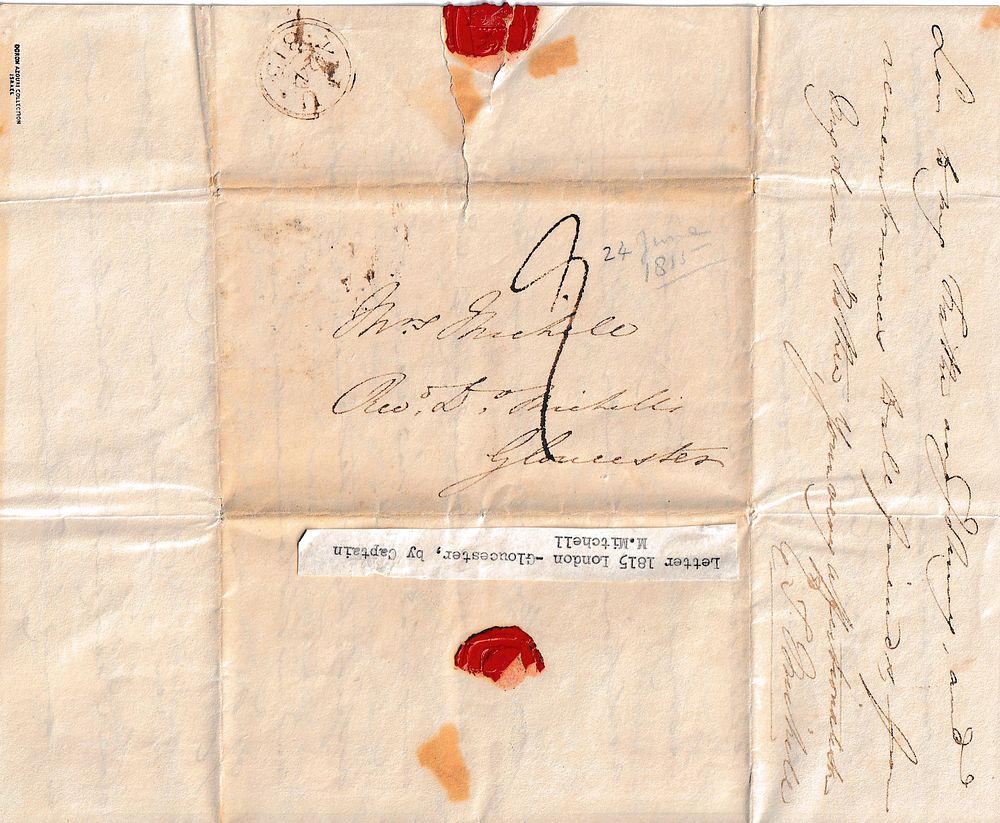
Battle of Waterloo, 1815 – Rare Family Letter Written Only Six Days after the Battle – First Reports of the Victory, Heavy Casualties and the British Artillery; Apparently Referring to Captain John Michell, Royal Artillery – London, 24 June 1815 - A remarkable and historically significant manuscript letter written from Leicester Square, London, on Saturday, 24 June 1815 – only six days after the Battle of Waterloo – recording the immediate reaction in London to the victory over Napoleon and the rapidly emerging scale of the casualties. Addressed to the writer's mother, Mrs. Michell, at Gloucester, the letter begins: “My dear Mother, I have waited in vain till the last moment for private letters, in order to give you the details of the late glorious victory…” The writer explains that he had delayed writing while awaiting private correspondence that might provide more reliable details of the recently won victory. He describes the battle as one of extraordinary importance, but immediately contrasts the triumph with its terrible human cost. Of particular interest is his reference to the British artillery: “the artillery were dreadfully exposed” and their losses as: “enormous and unexpected.” He adds poignantly: “I am sorry to say several of my friends are no more…” and discusses the large number of wounded, including men severely injured in the fighting. The writer criticizes the first published casualty lists as “wretchedly defective, ” indicating that they did not account for anything approaching the true number of killed and wounded. “John” and the Royal Artillery: One of the most historically intriguing passages concerns a family member or close associate named John, who had arrived late in Belgium. The writer expresses regret at his delayed arrival, but reflects that, considering the dreadful exposure and losses suffered by the artillery, the delay may ultimately have been fortunate. The biographical and family circumstances strongly suggest that this “John” was Captain John Michell (1781–1866) of the Royal Artillery, later General Sir John Michell, K.C.B. Michell was an experienced artillery officer of the Napoleonic Wars. Shortly before Waterloo he returned to Britain from service in North America and was immediately ordered to join Wellington's army in Belgium. He arrived too late to participate in the Battle of Waterloo itself, a remarkable correspondence with the writer's statement that “John” was late reaching Belgium and may consequently have escaped the devastating artillery casualties. John Michell had previously served in the Peninsular campaigns and southern France and subsequently in North America during the War of 1812, including the campaigns of Washington, Baltimore and New Orleans. London in the Immediate Aftermath of Waterloo: The letter vividly captures the extraordinary contrast between private grief and public celebration following Waterloo. The writer observes that there can have been few people in the Kingdom without some cause for lamentation over relatives, friends or acquaintances killed or wounded, while simultaneously emphasizing the immense importance of the victory to Britain and Europe. He describes the public mood as: “the general torrent of exultation” and refers to celebratory illuminations in London following news of the victory. The result is a compelling contemporary record of how Waterloo was experienced in Britain while casualty information was still incomplete and private reports from Belgium were only beginning to arrive. The letter concludes with affectionate family greetings and a signature appearing to read Michell. A particularly evocative Waterloo document combining an immediate contemporary reaction written only six days after the battle, discussion of the enormous casualties, specific reference to the severe exposure of the British artillery, personal friends among the dead and wounded, and an apparently direct family connection with Captain John Michell of the Royal Artillery. Dimensions: When fully opened, each page measures approx. 23 × 18.8 cm. The letter comprises 4 pages, all four handwritten.