Bidspirit auction | John Darkin – Autograph Letter
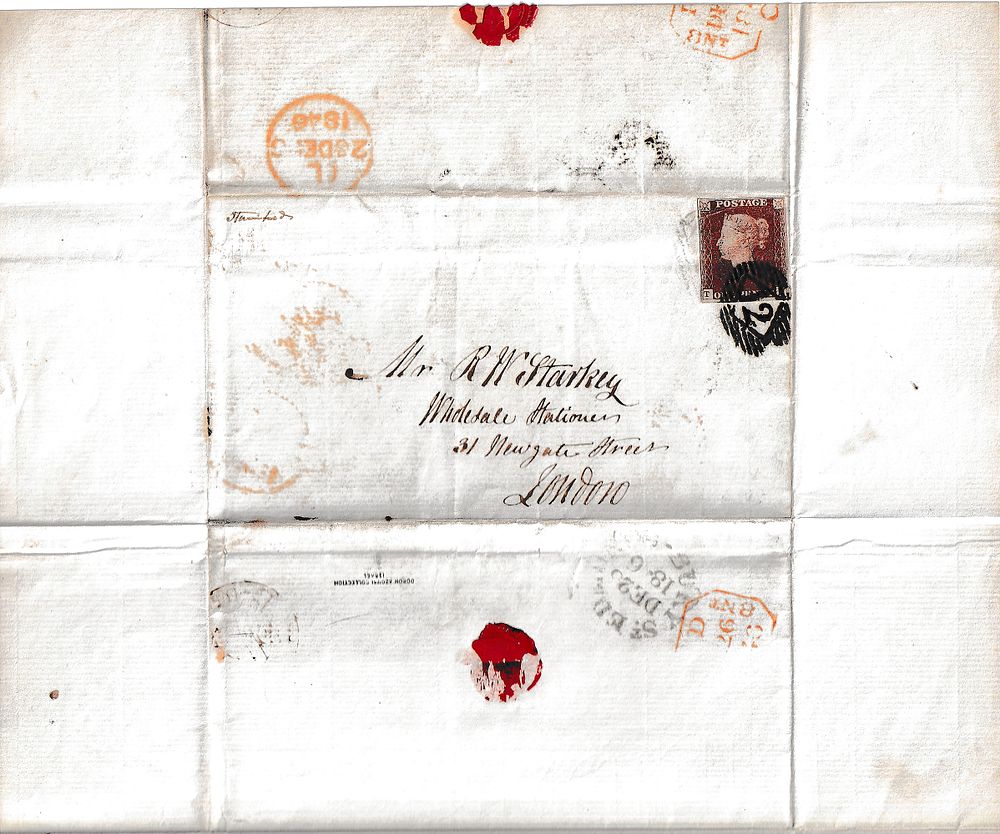
John Darkin – Autograph Letter with Original Architectural Drawing for the Entrance to Hengrave Hall – Written One Day after the Opening of the Railway to Bury St Edmunds – Sir Thomas Rokewode-Gage & Gunpowder Plot Connection – Christmas Day, 1846 - A fascinating signed autograph letter by John Darkin, a documented Bury St Edmunds builder, surveyor, stone and marble mason and architectural draughtsman, incorporating an original architectural drawing in his own hand for a new entrance to Hengrave Hall. Written from Westgate, Bury St Edmunds, on Christmas Day, 25 December 1846, the letter is addressed to his friend Mr. R. W. Starkey in London. Darkin begins by thanking Starkey for a Christmas gift: “Dear Starkey, Accept my thanks for the kind present of Oysters…” He then turns to two subjects of particular historical interest: the newly opened railway to Bury St Edmunds and his architectural work at Hengrave Hall. The Railway – Written One Day after Public Services Began Darkin discusses the excitement surrounding the new railway and its Passenger Trains, still a remarkable novelty to local residents. The date is particularly significant. The Ipswich–Bury St Edmunds line opened to public traffic on 24 December 1846 – only one day before this letter was written. Bury's permanent station was not yet complete, and a temporary station was being used; the permanent station opened the following year. Darkin writes: “We have a Railway here at present…” before commenting upon the new service and the facilities still lacking. The letter therefore constitutes an unusually immediate first-hand private account written on only the second day of public railway operation at Bury St Edmunds. John Darkin Contemporary records document John Darkin of Westgate Road, Bury St Edmunds, as a: “builder, surveyor & stone & marble mason.” His activities also extended to architectural drawing and design. The present manuscript provides particularly valuable primary evidence of this aspect of his professional work. Original Architectural Drawing – “Entrance to Hengrave Hall” At the foot of the first page Darkin has drawn in ink an original architectural design for an entrance to Hengrave Hall, depicting ornamental gates, piers and railings. The drawing is captioned in his own hand: “Entrance to Hengrave Hall.” It forms an integral part of the manuscript and is an original architectural drawing by Darkin rather than a printed illustration, directly relating to the project discussed in the letter. Hengrave Hall and Sir Thomas Rokewode-Gage: Hengrave Hall is an important Tudor country house in Suffolk. Its extensive family and estate archive is now preserved at Cambridge University Library and contains the papers of the Kytson, Gage and Rokewode families, prominent Catholic recusant families whose histories became intertwined through marriage. At the time of the present letter, Hengrave was owned by Sir Thomas Rokewode-Gage, 8th Baronet (1810–1866). His ownership and association with Hengrave are independently documented through important manuscripts from his library and collection. The Gunpowder Plot Connection: The Rokewode-Gage family had a direct ancestral connection with the Gunpowder Plot of 1605. Through the Rokewode line, Sir Thomas descended from the family of Ambrose Rookwood (c.1578–1606), one of the participants in the conspiracy against King James I and Parliament. Contemporary historical research records Ambrose Rokewode as a member of this family and notes his execution for complicity in the Gunpowder Plot. Thus, the older collector's description of Sir Thomas as a “descendant of one of the Guy Fawkes plotters” reflects a genuine historical connection, though “a descendant of one of the Gunpowder Plot conspirators” is the more precise formulation. The manuscript concludes with the writer's large and clear autograph: John Darkin An exceptional document combining architectural history, an original drawing connected with Hengrave Hall, the Rokewode-Gage family's association with the Gunpowder Plot, and a remarkable first-hand reference to the arrival of the railway at Bury St Edmunds written only one day after public services began. Dimensions: When fully opened, each page measures approx. 22.8 × 18.9 cm. The letter comprises 4 pages, of which 3 are handwritten, and bears the original signature of John Darkin.