Bidspirit auction | St Petersburg–London–Liverpool, 1856 – Extensive
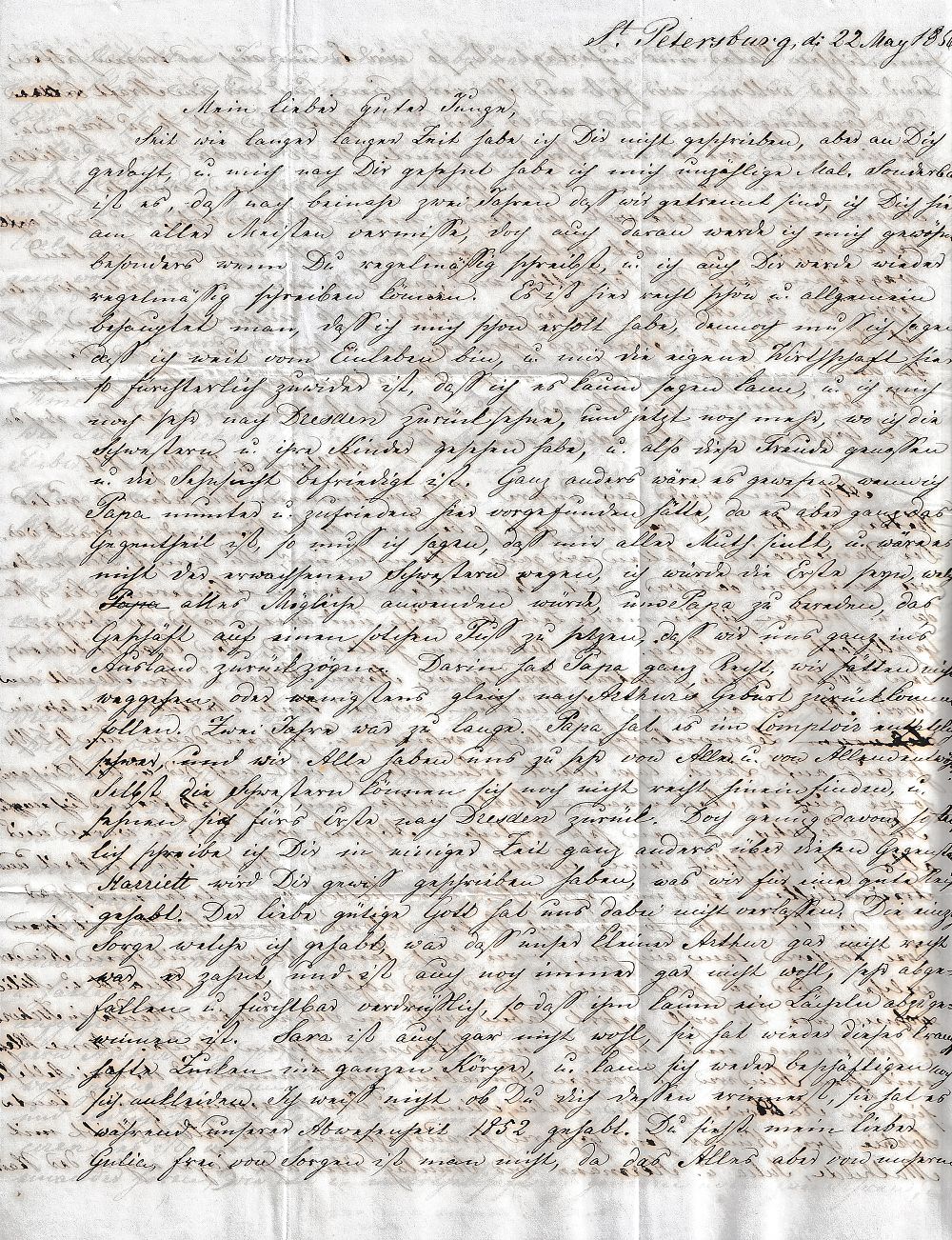
St Petersburg–London–Liverpool, 1856 – Extensive Undercover Letter from the Brandt Merchant & Banking Family – Pauline Brandt to Her Son Augustus Ferdinand Brandt, Later International Merchant and Banker – Immediately after the Crimean War – Cover with Penny Red - A remarkable and exceptionally extensive family letter, densely written in German, begun in St Petersburg on 22 May 1856, with a continuation dated 28 May, and sent to Augustus Ferdinand Brandt (1835–1904) during the earliest stage of his commercial career in Liverpool. The letter travelled by an interesting undercover mail arrangement: it was conveyed from St Petersburg under separate cover to London and only upon reaching Britain was it entered into the British postal system, being forwarded on 13 June 1856 to its final destination in Liverpool. The outer address reads: Mr. Augustus F. Brandt Care of Messrs Blessig Braun & Co. Liverpool and retains a Queen Victoria Penny Red, together with contemporary British postal markings. Augustus Ferdinand Brandt: The recipient is Augustus Ferdinand Brandt (1835–1904), a member of the prominent German-Russian Brandt merchant and banking family, whose commercial interests extended between St Petersburg, Germany and Britain. The identification is particularly compelling because biographical records specifically document that in 1856, at the age of twenty-one, Augustus Ferdinand Brandt was working for Blessig, Braun & Co. in Liverpool – precisely the firm named in the address on the present letter. Following his father's death in 1857, Augustus returned to St Petersburg and assisted with the family business. He subsequently pursued a successful commercial and banking career in London and became associated with the Brandt family's increasingly important international merchant-banking interests. The Writer – Pauline Catharina Brandt: The letter concludes with an affectionate maternal formula, approximately: “Deine Dich treu u. aufrichtig liebende Mutter P. Brandt” – “Your faithfully and sincerely loving mother, P. Brandt.” The writer is Pauline Catharina Brandt, née Amburger (1808–1891), mother of Augustus and wife of the prominent St Petersburg merchant Wilhelm Brandt Jr. (1804–1857). Portraits of Wilhelm and Pauline Brandt dating from 1854 have survived with direct Brandt family provenance and have appeared on the art market. Contents Pauline opens affectionately: “Mein lieber guter Junge” – “My dear good boy.” The manuscript is exceptionally extensive, densely filling the available paper in contemporary German script, with portions employing cross-writing to maximize the available writing surface. Pauline provides Augustus with a wealth of family and social news concerning relatives, friends and acquaintances, health, visits, travel, social events and future plans. Among the names discernible in the manuscript are Mathilde, Alexander, Anne, Thomas and others. The letter was composed over several days, with a later section headed: “Mittwoch d. 28 May 1856” providing an unusually rich glimpse into the private world of an internationally connected St Petersburg merchant family in the mid-nineteenth century. The Brandt Family and Anglo-Russian Trade The connection with Blessig, Braun & Co. is particularly significant. The Liverpool firm participated extensively in international commerce with Russia, including the movement of cotton and raw materials between Britain and the Russian Empire. The young Augustus was therefore acquiring commercial experience in Liverpool within the same Anglo-Russian trading network in which his family operated. The Brandt family's later London activities developed into substantial merchant-banking interests, with Augustus associated with family concerns including William Brandt’s Sons & Co. Immediately after the Crimean War The date provides an important historical context. The Treaty of Paris, ending the Crimean War, was signed on 30 March 1856, less than two months before the present letter was begun. The war and Allied blockade of Russian ports had seriously disrupted the Brandt family's international commercial interests and Anglo-Russian trade generally. The letter was therefore written at the very beginning of the restoration of commercial and personal communications between Russia and Britain after a war in which the two countries had been enemies. Undercover Postal History: The postal history is particularly attractive. Rather than being posted directly from Russia to Liverpool, the manuscript was privately conveyed under separate cover from St Petersburg to London, where it entered the British mails on 13 June and was forwarded to Augustus in Liverpool. Such undercover forwarding reflects the private and commercial networks employed by internationally active merchant families for transmitting correspondence across borders. An exceptional document combining the history of the Brandt merchant and banking family, Anglo-Russian commerce,