Bidspirit auction | Thun-Hohenstein Family – Extensive 1834
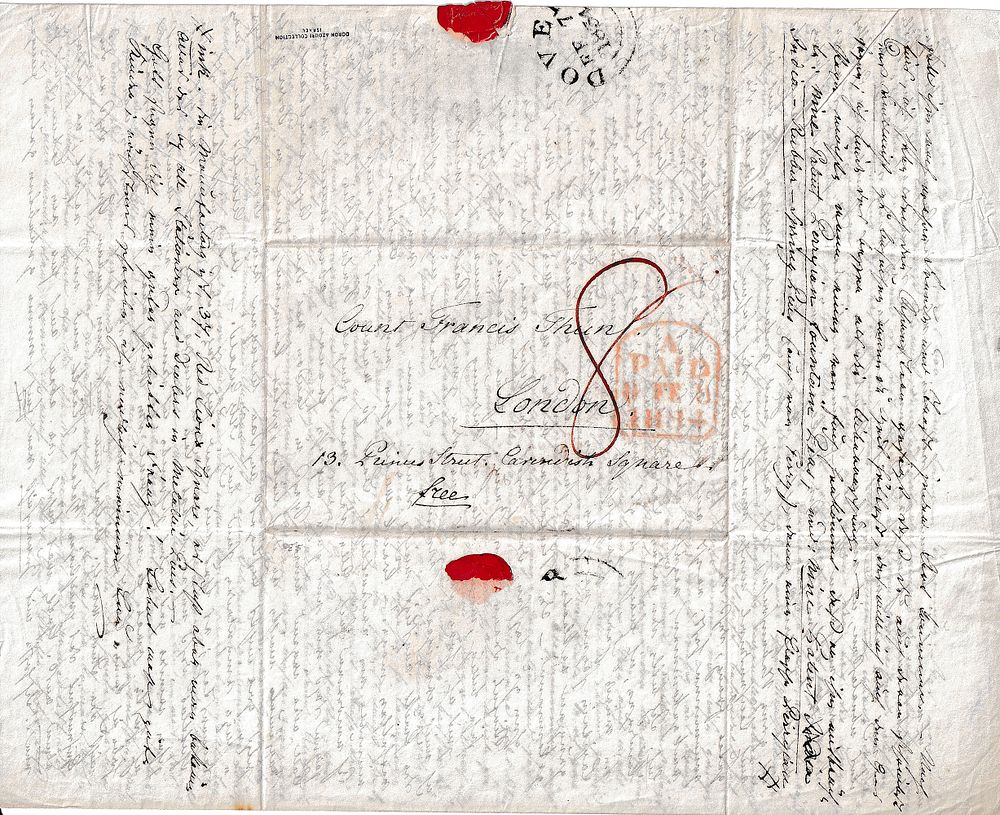
Thun-Hohenstein Family – Extensive 1834 Family Letter to Count Franz Anton II von Thun-Hohenstein during His Travels in England – from His Mother, Countess Therese Thun-Hohenstein, née Brühl – London - An exceptionally extensive 1834 family letter, densely handwritten in German and addressed in London to Count Franz Anton II von Thun und Hohenstein (1809–1870) – Bohemian nobleman, art patron and public figure, and a member of one of the prominent aristocratic families of the Habsburg Empire. The outer address reads: Count Francis Thun London 13 Prince Street, Cavendish Square The letter was sent to the young Count Franz during the period of his extended educational travels in Western Europe. Biographical sources document the Thun siblings travelling through Great Britain, France and Italy before returning to Bohemia in 1835. Count Franz Anton II von Thun-Hohenstein: Franz Anton II von Thun-Hohenstein (1809–1870) was the eldest son of Count Franz Anton I von Thun-Hohenstein and Theresia Maria, Countess Brühl (1784–1844). From an early age Franz displayed a strong interest in art and drawing. During the family's stay in Dresden in 1833 he became acquainted with the distinguished art historian Carl Friedrich von Rumohr and attended gatherings at the home of the celebrated Romantic writer Ludwig Tieck. He subsequently became an important figure in Bohemian cultural life, serving as President of the Bohemian Art Association, conservator of monuments in Bohemia, chamberlain, politician and a notable patron of the arts. The Writer – Countess Therese Thun-Hohenstein: Franz's mother, Countess Theresia Maria von Thun-Hohenstein, née Countess Brühl (1784–1844). Therese belonged to the distinguished Saxon Brühl family and was the wife of Count Franz Anton I. Their children included Franz Anton II, diplomat Friedrich von Thun-Hohenstein, statesman and reformer Leopold Leo von Thun-Hohenstein, and Anna Maria. Other letters from Therese to Franz dating from the period of his travels in 1834–1835 are documented. Contents: The manuscript is remarkable for its sheer extent. The sheets are almost entirely covered with densely written German text, with additional writing continuing around the outer address panel. The writer provides Franz with extensive family and social news, discussing numerous relatives and acquaintances, visits, travel, health and everyday affairs. Its character is that of a substantial family “news letter, ” intended to keep a young family member travelling abroad closely informed of events at home. It consequently provides an intimate glimpse into the private life and social world of a Central European aristocratic family during the early nineteenth century. The Thun-Hohenstein Family: The Thun und Hohenstein family ranked among the notable noble families of Bohemia and the Habsburg lands, with members active in diplomacy, politics, military affairs and cultural patronage. Franz's brother Friedrich von Thun-Hohenstein (1810–1881) pursued a distinguished diplomatic career and was present in England for Queen Victoria's coronation in 1838. Another brother, Leopold Leo von Thun-Hohenstein (1811–1888), became an important Austrian statesman and educational reformer. Postal History: The manuscript survives as its original entire letter: the written sheet itself was folded to form the postal cover, sealed with wax and addressed to Count Franz in London. The outer panel retains contemporary international postal markings and rate markings, together with remnants of the original red wax seal. The document therefore also constitutes an attractive example of European–British postal history from 1834, six years before the introduction of the first British adhesive postage stamp. An exceptional historical and personal document combining the Thun-Hohenstein aristocratic family, Count Franz Anton II and his formative European travels, early nineteenth-century family correspondence, Bohemian-Austrian cultural history and pre-stamp international postal history. Dimensions: When fully opened, each page measures approx. 20 × 25 cm. The letter comprises 4 pages, all densely handwritten.