Bidspirit auction | Thun-Hohenstein Family – Extensive 1834
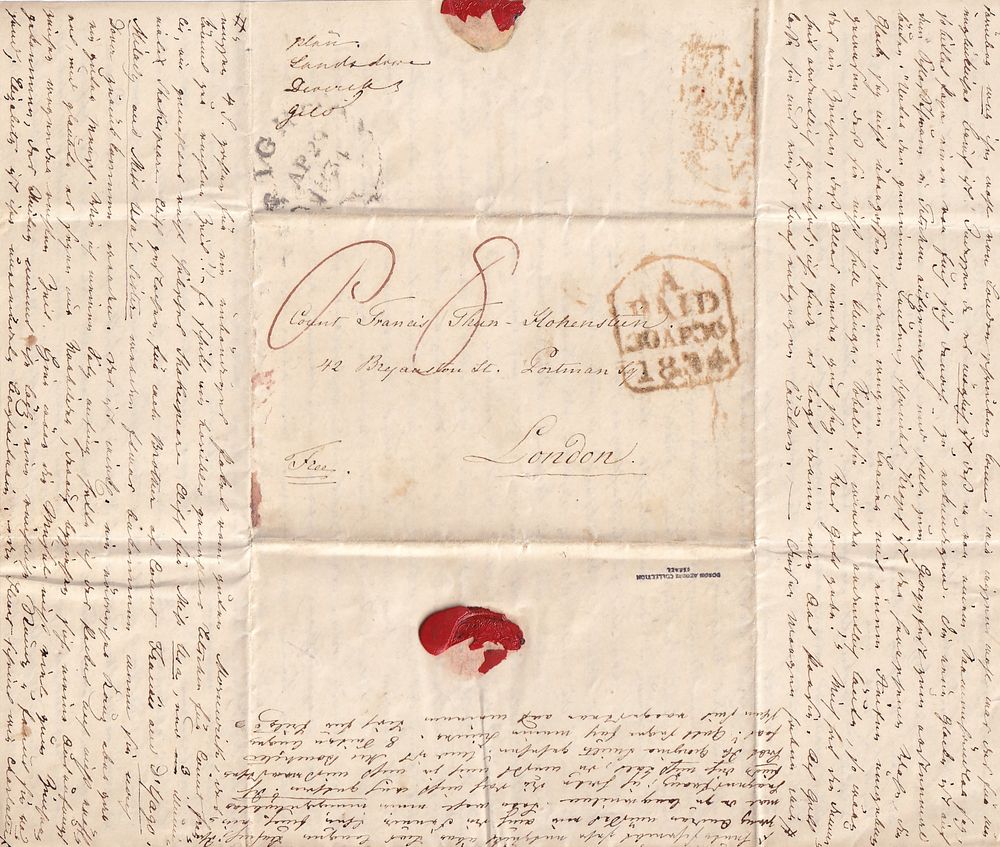
Thun-Hohenstein Family – Extensive 1834 Family Letter from Brighton to Count Franz Anton II von Thun-Hohenstein in London – from His Mother, Countess Therese, née Brühl – His English Travels - An exceptionally extensive family letter, densely handwritten in German, sent from Brighton on 25 August 1834 to Count Franz Anton II von Thun und Hohenstein (1809–1870) during his formative travels in England. The outer address clearly reads: Count Francis Thun-Hohenstein 42 Bryanston St. Portman Square London The manuscript survives as its original entire letter, the written sheet having been folded for transmission, sealed with wax and posted from Brighton to London. Count Franz Anton II von Thun-Hohenstein: Franz Anton II belonged to the distinguished Thun und Hohenstein family, one of the prominent aristocratic houses of Bohemia and the Habsburg lands. The eldest son of Count Franz Anton I von Thun-Hohenstein and Theresia Maria, Countess Brühl (1784–1844), Franz studied law in Prague but developed a profound interest in drawing, painting and the arts. During the family's stay in Dresden in 1833 he became acquainted with the distinguished art historian Carl Friedrich von Rumohr and attended gatherings at the home of the celebrated Romantic writer Ludwig Tieck. He subsequently became an important figure in Bohemian cultural life – an art patron, President of the Bohemian Art Association and conservator of monuments, in addition to his public and political activities. Franz Thun in England, 1834: The letter belongs to a formative period in Franz's life. During 1833–1835, members of the Thun family undertook extensive travels through Western Europe, including Britain, France and Italy. While in England, Franz encountered British social, cultural and artistic life and developed contacts within intellectual and artistic circles. Research based upon the surviving Thun family archives documents his correspondence from England during 1834. The present address at 42 Bryanston Street, Portman Square, London therefore provides contemporary documentary evidence of Franz's residence in London during this journey. Another 1834 letter addressed to Count Franz Thun during his stay in England is offered as a separate lot in this sale. The Writer – Countess Therese Thun-Hohenstein: The manuscript opens with the exceptionally affectionate salutation: “Mein Herzensfranz…” – approximately, “My dearest Franz / Franz, dear to my heart.” An intimate nature of the letter, its extraordinary length and wealth of family and social news, together with documented correspondence from the same period, from Franz's mother, Countess Theresia Maria von Thun-Hohenstein, née Countess Brühl. Surviving autograph letters from Therese to her son Franz dating from 1834–1835, during his European travels, are independently documented. The manuscript is remarkable for the density and extent of the writing. The German text fills virtually the entire available writing surface, with additional lines continuing along the margins. The writer provides Franz with extensive family and social news, discussing relatives and acquaintances, visits, plans, health, travel and numerous matters of everyday life. It consequently offers an intimate glimpse into the private world of an important Central European aristocratic family during the early nineteenth century, and the maintenance of family ties while the young Count travelled through Britain. Cultural Background of the Thun-Hohenstein Family: The Thun-Hohenstein family was closely connected with nineteenth-century European political and cultural life. Franz's brother Friedrich von Thun-Hohenstein became a distinguished Austrian diplomat, while another brother, Leopold Leo von Thun-Hohenstein, became an influential Austrian statesman and educational reformer. During the family's European travels in the 1830s they also entered the circle of Frédéric Chopin, who later visited the family at Tetschen/Děčín in 1835. This association is noted as historical family context and is not represented as a reference within the present letter itself. Postal History: The manuscript survives as an attractive pre-stamp entire letter, dating from six years before the introduction of Britain's first adhesive postage stamp. The outer panel retains contemporary British postal and rate markings, including a red PAID marking, together with substantial remnants of the original red wax seal. An exceptional document combining the Thun-Hohenstein aristocratic family, Count Franz Anton II during his formative English travels, extensive private family correspondence, Brighton–London pre-stamp postal history, and the early life of an important later Bohemian patron of the arts. Dimensions: When fully opened, each page measures approx. 22 × 18.5 cm. The letter comprises 4 pages, all densely handwritten.