Bidspirit auction | The Assyrian Court – Crystal
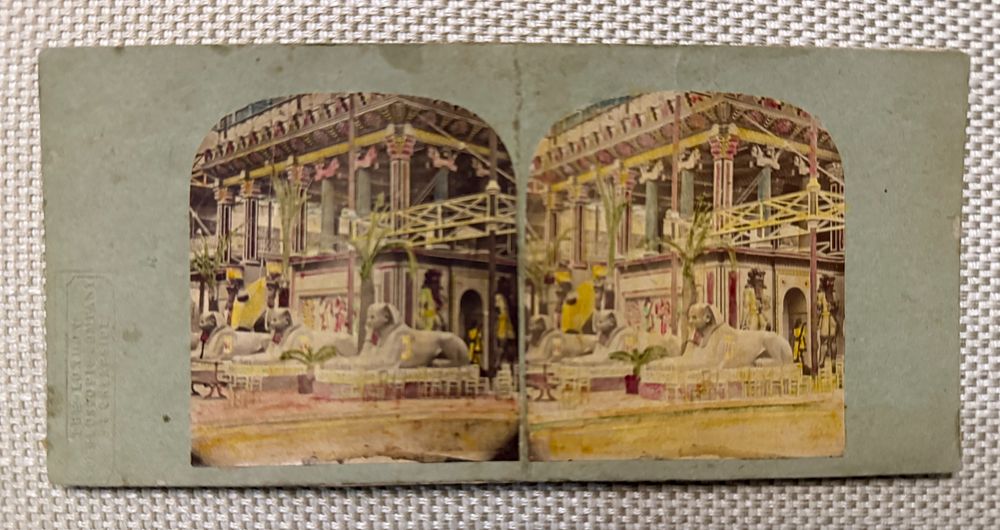
The Assyrian Court – Crystal Palace, Sydenham – Early Hand-Coloured Stereoview No. 12, Attributed to T. R. Williams, Mid-19th Century - An important early hand-coloured stereoview / stereograph depicting the celebrated Assyrian Court at the Crystal Palace, Sydenham, one of the remarkable archaeological reconstruction courts created for the Victorian Crystal Palace. The reverse bears the original printed heading: “No. 12. The Assyrian Court.” followed by an extensive contemporary description of the architecture, sculpture and archaeological sources represented in the Court. The card is associated with the Crystal Palace stereoscopic series of British photographer Thomas Richard Williams (1824–1871). The London Stereoscopic Company records CP 12 – The Assyrian Court within its T. R. Williams Crystal Palace series, while a further market record specifically identifies a T. R. Williams Crystal Palace No. 12, Assyrian Court stereoview. Hand-Coloured Photography The paired albumen photographs have been delicately coloured by hand, with red, yellow and green pigments highlighting architectural decoration, figures and sculpture. Such colouring enhanced the visual experience when viewed through a stereoscope and, in the present image, also evokes the richly coloured reconstruction through which the Victorian designers sought to present the ancient world. The Assyrian Court – Ancient Assyria in Victorian Britain The Assyrian Court was among the most intellectually ambitious of the historical reconstruction courts at the Sydenham Crystal Palace. Created during a period of intense European fascination with the recent archaeological discoveries in Mesopotamia, it introduced the Victorian public to a visual reconstruction of ancient Assyrian art and architecture. A contemporary 1855 account describes the Court as approximately 120 feet long and 50 feet wide and explains that it was intended to convey an impression of Assyrian architecture – a style of ancient art then still largely unfamiliar in Europe. The original printed description on the reverse identifies the archaeological sources represented: sphinxes based upon a Louvre example; colossal figures derived from sculptures discovered at Khorsabad; human-headed winged bulls modelled after discoveries at Nimrud; and columns inspired by remains at Persepolis and Susa. The Assyrian Court was designed by architect and scholar James Fergusson, under the general direction of the celebrated archaeologist and diplomat Austen Henry Layard, one of the principal nineteenth-century figures in the rediscovery and study of ancient Assyria. The stereograph is therefore not merely a view of the Crystal Palace, but a fascinating visual document of how Victorian Britain reconstructed, interpreted and presented the newly rediscovered civilizations of ancient Mesopotamia. An Early Collectible Stereoview: Other stereoscopic series of the Assyrian Court were subsequently produced, including the Negretti & Zambra Crystal Palace Art Union series of 1859, examples of which are preserved in the National Gallery of Victoria. These represent a different photographic series from the present No. 12 card. The present hand-coloured, numbered early version is an uncommon/Rare and highly attractive example. An exceptional early photographic document combining T. R. Williams, the Crystal Palace, Assyrian archaeology, Khorsabad, Nimrud, Persepolis, Susa, A. H. Layard, James Fergusson, hand colouring and the early history of stereoscopic photography.