Bidspirit auction | “Screen of the Kings and
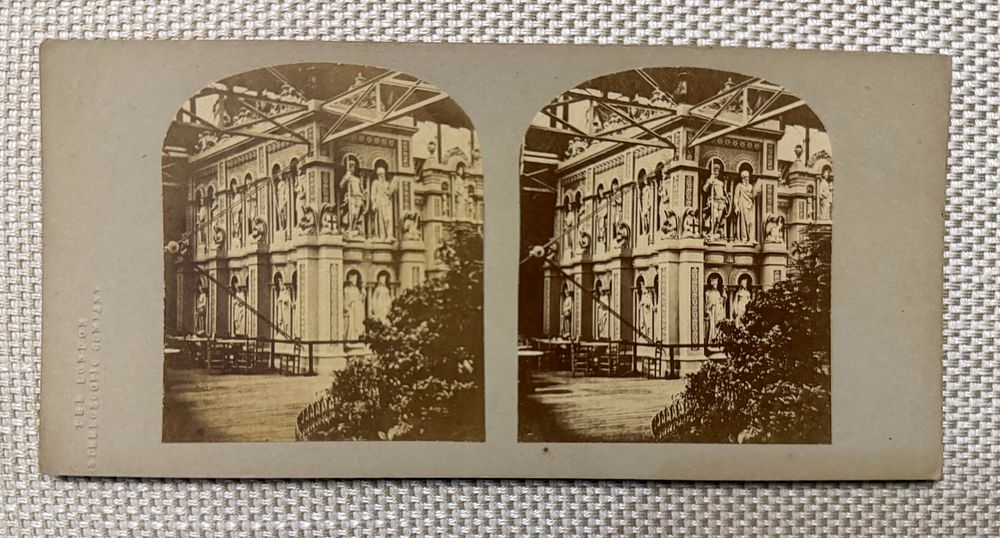
“Screen of the Kings and Queens of England” – Crystal Palace, Sydenham – Early Stereoview No. 35, Mid-1850s – London Stereoscopic Company - An early original stereoview / stereograph, numbered 35, depicting the celebrated “Screen of the Kings and Queens of England” at the Crystal Palace, Sydenham – a monumental display presenting the succession of English monarchs within the historical and artistic programme of the Victorian Crystal Palace. The reverse bears the original printed heading: “No. 35. Screen of the Kings and Queens of England.” followed by an extensive contemporary description identifying the principal figures represented. The number 35 and title correspond with CP 35 in the early Crystal Palace series associated with the London Stereoscopic Company and the mid-1850s. The series has also been associated with the important British stereoscopic photographer Thomas Richard Williams (1824–1871); as the photographer's name is not printed on the present card, the attribution to Williams is stated cautiously. The Kings and Queens of England – Including Queen Victoria The monumental screen was designed by British architect and designer Matthew Digby Wyatt (1820–1877). According to the original description on the reverse, its figures were casts derived from the Royal Statues created for the new Houses of Parliament – the Palace of Westminster. The principal front includes William the Conqueror and his Queen Matilda, surmounted by the Royal Arms, with statues of St George and St Andrew above and kneeling angels bearing shields with their respective crosses. To the left begins the series of Kings of the Saxon Heptarchy, while the contemporary text specifically notes, towards the centre and to the right: “the statue of her Majesty Victoria I.” The display therefore included a representation of Queen Victoria herself, the reigning monarch when the Crystal Palace at Sydenham opened. The sculptural programme relates to the work of John Thomas (1813–1862) for the new Palace of Westminster, creating a fascinating connection between two defining monuments of Victorian Britain – the Crystal Palace and the Houses of Parliament. Victorian Monarchy and National History Following the Great Exhibition of 1851, the Crystal Palace was transferred from Hyde Park to Sydenham and reopened in 1854. Its extensive displays presented art, industry, architecture, ancient civilizations and national history to an enormous Victorian public. The Screen of the Kings and Queens of England formed part of this educational and historical programme, presenting the succession of English monarchy through sculpture and national iconography. The stereograph is therefore not merely an architectural view of the Crystal Palace, but an early photographic document of Victorian ideas of monarchy, national history and cultural memory. Other photographic views of the same display are known, including an example preserved in the Metropolitan Museum of Art, New York. The present early numbered card, retaining its extensive original descriptive text, represents an uncommon and highly collectible example of mid-nineteenth-century stereoscopic photography. An important early photographic document combining the Crystal Palace, Queen Victoria, William the Conqueror, Queen Matilda, Matthew Digby Wyatt, John Thomas, the Houses of Parliament, British royal history and early stereoscopic photography.