Bidspirit auction | Sefer Maggid Devarav LeYaakov by
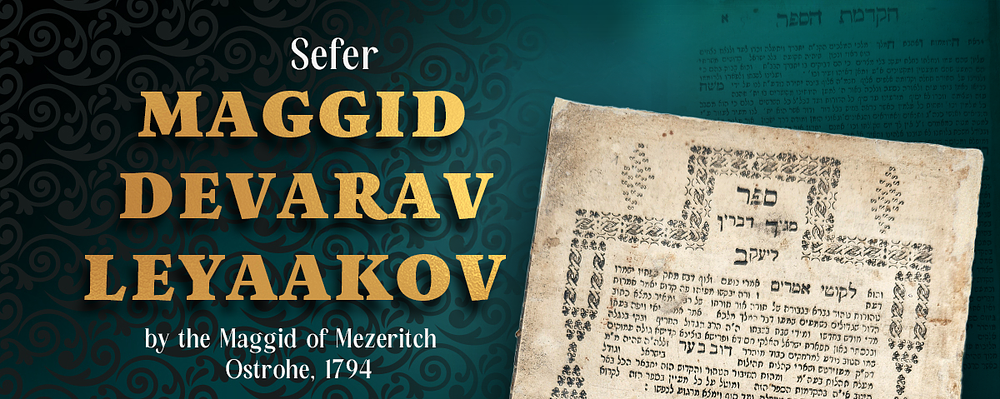
Sefer Maggid Devarav LeYaakov by the Maggid of Mezeritch - Ostrohe, 1794 - Sefer Maggid Devarav LeYaakov, Likutei Amarim by the Maggid Rabbi Dov Ber of Mezeritch - Ostrohe, the Press of Avraham ben Yitzchak Isaac and Eliyahu ben Yaakov Segal, in the year of ”Maggid Devarav LeYaakov Chukav Umishpatav LeYisrael” [1794]. On verso of the title page, an approbation by Rabbi Asher Zvi, the Maggid of Ostrohe. Added to this edition (on pages [2-4]) are new Likutom that were not published in previous editions. On the title page, the last letters of the book's title were emboldened: ”מגי ד דברי ו ליעק ב ” - implying the Author's name - Rabbi Dov. The book was edited by Rabbi Shlomo of Lutzk, the author of Dibrat Shlomo who was a leading disciple and relative of the Maggid. At the beginning of the book, Rabbi Shlomo wrote two famed forewords recalling the Ruach Hakodesh his rabbis, the Baal Shem Tov and the Maggid of Mezeritch, had and their virtues. The Maggid of Mezeritch , one of the leading disicples of the Baal Shem Tov and his successor, to whom leading Chassidic rabbis travelled and from whom most Chassidic Chatzerot originated In his youth, he studied under the Pnei Yehoshua in the city of Lviv. After his marriage, he expanded his knowledge of Torah and began studying Kabbalah. He served as a Maggid in Tortshin, then in Koretz, and later in Rovno. When the Baal Shem Tov's teachings became known, the Maggid initially opposed the Chassidic movement until one day he met the Baal Shem Tov, who asked him to explain a difficult passage from the Zohar. After he answered, the Baal Shem Tov offered a different commentary based on his true approach. The Baal Shem Tov shared his commentary, yet without Yirah and Ahava and the angels mentioned in the Zohar appeared before them, explaining that his learning had been ”without Neshamah.” Following this event, the Maggid grew closer to the Baal Shem Tov. After the Baal Shem Tov's passing on Shavuot of the year 1760, the Maggid was chosen, in accordance with his Rav's wish, to succeed him. He settled in the town of Mezeritch, which became the center of the Chassidic movement. Under his leadership, the movement grew and expanded its influence. He sent his leading disciples to various places, where they spread Chassidus throughout Poland and beyond. During his leadership, the Chassidic movement flourished, and many of the Chassidic dynasties known today were founded by his disciples. His son was Rabbi Avraham Hamalach, and his grandsons were Rabbi Yisroel Chaim of Ludmir, and Rabbi Sholom Shachna of Prohvisht, the father of Rabbi Yisrael Friedman of Ruzhin, founder of the Ruzhin Chassidus, which later branched out into numerous Chassidic dynasties, including Sadigura, Shtefansht, Husyatin, Boyan, and more. [4], 48 leaves. 19.4 cm. Detached binding. Stains. Tiny moth perforations. Leaves 45-48 with restored corners. 47-48 with damage to text. Except for the restorations, good overall condition.