Bidspirit auction | R. SHLOMO EIGER — EXTENSIVELY
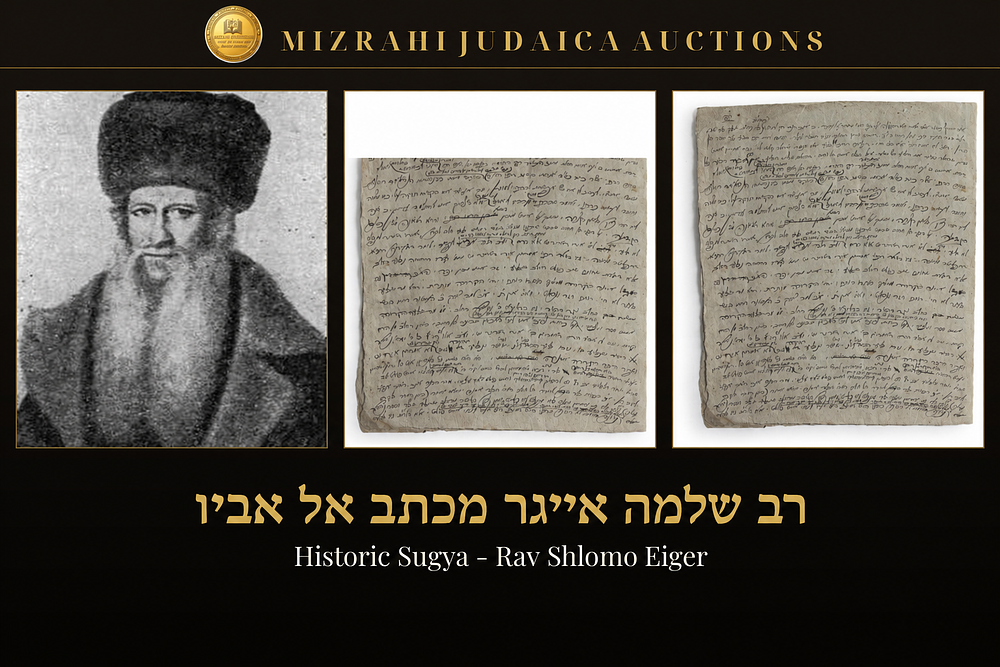
R. SHLOMO EIGER — EXTENSIVELY REVISED AUTOGRAPH WORKING DRAFT OF HIS HALACHIC EXCHANGE WITH HIS FATHER, R. AKIVA EIGER - R. SHLOMO EIGER — EXTENSIVELY REVISED AUTOGRAPH WORKING DRAFT OF HIS HALACHIC EXCHANGE WITH HIS FATHER, R. AKIVA EIGER THE MODLIN FORTRESS INCIDENT — HAGALAH WITH MILK Three densely written pages, in the autograph hand of R. Shlomo Eiger (1785/86–1852), extensively revised with cancellations, interlinear additions and marginal insertions. Working drafts from the celebrated halachic exchange with his father, R. Akiva Eiger, concerning an unusual question of hagalah which arose while R. Shlomo was staying at the fortress of Modlin. The question didn’t begin in the study but on the road. During a stay at Modlin Fortress, some 25 miles north of Warsaw, at the confluence of the Narew and Vistula Rivers, R. Shlomo Eiger wished to have coffee prepared before daybreak. The neighboring residents were still asleep, and the woman of the inn explained that no water was then obtainable; the fortress gates were closed, and water could only be fetched from the Narew, upon which Modlin stands. Meanwhile, military personnel stationed there had been cooking pork, and the utensil needed for R. Shlomo's coffee had been rendered non-kosher through contact with the hot pork cooking. With no water available for hagalah, R. Shlomo arrived at an ingenious practical solution: could the utensil instead be kashered in boiling milk, with sufficient milk to nullify the forbidden taste expelled from the vessel? What began as an improvised ruling before dawn at a military fortress developed into a sustained halachic correspondence between two of the great minds of nineteenth-century Polish Jewry. The exchange was eventually printed in Teshuvot R. Shlomo Eiger, nos. 15–19, while R. Akiva Eiger's side of the discussion appears independently in his own responsa, nos. 83–84. The present leaves bring us behind the polished printed texts and into the actual process of their composition. The leaves are numbered in manuscript רפ-רפא evidently surviving from a considerably larger manuscript sequence. They are emphatically not fair copies: passages are crossed through and rewritten, phrases inserted between lines, arguments expanded in the margins, and formulations repeatedly reconsidered. Their appearance strongly suggests working drafts in which R. Shlomo was organizing and refining his response, rather than the clean copy that would presumably have been dispatched to his father. The identification can be demonstrated directly. At the head of leaf רפ, R. Shlomo writes: The corresponding section was ultimately printed as the opening of Teshuvah no. 17: “אשר הוסיף אבא מארי וכו׳ מאור הגולה נ״י על דבר...” Thus the corrections covering these pages are not simply miscellaneous notes surrounding the subject. They preserve R. Shlomo in the midst of formulating his rejoinder to his father's critique, before the argument assumed the form in which it would eventually be transmitted in print. There is a particularly evocative counterpart in R. Akiva Eiger's own responsa. At the conclusion of his discussion of the question, no. 84, he leaves the issue deliberately open and turns it back to his son: “והדבר צריך הכרע, ובני הגאון נ״י ידון בזה” “The matter requires determination, and my son, the Gaon, will deliberate upon it.” The present manuscript appears to preserve something remarkably close to that deliberation itself: R. Shlomo's hand moving through the argument, cancelling one formulation, inserting another, and working toward his response to his father. R. Shlomo Eiger, son and close halakhic interlocutor of R. Akiva Eiger, spent a substantial portion of his earlier life as a merchant in Warsaw before serving as rabbi of Kalisz and later succeeding his father in Posen. He is familiar to generations of Talmud students through his Gilyon Maharsha, with part of that title series now gracing recent editions of Shulhan Arukh alongside his own father’s notes, while a considerable corpus of his responsa and novellae remained in manuscript and was brought to print only generations later. He was also the father of R. Leibele Eiger of Lublin. Three consecutive autograph pages, numbered ר״פ-רפ״א. Dense manuscript writing with exceptionally extensive autograph revisions, deletions, interlinear additions and marginal passages. Page ר״פ begins already mid-conversation. The leaves apparently originated in a substantially larger manuscript notebook or sequence of R. Shlomo Eiger's writings. An unusually immediate survival from the intellectual conversation between R. Akiva Eiger and his son: not merely the responsum they left to posterity, but R. Shlomo Eiger apparently working out the answer on paper. Condition: Very good condition