Bidspirit auction | Vilmos Aba-Novak , 1894-1941
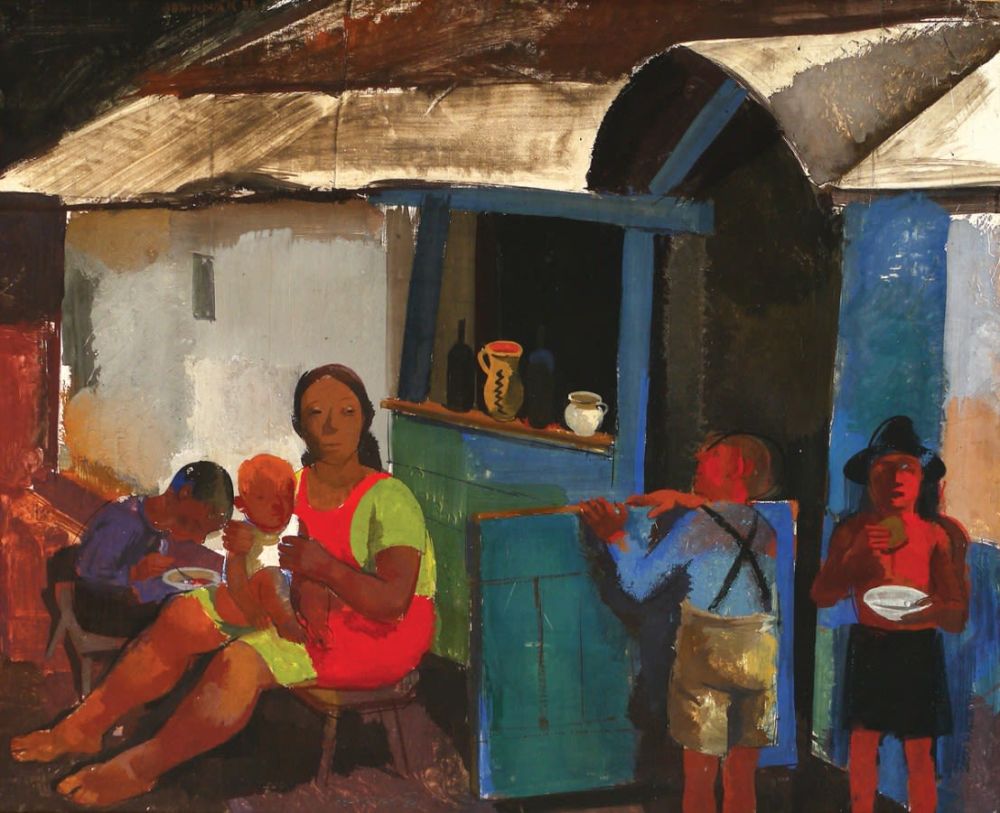
Vilmos Aba-Novak , 1894-1941 - Figures in the Village,1934. Artist's name: Vilmos Aba-Novak , 1894-1941 Item name: Figures in the Village,1934 Technique: Oil / tempera on wood Measurements: 49X59 cm Signed: Signed and dated. Estimate: $15000 - 20000 Remarks: The villagers, merchants and other passersby in exhaustive daily activities, inhabit Vilmos Aba-Novák's canvases, a leading Hungarian painter in between the two world wars, and one of the greatest mural painters in Hungary. He received his training at the College of Fine Arts in Budapest and later in a two-year fellowship in Rome, where he learned to paint in Fresco. Throughout his extensive career, the artist exhibited his work around the world and was awarded the jury's Grand Prize at the Paris World Exhibition in 1937 and the 1940 Venice Biennale. Aba-Novák is known for his work with bold colors and expressive style: solid forms construct the painted figures, stain by stain, in between twisting contour lines – and a lively scene is revealed to the viewer. Novák's human proportion is distorted and the hands receive a prominent place. In the painting ”Cattle Market, 1934” (p. 69) or ”Rest, 1934” (p. 75) the hands are the ones which give the painted scene its dynamic, or alternately, static quality. By mediation of the painted hands, the viewer senses the physical and emotional state of the characters – whether in the middle of a vocal argument, while bargaining in the market, or at rest, holding a bowl of a murky soup or a loaf of bread, in a rushed break during a grueling work day. The hands provide a glance to the painting's true subject, the human being. Indeed, Aba-Novák's best described themes centered on routine life and labor of the common man, in the village or city. However, alongside paintings of peasants and workers, the artist put up an impressive series of circus paintings in which he described circus workers at work and at rest. The two paintings at the auction, ”Circus Acrobatics, 1930's” (p. 70) and ”Circus Workers at Rest, 1935” (p. 73), are a taste of the rich series. At a time in which the circus provided an escapism for the masses, and its shining stars were venerated by the crowds, putting these two groups of works side by side is fascinating. In effect, the comparison illuminates the hidden similarity between the human figures - as its viewing crowd, the fatigued circus workers are observed during their break, the stardust disappearing above them. The broken dream in the hand of the same great maker. About The Artist: Vilmos Aba-Novák (1894, Budapest – 1941, Budapest ) was a Hungarian painter and graphic artist , whose many of his painted themes expressed his interest in the village fair and the circus , while his style combined elements of Expressionism and use of strong colors. Aba Novák studied at the Art School and at the College of Fine Arts in Budapest. In 1928 he was sent by the Hungarian Academy to Rome and became a renowned representative of the so-called ”Roman School” in Hungarian painting. Later, he taught at the College of Fine Arts in Budapest until his death. Aba Novák painted many commissions for the Roman Catholic Church of Jászszentandrás and the Hungarian Government, including Hõsök Kapuja ( Heroes' Gate ) commemorating World War I soldiers in Szeged , frescoes of the Saint Stephen Mausoleum in Székesfehérvár and the Church in Városmajor, Budapest . He was awarded the jury's Grand Prize at the Paris World Exhibition in 1937 and the 1940 Venice Biennale, and was officially patronized by the Hungarian nobility .