Bidspirit auction | Rare - Never Auctioned: Extraordinary
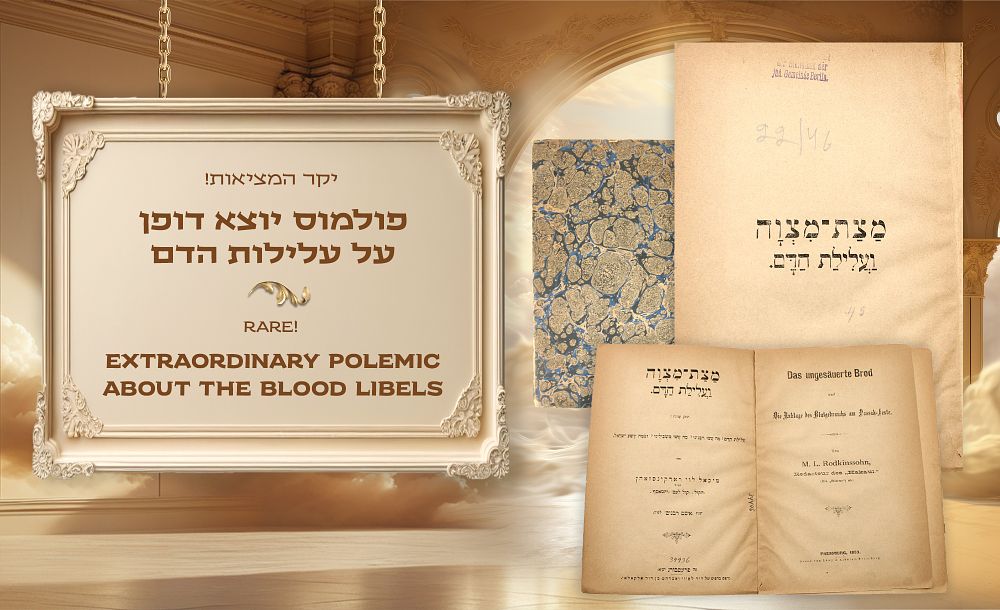
Rare - Never Auctioned: Extraordinary Polemic! Matzat Mitzvah VeAlilat Dam - Pressburg, 1883 - ”Matzat Mitzvah VeAlilat Dam, its content: blood libel! What did our rabbis do? What did our intellectuals do? and how can Israel be saved. By Michael Levi Rodkinson”. The Press of David Levi and Avraham ben David Alkalai, Pressburg - 1883. [8], 32 pp. 21 cm. Stains and small tears along the edges of several leaves. Old binding with taping to spine. Slightly dry paper. Very good overall condition. An extremely rare book that was never auctioned. The Polemic surrounding the book The book was written in response to the rise of modern anti-Semitism at the time, particularly in reaction to a blood libel that had occurred about a year earlier in Hungary. The author strongly criticizes the rabbis, claiming that the customs that had been added over the years to the process of baking Matzah are what cause the various blood libels due to their strangeness and the mystery that arises from them: ”The actions are so foreign, the customs are so strange and far from the understanding of any healthy mind, that it is almost necessary to believe that something secret is hidden in this Matzah!” In this work, Rodkinson does not spare his criticism of the members of the Enlightenment Movement either, who only publish writings but have no impact on the public, certainly not in actions or sacrifices for the Jews of the time. The work provoked sharp criticism from all sides, both from the Orthodox and from the members of the Enlightenment Movement, who did not hesitate to hurl insults and curses at Rodkinson (see more in Yonatan Meir's article: Naftulei Michael Levi Rodkinson, Gal-Ed issue 22). The author Michel Levi Rodkinson (Frumkin; 1845-1904) was born in Dubrovno to Alexander Sender Frumkin, a Chabad Chassid, and to Roda Chasia, the daughter of Rabbi Aharon of Streshla who was one of the leading disciples of Baal HaTanya. The Name Rodkinson (Roda's son), which he adopted later in his life is homage to his mother. He wrote books on Chassidut, mainly on the Chabadic tradition. Later, he grew close to the Jewish Enlightenment Movement and published Hebrew journals. He was the first to publish an English translation of the Talmud Bavli as well as an English historical foreword for it. Despite his pedigree, he frequently criticized conservative Jewry and his figure was thus controversial.