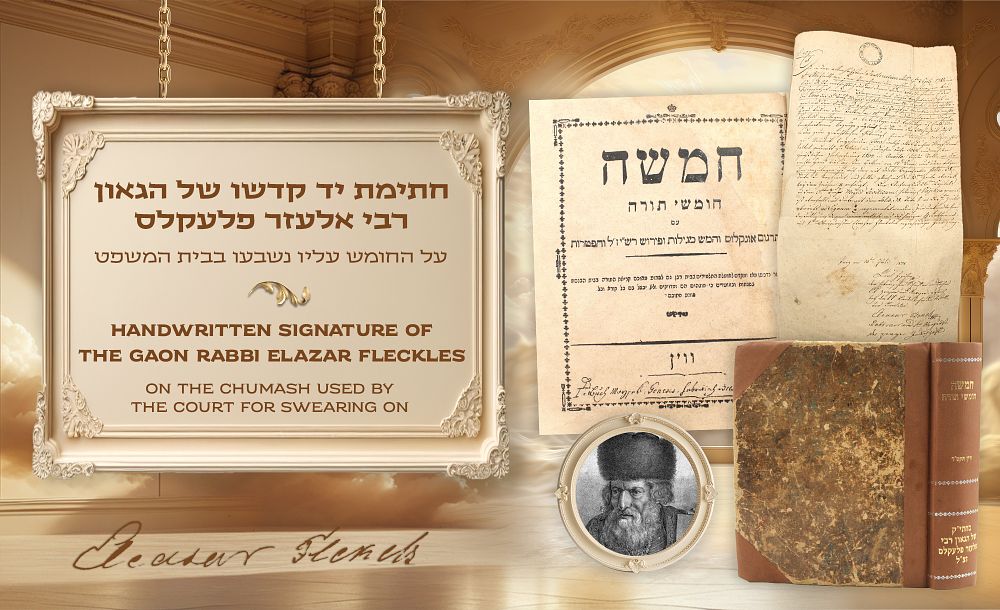
Bidspirit auction | Rare and Special Historical Item!
Rare and Special Historical Item! The Original Chumash on which Jews Swore in the Court of Prague with the Handwritten Signature of the Rosh Av Beit Din of Prague the Gaon Rabbi Elazar Fleckles: Chamisha Chumshei Torah - Wien, 1804 - Chamisha Chumshei Torah, ”with the Onkelos translation and Chamesh Megillot and Rashi's commentary and Haftarot”. Anton Schmidt Press. Wien [Vienna, 1804]. [2] handwritten leaves; 74, 72, 53, 62, 70 leaves. Separate title page for each Chumash. The first title page was incomplete and was completed with a professional photocopy on both its sides. Stains and some other blemishes. Original binding, worn with new fabric spine and corners. Embossments on spine. Good overall condition. Chumash for swearing in witnesses This is a special and interesting historical item which was used by the official court in Prague to swear in Jews who came to testify in court. The origin of this oath stems from a lack of trust in the oaths of Jews due to the recitation of Kol Nidrei and the custom of annulling vows (Hatarat Nedarim), which led Christians (and Muslims in Islamic countries) to force Jews to take an oath (sometimes humiliating) during court proceedings in official courts. To the dismay of the Jews, the oath was taken by placing a hand on the New Testament. The Jews appealed to the authorities to change this practice and allow them to swear on the Bible or the Torah. Emperor Franz Joseph I, who showed favor to the Jews of his land, was the first to respond to this appeal and accepted the proposal to swear on printed Chumashim. To strengthen this oath, the authorities approached the revered Rabbi Yechezkel Landau, the Rav of Prague, who wrote an extensive and detailed response on the matter (Shut Noda BiYehudah, 2nd edition, Yoreh De'ah, Siman 71), in which he addresses the severity of a false oath and the issue of swearing on a Sefer Torah, concluding that the oath is valid even when sworn on a printed Chumash. Handwritten signature of Rabbi Elazar Fleckles The famed Gaon Rabbi Elazar Fleckles, a leading disciple of the Noda BiYehuda and Rosh Av Beit Din of Prague, corresponded with Carl Fischer, the chief censor and critic of Hebrew books on behalf of Emperor Franz Joseph, on the matter, writing him a Halachic Responsum (Shut Teshuva MeAhava, section I Siman 26). Among others, he discusses the significance of placing one's hand on a Chumash, Tefillin or Sefer Hazohar while taking an oath. In this copy, 2 leaves in German script were added before the Chumash, from 1808, one of them signed by the Gaon Rabbi Elazar Fleckles Rosh Av Beit Din of Prague, titled here in German ”Chief Rabbi and jurist of the Jews of Prague”. The document notes where the hand should be placed during the oath in Chumash Vayikra (26, 14) and onwards. Consequently, this place is marked in Chumash Vayikra with script on the pagination, replacing the printed Hebrew letters. The place where the hand should be placed is also marked. In addition, in this copy, the third Commandment of the Ten Commandments (Shemot 20, 6) is also marked: ”לא תשא את שם ה' אלוקיך לשוא....”. On the leaf before this document, an additional handwritten confirmation signed by the censor Carl Fischer. The Gaon Rabbi Elazar Fleckles (1754-1826), one of the leading sages of Prague and a leading disciple of Rabbi Yechezkel Landau, the Nodah BiYehuda. Was famed for his Torah greatness, sharpness and clear Psikah. Was one of the greatest fighters against the Sabbatians and the Frankists not surrendering to them even when they imprisoned them. Served as Rosh Av Beit Din of Prague for many years. His Halachic Responsa was published in the book Teshuva MeAhava.