Bidspirit auction | Extremely Rare! Original Invitation Sent
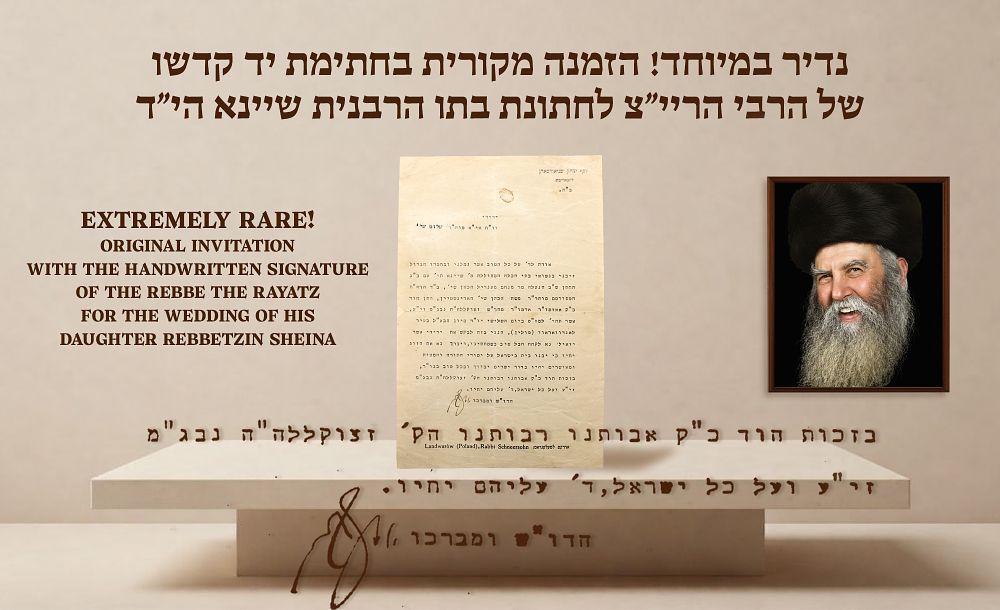
Extremely Rare! Original Invitation Sent by the Rebbe the Rayatz with His Handwritten Signature for the Wedding of the Rebbetzin Sheina with Rabbi Menachem Mendel Hornstein - Original printed invitation that was sent by the Rebbet the Rayatz to the wedding of his daughter, the Rebbetzin Sheina with Rabbi Menachem Mendel Hornstein, which took place on Tuesday, Sivan 10, in Landvarov (Landwarów), Poland. The Rebbe the Rayatz wrote that this specific location was chosen for the wedding due to current restrictions regarding borders and documentation: ”ומפני ההגבלות עכשיו בהנוגע לגבולין ותעודות, הגבלנו את מקום החתונה על אם הדרך בהתחנה לאדראווא במדינת פולין”. Varied types of invitations were sent by the Rayatz to this wedding of his youngest daughter. This is an invitation that was sent to Chabad Chassidim who, apparently, could participate in the event, as indicated by its version: ”הנני בזה לבקש את ידידי אשר יואיל נא לקחת חבל טוב בשמחתינו, ויברך נא את הזוג יחיו, כי יבנו בית בישראל על יסודי התורה והמצוה ומאושרים יהיו בדור ישרים יבורך ובכל טוב בגו”ר, בזכות הוד כ”ק אבותנו רבותנו הק' זצוקללה”ה נבג”מ זי”ע ועל כל ישראל, ד' עליהם יחיו. הדו”ש ומברכו... [the original handwritten signature of the Rebbe the Rayatz] . Interesting! The version of this invitation differs in a few details from the invitations that were sent by the Rebbe the Rayatz. For example, the ”השעה החמישית” [fifth hour] does not appear. In addition, unlike other invitations, the invitation is not divided into passages whose initials form the word 'אהבה' (see Moreshet Auction #79 lot #87). Following what the Rebbe had said about the version of these invitations (which were sent by the Rebbe the Rayatz to the wedding of the Rebbe and Rebbetzin and later to the wedding of Rebbetzin Sheina) , the version was adopted by Chabad Chassidim and to this day, it is the version used by them for invitations to their children's weddings. The Rebbe said (Torat Menachem Hitvaduyot Section X, p. 198): ”הדיוק במנהגי החתונה - כבכל המנהגים... הוא עד כדי כך שדייקו אפילו בנוסח ההזמנה. קודם חתונת גיסתי (הרבנית שיינא הורנשטיין הי”ד) צוה כ”ק מו”ח אדמו”ר שיעתיקו את נוסח ההזמנה מההזמנה לחתונה שלנו. ובמענה לשאלתי, השיב כ”ק מו”ח אדמו”ר שנוסח זה הוא מההזמנה לחתונה שלו, וכנראה שכן היה גם בחתונות שלפני זה” [The precision in wedding customs - as with all customs... is so much so that they were precise even regarding the version of the invitation. Before the wedding of my sister-in-law (Rebbetzin Sheina Hornstein), my father-in-law, the Rebbe, instructed that the version of the invitation be copied from our own wedding invitation. In response to my question, my father-in-law, the Rebbe, replied that this version was taken from his own wedding invitation, and apparently, this was also the case in the weddings prior to that]. 24X15.5 cm. Fold lines. Some stains. Minor restorations. Good overall condition. The bride Rebbetzin Sheina (1904-1943), the youngest daughter of the Admor the Rayatz. Was known as an intelligent, noble and charitable woman. Her mother, Rebbetzin Nechamah Dinah, wrote of her in a letter after her wedding that she had merited much Naches from her, blessing her friends that they too merit such Naches from their daughters. Sheina was very close to her father and accomapnied him on many of his journeys. She witnessed his arrest and release and the wedding in Lanvarov was a moment of relative peace for her before the great storm. The bridegroom Rabbi Menachem Mendel Hornstein (1905-1943), a model figure of Yoshev Ohalim combined with Halichot Olam. As the grandson of the Admor the Maharash, he bore the weight of the Lubavitch Kingdom. After their marriage, the couple remained in Poland and became an integral part of the leadership of the Chassidic community. Unfortunately, the couple did not have children. They perished in Treblinka during the Holocaust. The tragedy surrounding this invitation is the bitter fate of the couple. With the outbreak of World War II, they remained trapped in occupied Poland. Despite the desperate efforts of the Rebbe the Rayatz from New York to rescue them, including the intervention of high-ranking diplomats, the gates were locked. In the autumn of 1942, they were sent to Treblinka. The news of their deaths was kept secret from the Rayatz until the day of his passing in 1950, so as not to break his heart. This invitation is thus a living testament to a joy that was cut short and to a magnificent Chassidic world that was destroyed.