Bidspirit auction | “Hidden Light Among the Trees”
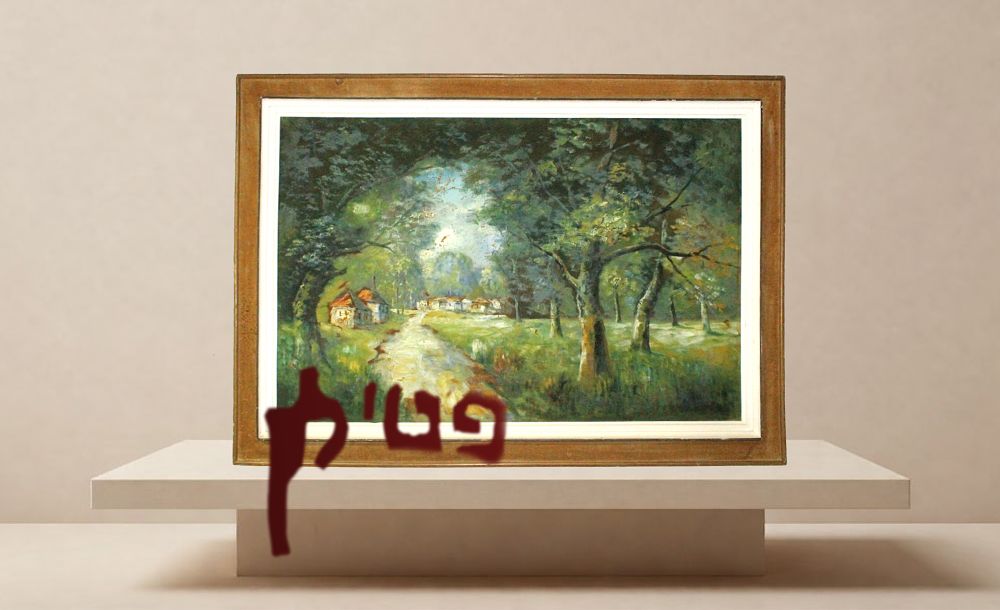
“Hidden Light Among the Trees” – A Monumental Oil Painting by the Mekubal Artist and Hidden Tzaddik Rabbi Leon Patillon - A monumental signed work by the Mekubal painter Rabbi Leon Patillon, an enigmatic and awe-inspiring figure whose name was whispered with reverence among those in the know. He was regarded not only as a gifted artist, but also as a divine Mekubal and Hidden Tzaddik. Israel, ca. 1950s This work, one of the most impressive and largest of his creations, depicts a dense and expansive forest filled with towering trees and rich green foliage. Between the trunks winds a narrow, partially concealed path leading toward a cluster of small cottages hidden deep within the woods. A soft, luminous light filters through the branches, illuminating the red-tiled roofs, while deep shadowed areas envelop the path and vegetation in an almost hypnotic, mysterious atmosphere. The compositional structure of a winding rural path, dense grove, and hidden cottages is a recurring motif in Patillon’s landscapes. His works are characterized by short, free, impressionistic brushstrokes that construct the scenery as a network of fragmented light and color. He employed deep tones of green, blue, and brown in the shaded areas of the forest, contrasted with bright focal points of light in the composition’s center and across the sky. This contrast expresses the Kabbalistic idea of “light emerging from darkness”. Specifications : Oil on canvas, mounted on a period wooden stretcher. Dimensions: 90×60 cm; framed: 107×77 cm. Signed in Hebrew “Patillon”on the lower right corner. Fair–good overall condition; localized paint losses and signs of age. Not examined outside frame. Provenance This impressive work is offered directly from a private collection of an elderly Jewish owner, who recounts that his parents acquired the painting directly from the artist during his lifetime. The painting hung for decades at the center of the family home and was regarded not only as a valuable artwork, but as an object of blessing and protection. ............................................... ..... A fascinating and highly unusual detail is revealed on the reverse of the painting A fascinating and highly unusual detail is revealed on verso of the painting , offering a rare glimpse into the artist’s hardship and ascetic way of life. The canvas stretched over the wooden frame is not a conventional artist’s canvas, but a recycled flour sack used by Patillon as his painting surface - a silent indication of his poverty and detachment from worldly possessions. The original printed markings on the sack remain clearly visible, revealing its historical origin. On the back appears the inscription: “ROBIN’S BEST – HARD WINTER WHEAT FLOUR, ” a historic American flour brand widely distributed in the mid-20th century. Alongside it appears another marking: “ISRAEL FOOD CONTROL – HAIFA.” This inscription indicates that the sack arrived in Israel through food control mechanisms operating at the Port of Haifa in the early years of the State, most likely in the late 1940s or 1950s. It may have formed part of food aid shipments or regulated imports during the austerity period of the young State of Israel. ............................................... ..... A Segulah Object Patillon’s paintings were not considered mere works of art. Those close to him testified that during his creative process he would enter a state of profound devotion, directing mystical intentions according to the hidden wisdom of Kabbalah. His works were therefore regarded as spiritual objects, absorbing hidden light from higher realms. For this reason, his paintings became known as objects of segulah when placed in a home, believed to bring protection, tranquility, and an atmosphere of holiness and peace. It is difficult to define the precise intention behind this work. The location is unknown, as is the period it depicts. It appears that the artist did not seek to portray a literal landscape, but rather an inner vision existing between visible reality and a concealed spiritual dimension. Indeed, many have testified over the years that prolonged contemplation of Patillon’s works induces a deep and inexplicable sense of calm. After a few moments, the viewer feels as though drawn into the forest itself, walking along the winding path and becoming part of the scene, an experience difficult to rationalize in ordinary terms. Jewish tradition holds that an object created by a true tzaddik may serve as a protective amulet for the home. In many respects, this work may be understood as such — not a small parchment concealed away, but a monumental oil painting occupying the heart of the home, radiating beauty, sanctity, and presence throughout its surroundings. ............................................... ..... Presence in the Space Beyond its spiritual aura and exceptional tradition, the painting possesses a rare and commanding presence,