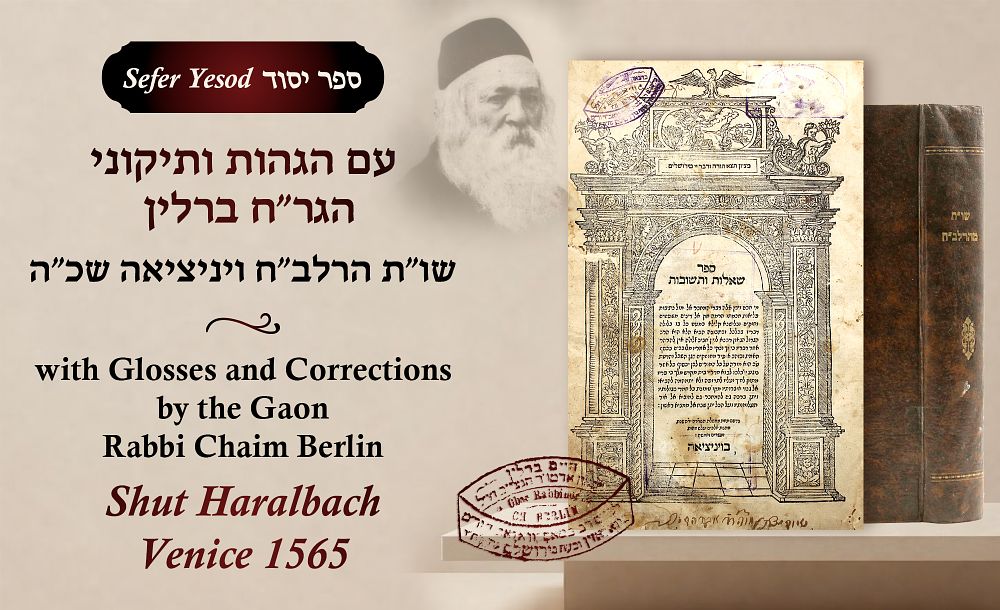
Bidspirit auction | Sefer Yesod with Glosses and
Sefer Yesod with Glosses and Corrections by the Gaon Rabbi Chaim Berlin: Shut Haralbach, with the Chidush Semichah Polemic - First Edition Venice, 1565 - Shut by Rabbi Levi ben Chaviv - the Ralbach, with his work on Hilchot Kiddush Hachodesh and Kuntres Hasemichah. Venice, 1565. First ediiton. Stefansky, Sifrei Yesod #292. First and important edition of one of the most foundational Shut books from the period of Chachmei Sepharad after the Expulsion. Printed from leaf 277 and onward is Kuntres Hasemichah - the famed historical controversy between the author, Rabbi Levi ben Chaviv, and the Marahri Beirav, about the attempt to renew the Semichah in Eretz Yisrael by teh sages of Safed. Printed here for the first time is also the Ralbach's important work on Hilchto Kiddush Hachodesh, with illustrations and many sketches. Chidush Hasemichah Polemic In 1538, Mahari Beirav sought to renew Rabbinic Semichah) in Eretz Yisrael - that ancient Semichah granting Dayanim the authority to rule on cases involving fines and capital offenses, which had ceased at the end of the Amoraic period. One of the primary aims of this initiative was to facilitate spiritual rectification and atonement for the Spanish Anusim through the court-ordered punishment of lashes, a penalty that could only be administered by a Dayan Musmach. Mahari Beirav received his Semichah by twenty-five of the Sages of Safed, after which he gave Semichah to his disciples, chief among them Maran the Beit Yosef and the Mabit. However, the Ralbach, who headed the Rabbis of Jerusalem, fiercely opposed the renewal of the Semichah on various Halachic grounds. Principal among these was the fact that the Rambam himself concluded his words on the subject with the phrase, ״והדבר צריך הכרע״ [and the matter requires resolution] as well as the principle that a renewed Semichah must be conducted with the consent of the majority of the Sages in Eretz Yisrael - not merely the Rabbis of Safed. Although the chain of Semichah continued for a few generations during those days - until Rabbi Yosef Karo gave Semichah to the Alshich Hakadosh, who in turn gave Semichah to Rabbi Chaim Vital - the position of the Ralbach ultimately prevailed, and the renewal of Semichah was annulled. The central and most important source for this entire controversy is Kuntres HaSemichah, comprising roughly thirty leaves, which was printed for the first time in this book. Pedigreed copy On the title page of the book and throughout its leaves, there are ownership stamps of the Gaon Rabbi Chaim Berlin - the son of the Natziv of Volozhin and Rav of Moscow and Jerusalem. Throughout the book there are also dozens of corrections and glosses handwritten by Rabbi Chaim Berlin. At the top of the title page, an ancient signature. In addition, on the margins of the title page there is another ancient Rabbinic ownership signature in Ashkenazi script from the ca. 16th century. Unfortunately, the signatoree's identity was not deciphered. [4], 209, [1], 217-328, [2] leaves. Including the leaves with the table of errors which are not in all copies. Stains. Marks of usage and minor blemishes. Some restorations. Minor moth perforations. Trimmed lower edges in several leaves. Late binding. Good overall condiiton. *** The Gaon Rabbi Chaim Berlin (1832–1912) was the eldest son of the illustrious Natziv of Volozhin and a great Torah leader of his generation. He served as Rav and Av Beit Din of Kobryn, Moscow, and Yalta, and was known as a staunch defender of religious observance during a time of spiritual persecution in Russia. After his father’s passing, he briefly headed the Volozhin Yeshiva. He later immigrated to Eretz Yisrael, and following Rabbi Shmuel Salant's passing, was appointed Ashkenazi Chief Rabbi of Jerusalem, though he humbly declined to accept the title officially. He was Rosh Yeshiva of Etz Chaim and was considered a pillar of the Old Yishuv in Jerusalem. Renowned for his humility, peaceful demeanor, and measured Halachic rulings, he left a lasting imprint on his contemporaries and on the path of Torah leadership in Eretz Yisrael. He passed away in 1912 and was buried on the Mount of Olives.