Bidspirit auction | Copy of the Admor Rabbi
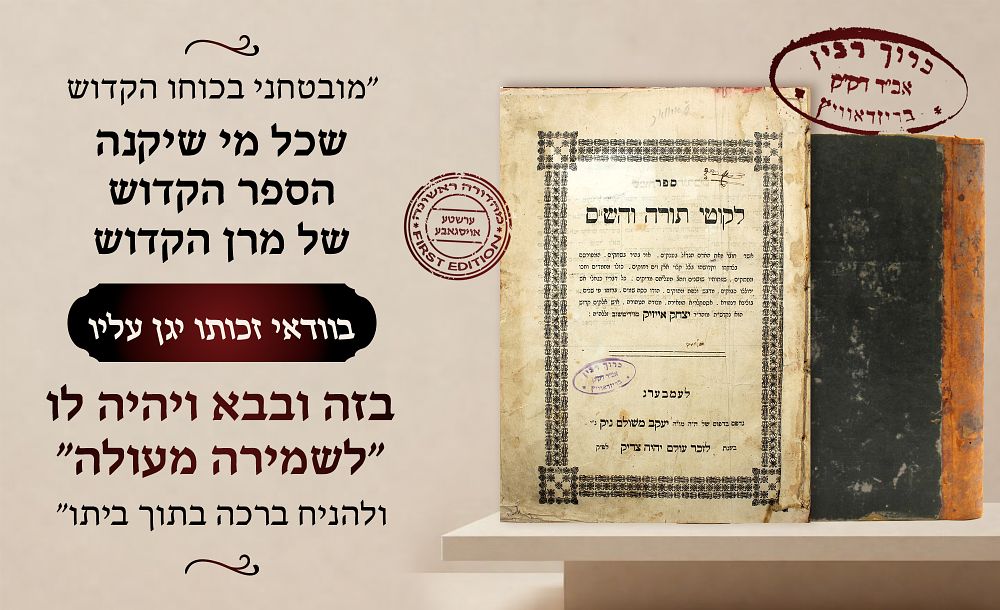
Copy of the Admor Rabbi Baruch'l Kolomyer - the In-Law of Rabbi Yeshayaleh of Krestir: First Edition of the Chassidic-Kabbalistic Segulah Book Likutei Torah Vehashas by Rabbi Issac'l of Ziditchov on Sefer Bereshit - Lemberg, 1877 - ”...מובטחני בכוחו הקדוש שכל מי שיקנה הספר הקדוש של מרן הקדוש בוודאי זכותו יגן עליו בזה ובבא ויהיה לו ”לשמירה מעולה” ולהניח ברכה בתוך ביתו...”. (Approbation of the Imrei Yosef of Spinka) First edition of the Chassidic-Kabbalistic Segulah Book Likutei Torah Vehashas by Rabbi Yitzchak Issac of Ziditchov. Section I on Sefer Bereshit - Lemberg, 1877. Stefansky Chassidut 298. With the additional title page on whose verso, the names of pre-subscribers were printed. This title page does not appear in all copies and is bibliographically not recorded . [4], 209 leaves 25 cm. Small tears and minor taping to several leaves. creases. Stains and marks of usage. Other minor blemishes. Original half-leather and fabric binding, slightly loose. Good overall condition. This is the personal copy of the Admor Rabbi Baruch Rubin of Radovich who was known as Der Kolomyer Rebbe, author of the She'erit Baruch, a descendant and in-law of several leading Admorim and the father of several Chassidic dynasties. Was known as an Ish Kadosh whom many came to for a blessing. Rarely, throughout the entire book there are repeated handwritten signatures of the Kolomyer Rebbe: at the top of the first and second title pages and at the end of the last leaf. Inexplicably, on every single page from which the Rebbe's first name or surname can be assembled, he also signed his name there [about 10 times!]. For example, on leaf [ר”ב” [202, the Rebbe handwrote alongside the pagination of the leaf the letters ”ין” , forming his surname ”רבין”; likewise, on leaf ר' [200], he added the letters ב', ו', ך', forming his first name ”ברוך”. Possibly, the Rebbe feared someone might covet the Segulah book which apparently, was especially rare already in the 18th century due to the promise of the Imrei Yosef of Spinka that the book would be a Segulah for protection. It is also possibly that the Rebbe wanted his sacred name to be written as a blessing inside the Segulah book. The Rebbe's personal stamps (two types) also appear four times the leaves of the book as well as a pen notation on the last leaf, partly erased. This is the complete copy of the book, with the additional title page, in good condition and with its original binding. The leaves, however, also indicate that the book was repeatedly studied by the Rebbe. Segulah book This sacred book was known as a book of Segulah and safekeeping, as written by the author's leading disciple, the Admor Rabbi Yosef Meir of Spinka, in the foreword to Sefer Vayikra, which he had published: ”...מובטחני בכוחו הקדוש שכל מי שיקנה הספר הקדוש של מרן הקדוש בוודאי זכותו יגן עליו בזה ובבא ויהיה לו ”לשמירה מעולה” [ההדגשה במקור!] ולהניח ברכה בתוך ביתו...” [I am assured by his sacred power that whoever purchases the book of Maran will surely be protected by his merit in this world and in the Next, and it will serve as an exceptional safegkeeping [original emphasisl!] and bring blessing into his home...]. *** Rabbi Baruch Rubin Av Beit Din of Kolomyia, known as Der Kolomyer Rebbe (1864-1936) a foremost Tzaddik who was a model of Chassidut, humility and sanctity. In 1895, he was appointed Rav and Av Beit Din of Brizdovich, near Ziditchov, where he led his community for dozens of years. In WWI, he was forced to leave the city and moved to Deyzh. In 1917, he settled in Samosh-Oivar in Transylvania and there became known as the Admor of Kolomyia. From all over Hungary, Galicia and Transylvania, people came to him for a blessing and to hear the DEvar Hashem. The author Rabbi Yitzchak Isaac Eichenstein of Ziditchov (1805-1873) one of the leading Admorim and Mekubalim of his generation. The second Admor of Ziditchov. Due to the fact that many Admorim, including the Yitav Lev of Sighet, the Divrei Yechezkel of Shinova, the Heichal Heberachah of Komarno, the Imrei Yosef of Spinka and many more, were his disciples, Ziditchov customs were adopted by additional Chassidic Chatzeirot. In addiiton, Nigunim whose source is the Ziditchov Chassidut survived in the Chassidut of Belz and Munkatch.