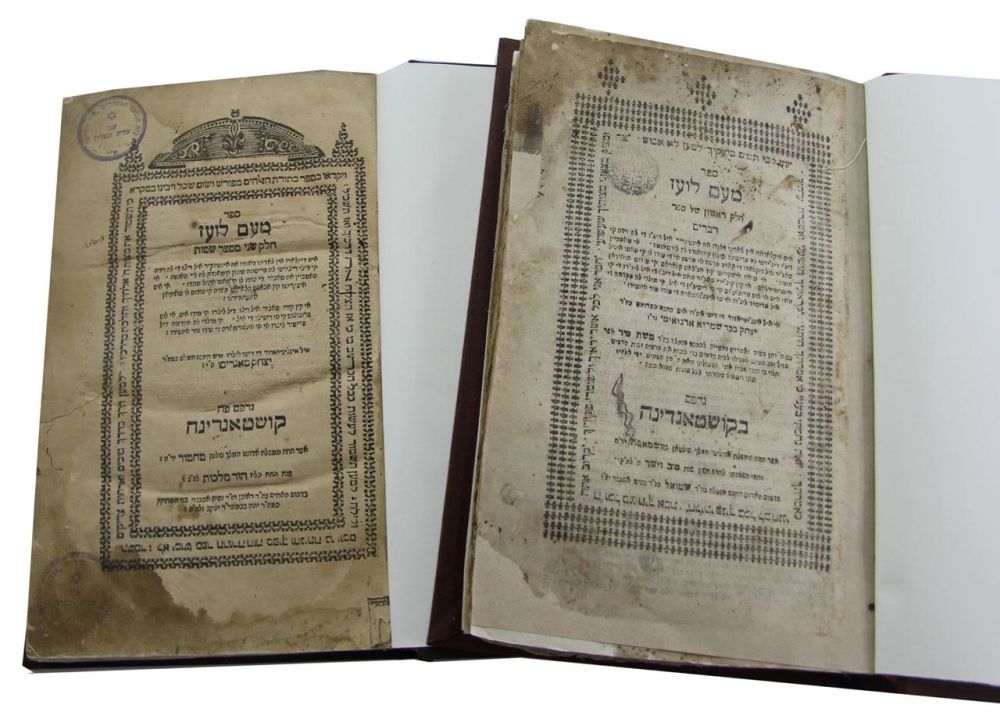
Bidspirit auction | 2 volumes of the Yalkut
2 volumes of the Yalkut Me’am Loez in Ladino, first edition—Constantinople 1746/73 - Volume with second section from the Book of Exodus, first edition—Constantinople 1746. Stamp of the “Beit Knesset HaSefardim ‘Or HaHayyim’.” Sefardi stamp on the cover, other notes in Sefardi handwriting in the beginning and end of the book. One note in the body of the work. [2], 6 120 pages, [4]. Volume with first section of the Book of Deuteronomy, first edition—1773. 8 227 pages, partially missing (supposed to be 231 pages). New bindings, many stains, moth holes, cover and page in the first volume are professionally repaired, otherwise generally good condition. Volume with second section from the Book of Exodus, first edition—Constantinople 1746. Stamp of the “Beit Knesset HaSefardim ‘Or HaHayyim’.” Sefardi stamp on the cover, other notes in Sefardi handwriting in the beginning and end of the book. One note in the body of the work. [2], 6 120 pages, [4]. Volume with first section of the Book of Deuteronomy, first edition—1773. 8 227 pages, partially missing (supposed to be 231 pages). New bindings, many stains, moth holes, cover and page in the first volume are professionally repaired, otherwise generally good condition. Initiated by Rabbi Yaakov Culi in 1730, the work is a widely studied commentary on the Tanakh written in Ladino. It is perhaps the best-known publication in that language. While Rabbi Culi died only two years later after completing the Book of Genesis and 2/3 of Exodus (up to Terumah), due to its mass popularity—and the extensive notes already written by Rabbi Culi—a decision was taken to complete the commentaries. Rabbi Yitzhak Magriso completed Exodus, and wrote the commentary on the books of Leviticus and Numbers. Deuteronomy was done by Rabbi Yitzhak Bechor Agruiti. The commentary on Joshua was written by Rabbi Rachamim Menachem Mitrani. The Book of Esther was done by Rabbi Raphael Chiyya Pontremoli. Rabbi Shmeul Yerushalmi translated the works into Hebrew, although greatly deviated from the originals on their Nach commentaries and the book of Avoth. He also continued the Meam Loez work in Hebrew on many of the books of Nach that the sages before him did not write. The book was hugely popular among Sefardi Jewish communities, who would read it as a family unit around the shabbat table, and as a book for reading to children before bed. Rabbi Yaakov Culi initially dedicated his book to women and children who were not proficient in the holy language, but speak in other (loazi) languages. The title derives from a Psalm that begins with the words: ”Israel came out of Egypt from Beit Ya'akov from the people of Loaz.” It ends with the words “Before God, the sands [holei] aretz, before ... Jacob.” Chazal comment that ”Beit Yaakov” implies women, the words ”Ma'am Loaz” implies the group in the people who understand and speak in foreign language, while the appearance of the name ”Jacob” twice and the word “holei” implies the author’s name.