Bidspirit auction | [Illustration.] Richard Knötel (1857–1914). The
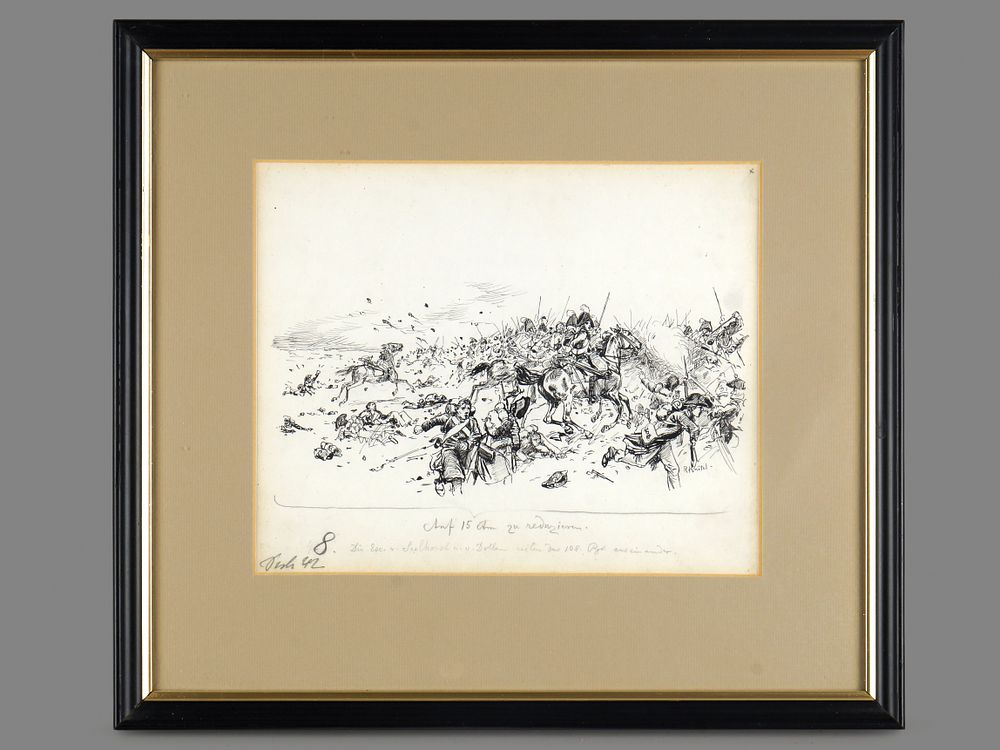
[Illustration.] Richard Knötel (1857–1914). The Columns of von Schlotheim and von Dollen Diverge by 168 Paces. Germany. Turn of the 20th Century. Medium: Bristol board, graphite pencil, black Indian ink. Dimensions: 30.8 x 34.3 cm (frame); 17.8 x 22 cm (sight). Condition: Very good; minor toning of the substrate; professionally framed with a passe-partout. Signature: Signed by the artist in the lower right: ”R. Knötel”. Inscriptions: Below the image, there are autograph inscriptions in graphite pencil (German) with printing instructions, reading: ”8. Auf 15 cm zu reduzieren / Die Zuge v. Schlotheim u.v. Dollen reichen / bis 168 Pce auseinander” (translated as: ”Reduce to 15 cm / The columns of von Schlotheim and von Dollen diverge by 168 paces”). Provenance & Context: The subject matter, layout, and stylistic execution suggest the work was produced for one of the historical publications illustrated by the artist. Original graphic works by Richard Knötel are exceedingly rare. In Russian museum collections, the artist’s oeuvre is represented primarily by lithographs. His original drawings appear infrequently at international auctions. Works by the artist are held in the following collections: — Berlin State Museums (Gemäldegalerie); — Berlin Academy of Arts; — Kupferstichkabinett (Museum of Prints and Drawings) and the Art Library, Berlin; — Dresden State Art Collections (Gemäldegalerie). Biographical Note: Richard Knötel (1857–1914) was a prominent German battle painter, illustrator, professor of painting, and a pioneer of uniformology. Educated at the Berlin Academy of Arts, he dedicated his career to military art, gaining renown as a vivid and gifted illustrator of military history. His paintings Garcia Hernandez and Frederick the Great at the Battle of Reichenbach were acquired by the German Emperor. During his lifetime, Knötel was regarded as Europe’s leading authority on military costume across all eras and nations. Based on extensive archival research, he produced a monumental body of work documenting European uniforms from the 17th to the early 20th century. His seminal work, Handbuch der Uniformkunde (Handbook of Uniformology), remains a foundational source in the field. From 1900, he published the monthly journal Uniformkunde. In collaboration with battle painter Carl Röchling, he also authored and illustrated several children's books on German military history. Beyond his graphic work, the artist created numerous large-scale battle canvases. Expertise: The work has been examined by D.V. Sergeeva, expert at the Grabar Research and Restoration Center, Expert on Cultural Property for the Ministry of Culture of the Russian Federation, and Category III Graphic Arts Conservator.