Bidspirit auction | [Illustration.] Richard Knötel (1857–1914). Night
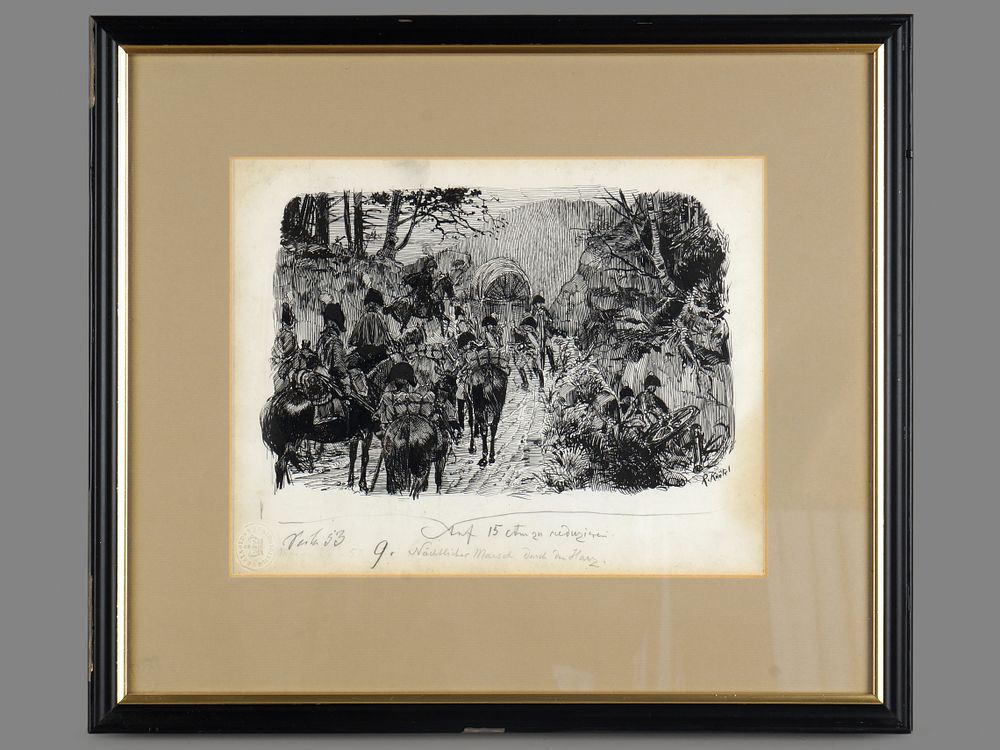
[Illustration.] Richard Knötel (1857–1914). Night March through the Harz. Germany. Late 19th – early 20th century. Medium: Graphite pencil, black ink, and pen on Bristol board. Dimensions: 35.5 x 30.9 cm (frame), 18 x 23 cm (sight). Condition: Very good; a yellowish stain is visible along the right edge. Professionally framed with a mount (passe-partout). Inscriptions and Marks: An oval embossed stamp in the lower-left corner of the support reads ”Reynolds's Bristolboard, ” identifying the manufacturer of the board. The artist's signature, ”R. Knötel, ” is located in the lower-right corner of the image. Below the image, there are handwritten inscriptions by the artist in graphite pencil (German) with printer’s marks, reading: ”9. Nachtlicher Marsch Durch den Harz” (translated as ”9. Night March through the Harz”). Art Historical Note: The subject matter, composition on the sheet, and stylistic features suggest that this work was created for one of the historical publications illustrated by the artist. Original graphic works by Richard Knötel are extremely rare. In Russian museum collections, his work is primarily represented by lithographs. Original drawings by Knötel seldom appear at international auctions. Works by the artist are held in the following collections: — Berlin State Museums (Gemäldegalerie); — Berlin Academy of Arts; — Berlin Kupferstichkabinett (Museum of Prints and Drawings) and the Art Library (Kunstbibliothek); — Dresden Paintings Gallery (Gemäldegalerie). Richard Knötel (1857–1914) was a renowned German military painter, illustrator, and professor of painting. He is celebrated as one of the founders of uniformology. Educated at the Berlin Academy of Arts, Knötel dedicated his career to battle painting and soon became a leading illustrator of books on military affairs and history. His paintings, such as Garcia Hernandez and Frederick the Great at the Battle of Reichenbach, were acquired by the German Emperor. During his lifetime, he was considered Europe’s foremost expert on military dress across all nations and eras. Following his studies, he amassed an extensive library of military history. Based on these sources, he produced a vast body of illustrations documenting European military uniforms from the 17th to the early 20th century. His magnum opus, Handbuch der Uniformkunde (Handbook of Uniformology), contains dozens of masterful plates detailing the uniforms of the German states. In 1900, he began publishing the monthly journal Uniformkunde. The colossal collection of prints presented therein is rightfully regarded as a foundational source for the history of European military costume. In collaboration with his friend, the battle painter Carl Röchling, he also wrote and illustrated several children's books on German military history. In addition to his graphic work, the artist produced a significant number of monumental battle canvases. Expertise: Consultation provided by D.V. Sergeeva, expert at the Grabar Art Conservation Center, Expert on Cultural Property for the Ministry of Culture of the Russian Federation, and Category III Graphic Arts Restorer. Нужно ли адаптировать это описание под формат аукционного каталога или музейного этикетажа? Задайте вопрос