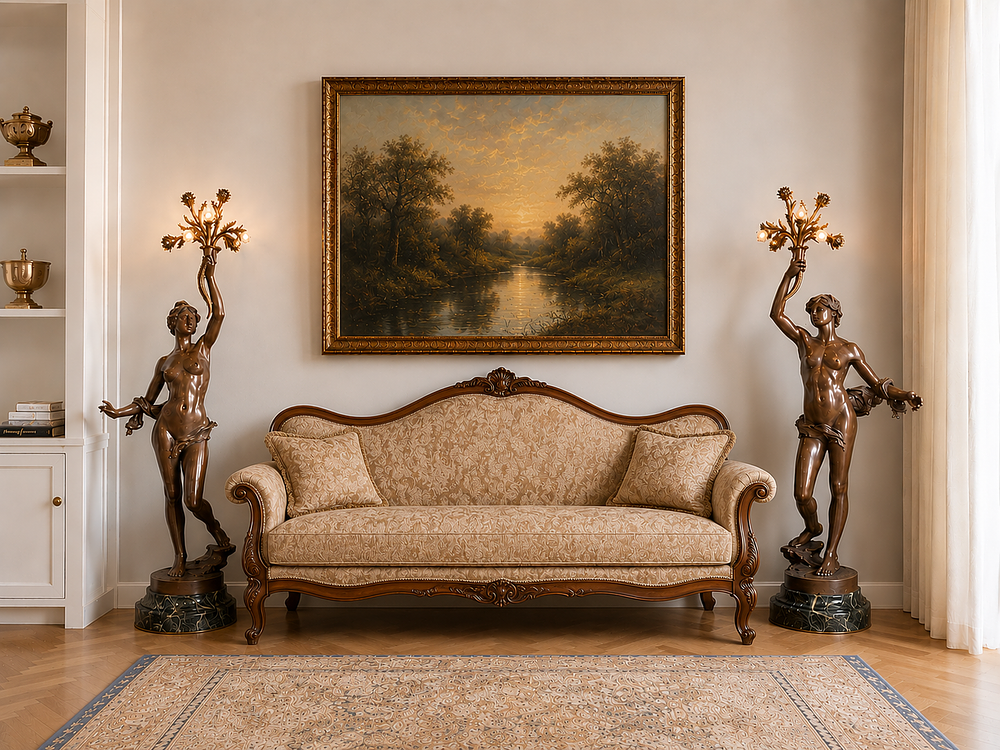
Bidspirit auction | Georges Bareau. Ferdinand Barbedienne. Pair
Georges Bareau. Ferdinand Barbedienne. Pair of life-size sculptural floor lamps “Fin de Siècle”, Neo‑Baroque with elements of Art Nouveau. Paris, France, circa 1890. Bronze, casting, chasing, patination; brass, stamping; marble, turning, polishing; mounting. Art-historical expert opinion by Dr Elena Yu. El’kova, Senior Research Fellow of the State Historical Museum in Moscow and certified expert on works of art for the Ministry of Culture of the Russian Federation. Marks: to the upper parts of the bases, cast facsimile signature of the sculptor “GEORGES – BAREAU”; to the sides of the bases, engraved foundry mark “F. BARBEDIENNE. FONDEUR.”. Dimensions : 149 × 69 × 31 cm and 147 × 67.5 × 34 cm. Condition: excellent. The ensemble is an extremely rare embodiment of the spirit of the “fin de siècle”, the “end of the century”. This term describes the transitional period from about 1880 to 1914, when art bid farewell to strict Classicism and opened itself to sensuality and freedom. The sculptor abandons conventional antique narratives in favour of natural male and female nudity: these figures are true “icons” of the Decadent era, in which the human body becomes the primary vehicle for expressing passion and emotion. The S‑shaped twist of the bodies and the affected, rapt and passionate expressions of the protagonists are characteristic signatures of the Art Nouveau period. A world-class exclusive: no comparable pair could be traced in the published archives of the major international auction houses. Works of a level appropriate for Sotheby’s and Christie’s. The large vertical format (height approx. 1.5 metres) makes these floor lamps an ideal focal point for any interior. Georges Bareau (Georges Marie Valentin Bareau, 1866–1931) was a recognised master of allegory (Maître de l’allégorie), renowned for complex compositions such as “L’Histoire” and “La Renommée”; his works are considered benchmarks of high-quality cabinet bronzes. Most of his models were cast by the finest French foundry of the period, F. Barbedienne (F. Barbedienne, Fondeur). A triumphant exhibitor at the 1900 Exposition Universelle in Paris, he was awarded the Grand Prix, which confirmed his status as a leading figure of the French school of sculpture. Bareau’s oeuvre combines academic precision with the elegance of Art Nouveau; his bronzes are distinguished by impeccable anatomy and a refined patina. Among his popular bronze subjects are “L’Histoire”, “Diane sur l’aigle” (“Diana on an Eagle”) and “Le Jeune Forgeron / Le Réveil du travail” (“The Young Blacksmith / The Awakening of Labour”). Ferdinand Barbedienne (1810–1892) was the greatest French art‑bronze founder of the nineteenth century, synonymous with technical perfection and luxury, often described as the “Gutenberg of sculpture”. Founder of one of the largest bronze manufactories in Paris, his stamp “F. Barbedienne. Fondeur” guarantees the highest level of detail and superbly finished chasing. In partnership with Achille Collas he was the first to apply mathematically precise mechanical reduction to sculpture, making museum masterpieces available for private interiors. Barbedienne was the exclusive founder for many leading sculptors (including Antoine‑Louis Barye and Clésinger), whose original models were cast only in his workshops. A regular prize-winner at the great international exhibitions, he received two Council Medals in London in 1851, the Grand Medal of Honour in Paris in 1855, and was later promoted to Officer and then Commander of the Légion d’Honneur after the 1867 and 1878 Expositions Universelles. His contemporaries hailed him as the “prince of industry” and the “king of bronze casting