Bidspirit auction | [Legend of World Cinema. Highest
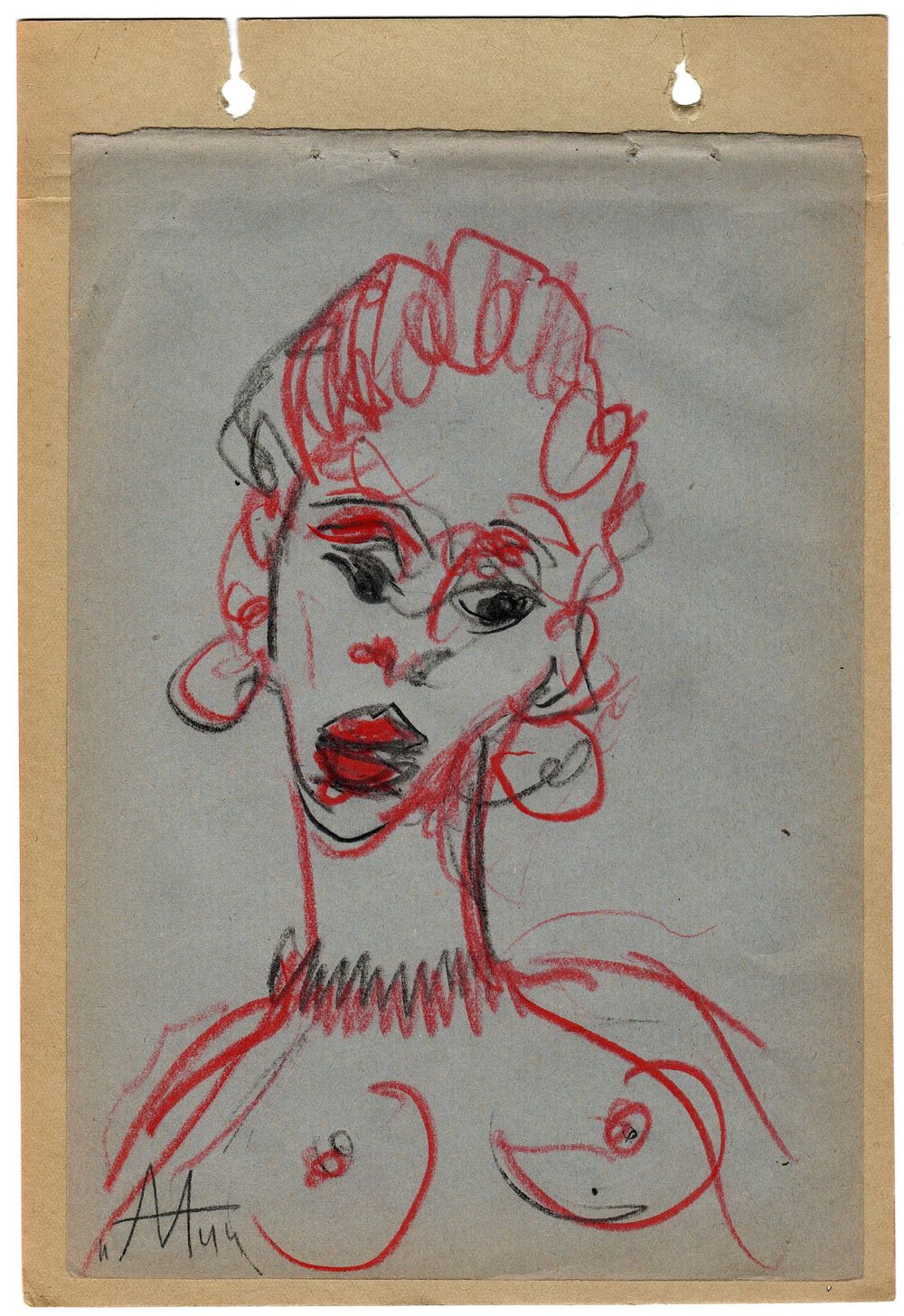
[Legend of World Cinema. Highest Level.] S. M. Eisenstein, “Nude.” USSR, 1944. Tinted blue paper, coloured pencils, black pastel pencil. The artist’s monogram and the date (1944) are in the lower left corner. The work has exceptional museum significance and may represent the artist’s oeuvre in a museum collection. This 1944 drawing belongs to the master’s mature period. For Eisenstein, graphic art was not merely a hobby, but a natural way of thinking. His manner is “visual montage”: rapid lines, expressiveness and deliberate grotesque. Size: 20 × 14.5 cm. Condition: collectible, very good; the drawing is mounted on an album sheet, with traces of use. The work fully represents the graphic legacy of Sergei Mikhailovich Eisenstein (1898–1948), the great film director, film theorist and artist whose groundbreaking works (“Battleship Potemkin, ” “Alexander Nevsky, ” “Ivan the Terrible”) permanently changed world cinema. Eisenstein’s drawings are an independent part of his oeuvre, in which the director’s temperament and his inclination toward visual experiment are clearly visible. They are executed in a free, improvisational manner: the lines are rapid, the images exaggerated, and the emotions intentionally pushed to the point of grotesque. Eisenstein drew constantly — literally every day. A huge number of his graphic works survived on the reverse sides of drafts, scripts and working notes. For him, drawing was not just entertainment, but a natural way of thinking that accompanied the creative process and helped generate images. During the artist’s lifetime, his talent as a draughtsman was appreciated only by a small circle of connoisseurs, including an enthusiastic review in The New York Times of an exhibition in the United States, but full recognition came after 1957. Nine years after Eisenstein’s death, a major solo exhibition of his graphic works was held at the Central House of Arts Workers in Moscow. In 1961, the first book of Eisenstein’s drawings was published by the Iskusstvo publishing house, which made him widely known as an artist as well. Sergei Mikhailovich Eisenstein (1898–1948) was a Soviet film director, film theorist and artist, one of the founders of montage cinema. He trained as an engineer, but early on became fascinated by theatre and artistic experiment. In the 1920s he created his landmark films — “Battleship Potemkin, ” “Strike, ” and “October” — which established him as an innovator of world cinema. In the late 1930s he directed the historical epic “Alexander Nevsky, ” and then began work on the trilogy “Ivan the Terrible.” In addition to directing, Eisenstein wrote extensively on montage theory and taught at VGIK, becoming a key figure in the development of cinema as an art form.