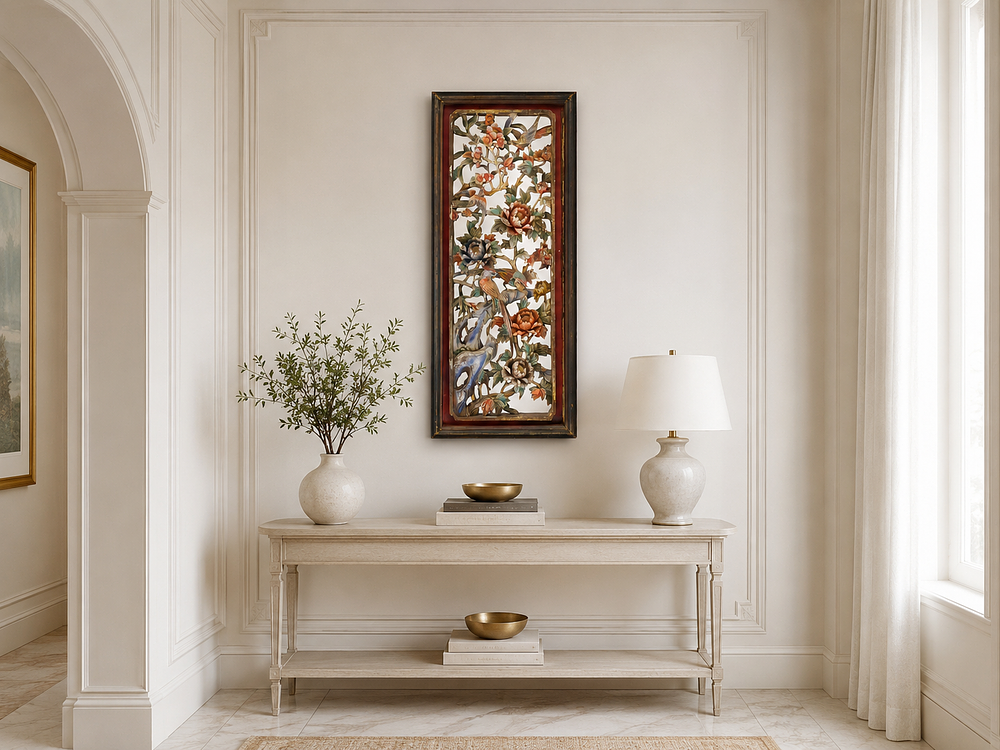
Bidspirit auction | Carved Polychrome Panel ”Spring Prosperity:
Carved Polychrome Panel ”Spring Prosperity: Peonies and Paradise Flycatchers” from the Quadriptych ”The Four Seasons”. Southern China, Guangdong Province; Chaozhou school of carving. Late Qing Dynasty, 1890–1910. Solid sandalwood, gesso, mineral pigments, gold leaf. Dimensions: 96.5 × 40.5 × 5.5 cm. Condition: very good. The original paint layer and gilding on the details underscore the status of the object; the natural patina on the frame harmonises with the overall antique appearance. The wall panel is a multi-figure carved composition conveying the atmosphere of spring — a season of renewal, blossoming and promised well-being. The central composition is devoted to the peony — the ”king of flowers”, which in Chinese tradition embodies spring, wealth and aristocratic refinement — and a pair of long-tailed paradise flycatchers. The pair of paradise flycatchers (”the bird with the ribbon of longevity”) is depicted in dynamic movement: their exceptionally long, ribbon-like tails, two to three times the length of the body, intertwine at the centre of the composition, forming a visual symbol of an inseparable bond and a wish for ”life together into deep old age”. The choice of this particular bird in the canon of Chinese decorative art is dictated not by biological resemblance but by a phonetic code: its consonance with the word ”longevity” (Shòu) transforms the depiction of the pair into a powerful auspicious formula. The peonies, the principal flower of spring and an emblem of wealth and nobility (Fùguì), are rendered with particular plasticity: the lush buds are painted in a gradient from deep cinnabar to delicate pink tones, while the green of the leaves is executed in matte mineral pigments. Together with the paradise flycatchers, the panel invokes the established iconographic formula ”wealth, nobility and longevity into old age” (Fùguì shàngshòu). The panel's thickness of 5.5 cm allowed the carver to employ deep openwork carving in sandalwood: the birds and peony buds are almost entirely detached from the background and held by the thinnest wooden ”bridges”, producing a pronounced spatial effect. A dense layer of antique chalk ground lends the carved details a resemblance to carved lacquer or ivory. The characteristic network craquelure on the lighter areas — petals and bodies of the birds — serves as a flawless marker of the object's authenticity at the turn of the 19th–20th centuries. In terms of the quality of the timber, the complexity of the multi-tiered carving and the preservation of the original surface, the panel ranks among high-status commissions of the Chaozhou school and, as part of the quadriptych ”The Four Seasons”, constitutes the spring ”leaf” of a unified artistic cycle.