Bidspirit auction | Carved Polychrome Panel ”Summer Idyll:
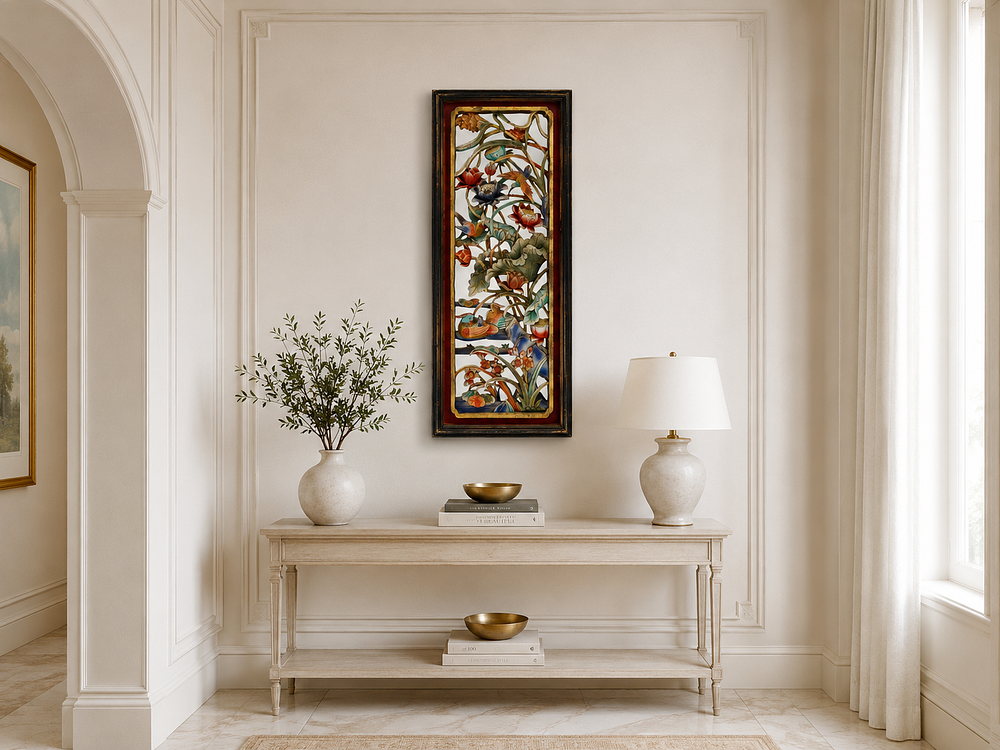
Carved Polychrome Panel ”Summer Idyll: Lotuses, Mandarin Ducks and Kingfishers” from the Quadriptych ”The Four Seasons”. Southern China, Guangdong Province; Chaozhou school of carving. Late Qing Dynasty, 1890–1910. Solid sandalwood, gesso, mineral pigments, gold leaf. Dimensions: 96.5 × 40.5 × 5.5 cm. Condition: very good, approaching excellent; original paint layer and gilding with minimal wear; the reverse retains the original texture of the sandalwood block with traces of hand-tooling typical of the late 19th century; no signs of restoration or joins — the panel is carved from a single solid block. The wall panel is a multi-figure carved composition devoted to summer — a season of fullness, mature beauty and family harmony. At the centre of the scene is a lotus pond, embodying the highest degree of spiritual purity and concord, around which an elaborate system of floral and zoomorphic motifs unfolds. The mandarin ducks (Yuānyāng), a timeless symbol of conjugal fidelity and inseparable love, are shown as a pair: in Chinese art it is held that mandarin ducks form a union once and for life, and their presence transforms the panel into a powerful family talisman. The formula ”lotus + mandarin ducks” is traditionally read as a wish for harmony in the family and the birth of noble children. The lotus (Liánhuā), rising from the mud yet remaining immaculately pure, symbolises nobility of spirit and a ”virtuous life”; it is also the principal flower of summer. Buds and open blossoms at different stages of development embody the continuity of the lineage and the prosperity of descendants: a tight bud on the verge of opening stands beside a full bloom whose petals curve gracefully, demonstrating the virtuosity of the carver's chisel. Thanks to the gesso, the petals appear translucent and fragile, while the gradient from deep cinnabar to delicate pink lends them an almost living warmth. In the upper part of the composition a kingfisher (Cuìniǎo) is shown in swift flight above the flowers; in Chinese tradition this bird is associated with good fortune, tranquillity, beauty and nobility. The plumage of the wings and the characteristic sharp beak are rendered with great skill; the lightness of the silhouette creates the impression of a frozen instant above the surface of the water. The intertwining lotus stems form the graphic framework of the panel. Deep openwork carving (up to 5.5 cm) allows light to penetrate through the depth of the wood, imitating reflections on water and the gentle movement of stems in the breeze: the stems and birds are almost entirely detached from the background and held by the thinnest wooden bridges, producing the effect of ”living water”. The slender, curving elements are executed with such precision that they seem capable of swaying. The surface is prepared with a thick layer of chalk gesso, lending the carved details a resemblance to carved ivory or porcelain. The painting is executed in mineral azurite (cool blue tones of water) and cinnabar (warm shades of the buds), underscoring the summer freshness of the subject. In terms of the quality of the timber, the complexity of the multi-tiered carving and the preservation of the original surface, the panel ranks among high-status commissions of the Chaozhou school and, as part of the quadriptych ”The Four Seasons”, constitutes the summer ”leaf” of a unified artistic cycle.