Bidspirit auction | Supplier to the court of
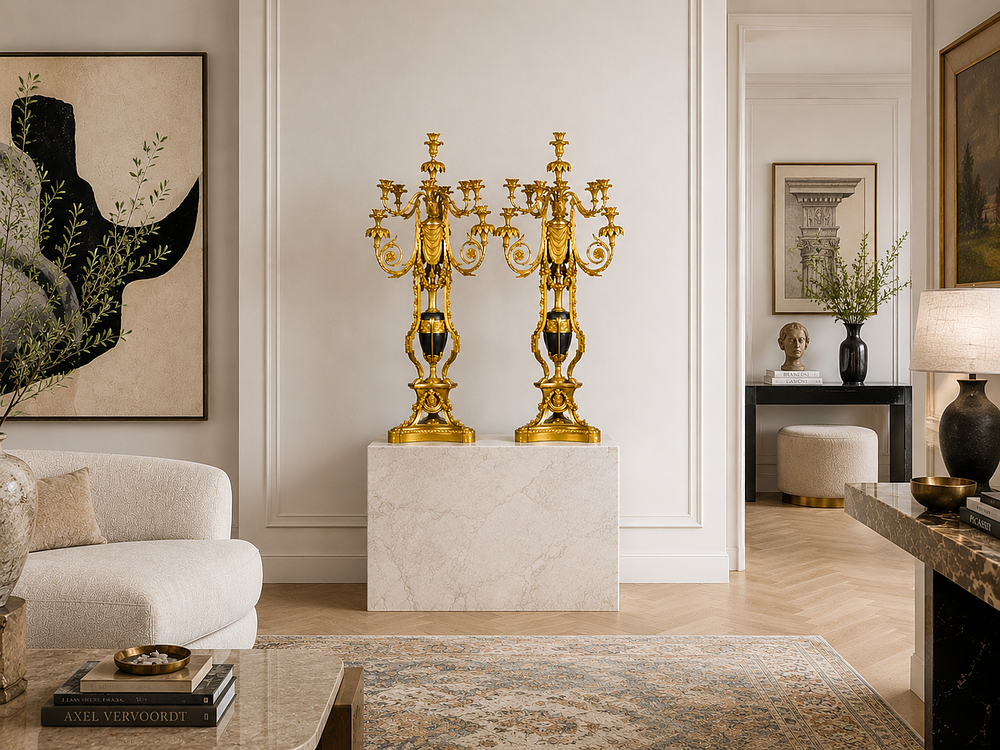
Supplier to the court of Napoleon III. Palace candelabra. Important pair of ten‑light candelabra after the model by Pierre Gouthière, cast by the firm of Alfred‑Emmanuel Beurdeley. France, Paris, circa 1880. Gilt and patinated bronze; casting, chasing, mercury gilding, patination. A detailed historical and cultural attribution report has been prepared by Dr Elena Y. El’kova, Senior Research Fellow of the State Historical Museum in Moscow, expert on works of art for the Ministry of Culture of the Russian Federation. In her conclusion the expert notes that the candelabra possess great artistic, antique and collectors’ value. Dimensions: height 97.3 cm (38 1/4 in); width 39 cm (15 3/8 in); depth 37 cm (14 1/2 in). Condition: very good, close to excellent; minor scratches to flat surfaces, scattered small losses to the gilding and occasional dark patina spots; one or two branches in the middle tier slightly loose. Structurally sound, the candelabra retain a high proportion of their original mercury gilding and remain fully functional as candle‑lit fixtures. This monumental pair of ten‑light candelabra in gilt and patinated bronze follows the celebrated model by the Parisian bronzier Pierre Gouthière of the Louis XVI period; a comparable pair is preserved in the Petit Trianon at Versailles and was originally supplied for the Château de Bellevue, the country residence of the daughters of Louis XV. The present candelabra belong to the prestigious type of large ceremonial lighting devices of the late eighteenth century, re‑interpreted in the second half of the nineteenth century in the spirit of historicism and refined late Neoclassicism. Each candelabrum is arranged in three tiers of branches carrying ten lights: powerful S‑shaped arms in the lower tier, six more slender scrolling branches in the middle tier and a central upper nozzle together form a lively silhouette of acanthus leaves, grape clusters and floral rosettes. The stem is conceived as a tall patinated vase of fuseau form encircled by a gilt frieze of playing and music‑making putti and amorini, framed by three upright consoles hung with rich garlands of flowers and fruit and lambrequin draperies with tassels. The composition is completed by a tripod with hoof feet set on a two‑stage shaped triangular base adorned with garlands, a recessed central rosette and a running “plait” border. The superb quality of the casting and hand chasing, the subtle modulation of matte and burnished mercury gilding and the noble dark patina allow the ensemble to be confidently attributed to the Maison Beurdeley, one of the leading Parisian workshops of the second half of the nineteenth century, supplying European royal households and the greatest collectors in Europe and America. Contemporary critics noted that Beurdeley’s production often rivalled, and at times was almost indistinguishable from, late eighteenth‑century originals. In the second half of the nineteenth century the Beurdeley firm was among the principal suppliers to the Imperial Garde‑Meuble under Napoleon III, executing important official commissions for the Emperor and Empress Eugénie, including furniture for the Tuileries and Saint‑Cloud. Through these court commissions and its participation in the great international exhibitions, the firm gained wide renown among European royal and imperial courts and, later, among the wealthiest American families, including the Rothschild and Vanderbilt dynasties