Bidspirit auction | [Russian Revival. Hot Enamel on
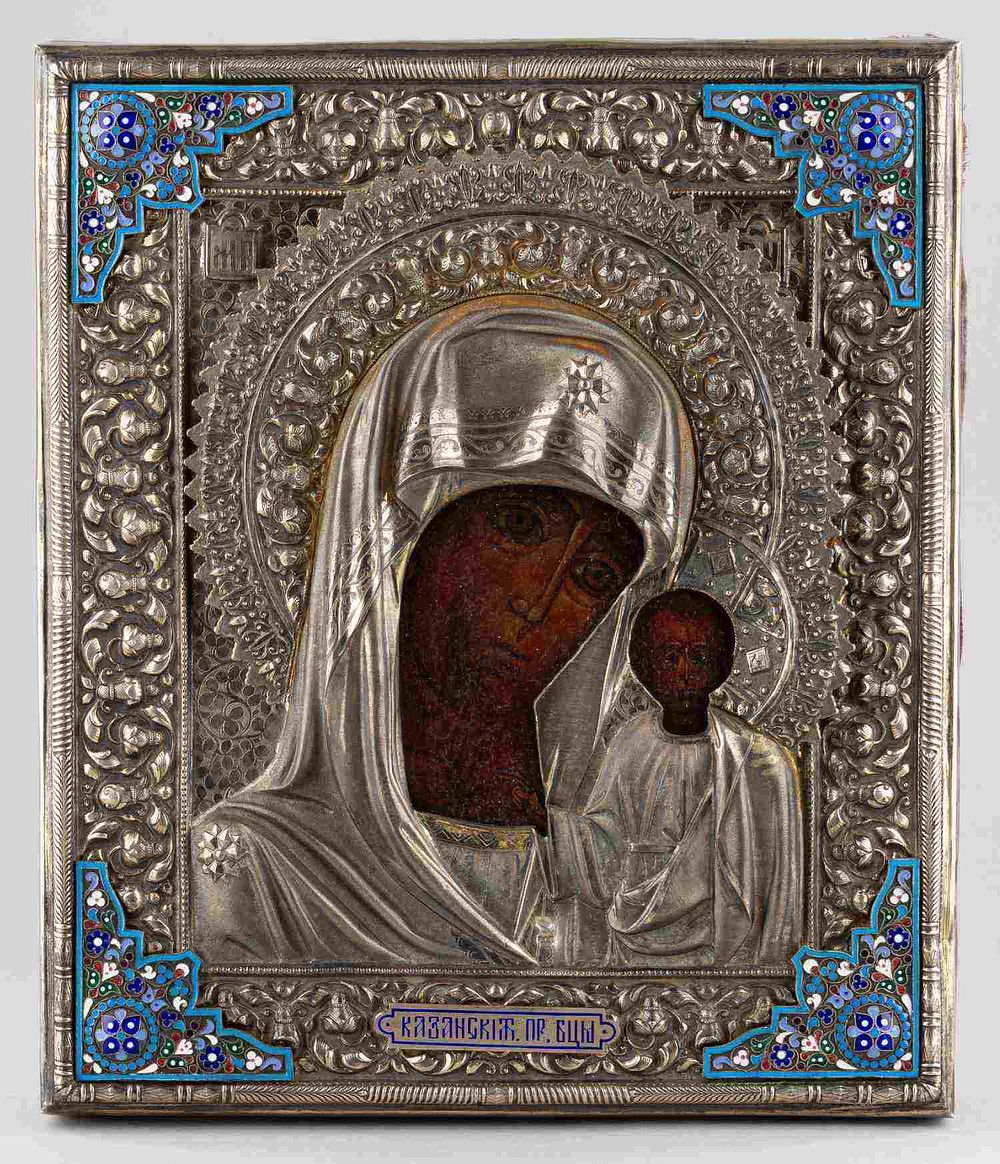
[Russian Revival. Hot Enamel on Silver] Icon of the Kazanskaya Mother of God in a silver oklad of 84 standard with enamel corner plaques. Russian Empire, Moscow, 1899–1908. Wood panel, gesso (levkas), tempera; silver 84 standard, chasing, engraving, embossing, hot enamel (seven colours), parcel‑gilt relief. Marks: silver oklad of 84 standard, Moscow assay office, assayer Ivan Sergeevich Lebedkin; master’s mark “K.I.G.” – an unidentified Moscow workshop, in expert practice often associated with the workshop of I. G. Kirillov. Dimensions: in oklad – 31.6 × 26.7 cm; without oklad – 31.5 × 26.5 cm. Weight of the silver oklad: 492 g. Condition: icon and oklad in very good, close to excellent condition; darkened varnish and minor wear to the paint layer in the area of the faces and garments, light surface soiling; silver oklad with natural patina, small dents and scratches to the borders; enamel corner plaques with minimal rubbing. The panel is flat, without deformations, structurally stable, with no later interventions, repainting or restoration. The image of the Kazanskaya Mother of God follows the traditional iconographic type: the Mother of God shown half‑length, her head slightly inclined towards the viewer, indicating Christ with her right hand; the Christ Child frontally, blessing with his right hand. The faces are painted in a warm brown‑ochre palette with soft modelling, the garments enriched with floral ornament. The silver oklad is executed in the Neo‑Russian (Russian Revival) style: the wide borders bear a dense repoussé foliate ornament with alternating flowers and fruits, while the halo is encircled by a decorative band with stippled ground and stylised rosettes. At the four corners are shaped silver corner plaques, decorated with seven‑colour enamel in geometric and floral motifs. At the bottom border is a rectangular cartouche inscribed “KAZANSKAYA PR. B.TSY” (“Kazan Mother of God”). The relief of the Virgin’s maphorion and the Child’s chiton is treated in large, flowing folds that emphasise the plastic richness of the oklad. The combination of Moscow assay marks of 1899–1908, the master’s mark “K.I.G.”, the rich foliate ornament in Russian style and the multi‑coloured enamel corner plaques defines the oklad as a high‑quality work of Moscow silver craftsmanship of the late Imperial period, created in the spirit of the fashionable Russian Revival style for the venerated icon of the Kazanskaya Mother of God.